p.33 抽出テキスト
5.5.3 Fluoropyrimidines

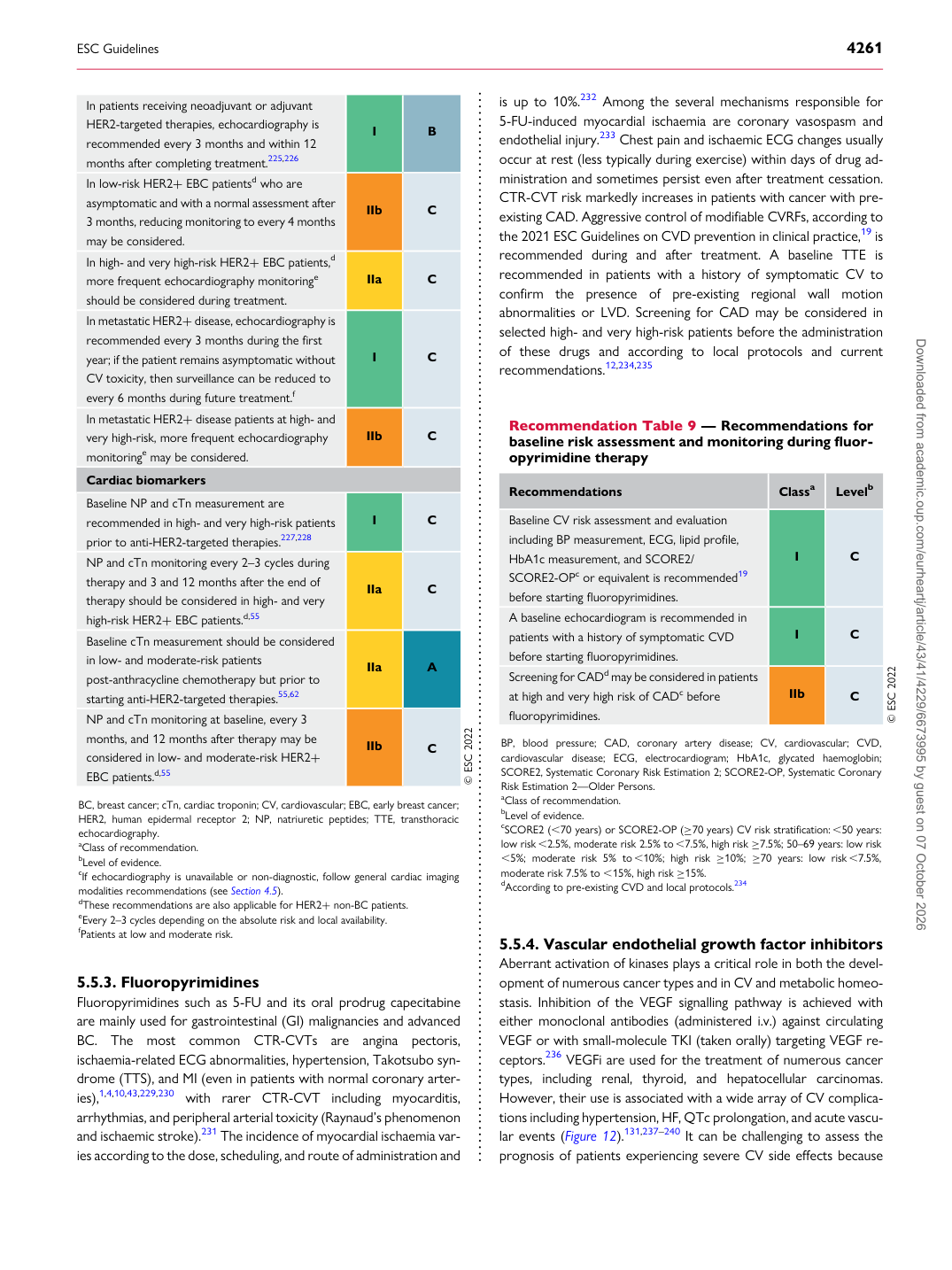
Fluoropyrimidines such as 5-FU and its oral prodrug capecitabine are mainly used for gastrointestinal (GI) malignancies and advanced BC. The most common CTR-CVTs are angina pectoris, ischaemia-related ECG abnormalities, hypertension, Takotsubo syndrome (TTS), and MI (even in patients with normal coronary arteries),1,4,10,43,229,230 with rarer CTR-CVT including myocarditis, arrhythmias, and peripheral arterial toxicity (Raynaud’s phenomenon and ischaemic stroke).231 The incidence of myocardial ischaemia varies according to the dose, scheduling, and route of administration and is up to 10%.232 Among the several mechanisms responsible for 5-FU-induced myocardial ischaemia are coronary vasospasm and endothelial injury.233 Chest pain and ischaemic ECG changes usually occur at rest (less typically during exercise) within days of drug administration and sometimes persist even after treatment cessation. CTR-CVT risk markedly increases in patients with cancer with preexisting CAD. Aggressive control of modifiable CVRFs, according to the 2021 ESC Guidelines on CVD prevention in clinical practice,19 is recommended during and after treatment. A baseline TTE is recommended in patients with a history of symptomatic CV to confirm the presence of pre-existing regional wall motion abnormalities or LVD. Screening for CAD may be considered in selected high- and very high-risk patients before the administration of these drugs and according to local protocols and current recommendations.12,234,235

5.5.4 Vascular endothelial growth factor inhibitors

Aberrant activation of kinases plays a critical role in both the development of numerous cancer types and in CV and metabolic homeostasis. Inhibition of the VEGF signalling pathway is achieved with either monoclonal antibodies (administered i.v.) against circulating VEGF or with small-molecule TKI (taken orally) targeting VEGF receptors.236 VEGFi are used for the treatment of numerous cancer types, including renal, thyroid, and hepatocellular carcinomas. However, their use is associated with a wide array of CV complications including hypertension, HF, QTc prolongation, and acute vascular events (Figure 12).131,237–240 It can be challenging to assess the prognosis of patients experiencing severe CV side effects because

In patients receiving neoadjuvant or adjuvant HER2-targeted therapies, echocardiography is recommended every 3 months and within 12 months after completing treatment.225,226 I B In low-risk HER2+ EBC patientsd who are asymptomatic and with a normal assessment after 3 months, reducing monitoring to every 4 months may be considered. IIb C In high- and very high-risk HER2+ EBC patients,d more frequent echocardiography monitoringe should be considered during treatment. IIa C In metastatic HER2+ disease, echocardiography is recommended every 3 months during the first year; if the patient remains asymptomatic without CV toxicity, then surveillance can be reduced to every 6 months during future treatment.f I C In metastatic HER2+ disease patients at high- and very high-risk, more frequent echocardiography monitoringe may be considered. IIb C Cardiac biomarkers Baseline NP and cTn measurement are recommended in high- and very high-risk patients prior to anti-HER2-targeted therapies.227,228 I C NP and cTn monitoring every 2–3 cycles during therapy and 3 and 12 months after the end of therapy should be considered in high- and very high-risk HER2+ EBC patients.d,55 IIa C Baseline cTn measurement should be considered in low- and moderate-risk patients post-anthracycline chemotherapy but prior to starting anti-HER2-targeted therapies.55,62 IIa A NP and cTn monitoring at baseline, every 3 months, and 12 months after therapy may be considered in low- and moderate-risk HER2+ EBC patients.d,55 IIb C © ESC 2022

BC, breast cancer; cTn, cardiac troponin; CV, cardiovascular; EBC, early breast cancer; HER2, human epidermal receptor 2; NP, natriuretic peptides; TTE, transthoracic echocardiography. aClass of recommendation. bLevel of evidence. cIf echocardiography is unavailable or non-diagnostic, follow general cardiac imaging modalities recommendations (see Section 4.5). dThese recommendations are also applicable for HER2+ non-BC patients. eEvery 2–3 cycles depending on the absolute risk and local availability. fPatients at low and moderate risk. Recommendation Table 9 — Recommendations for baseline risk assessment and monitoring during fluoropyrimidine therapy

Recommendations Classa Levelb

Baseline CV risk assessment and evaluation including BP measurement, ECG, lipid profile, HbA1c measurement, and SCORE2/ SCORE2-OPc or equivalent is recommended19 before starting fluoropyrimidines. I C A baseline echocardiogram is recommended in patients with a history of symptomatic CVD before starting fluoropyrimidines. I C Screening for CADd may be considered in patients at high and very high risk of CADc before fluoropyrimidines. IIb C © ESC 2022

BP, blood pressure; CAD, coronary artery disease; CV, cardiovascular; CVD, cardiovascular disease; ECG, electrocardiogram; HbA1c, glycated haemoglobin; SCORE2, Systematic Coronary Risk Estimation 2; SCORE2-OP, Systematic Coronary Risk Estimation 2—Older Persons. aClass of recommendation. bLevel of evidence. cSCORE2 (,70 years) or SCORE2-OP (≥70 years) CV risk stratification: ,50 years: low risk ,2.5%, moderate risk 2.5% to ,7.5%, high risk ≥7.5%; 50–69 years: low risk ,5%; moderate risk 5% to ,10%; high risk ≥10%; ≥70 years: low risk ,7.5%, moderate risk 7.5% to ,15%, high risk ≥15%. dAccording to pre-existing CVD and local protocols.234 Downloaded from academic.oup.com/eurheartj/article/43/41/4229/6673995 by guest on 07 October 2026