p.32 抽出テキスト
For patients requiring adjuvant chemotherapy and anti-HER2-targeted therapy, the use of non-anthracycline chemotherapy should be considered by the MDT according to risk of relapse, cardiac risks, and in discussion with the treating oncologist.217 When anthracycline chemotherapy in the (neo)-adjuvant setting is necessary, sequential use (anthracyclines followed by taxanes and anti-HER2 agents) has been shown to significantly decrease the incidence of CTRCD in several adjuvant trials, compared with concomitant use in earlier trials.220–224 Recommendation Table 8 — Recommendations for baseline risk assessment and monitoring during human epidermal receptor 2-targeted therapies and in the first 12 months after therapy

Recommendations Classa Levelb

TTE Baseline echocardiographyc is recommended before HER2-targeted therapies in all patients.225 I B

Continued

9 M 12 M 3 M 6 M

HER2-targeted therapy surveillance protocol

High and very high

riskb

Low and moderate

riska Baseline

e

ECG

cTnd / NPd

TTEc

ECG

cTn / NP

TTEc

Class 1 Class 1Ia Class 1Ib

3 M post tx 12 M post tx

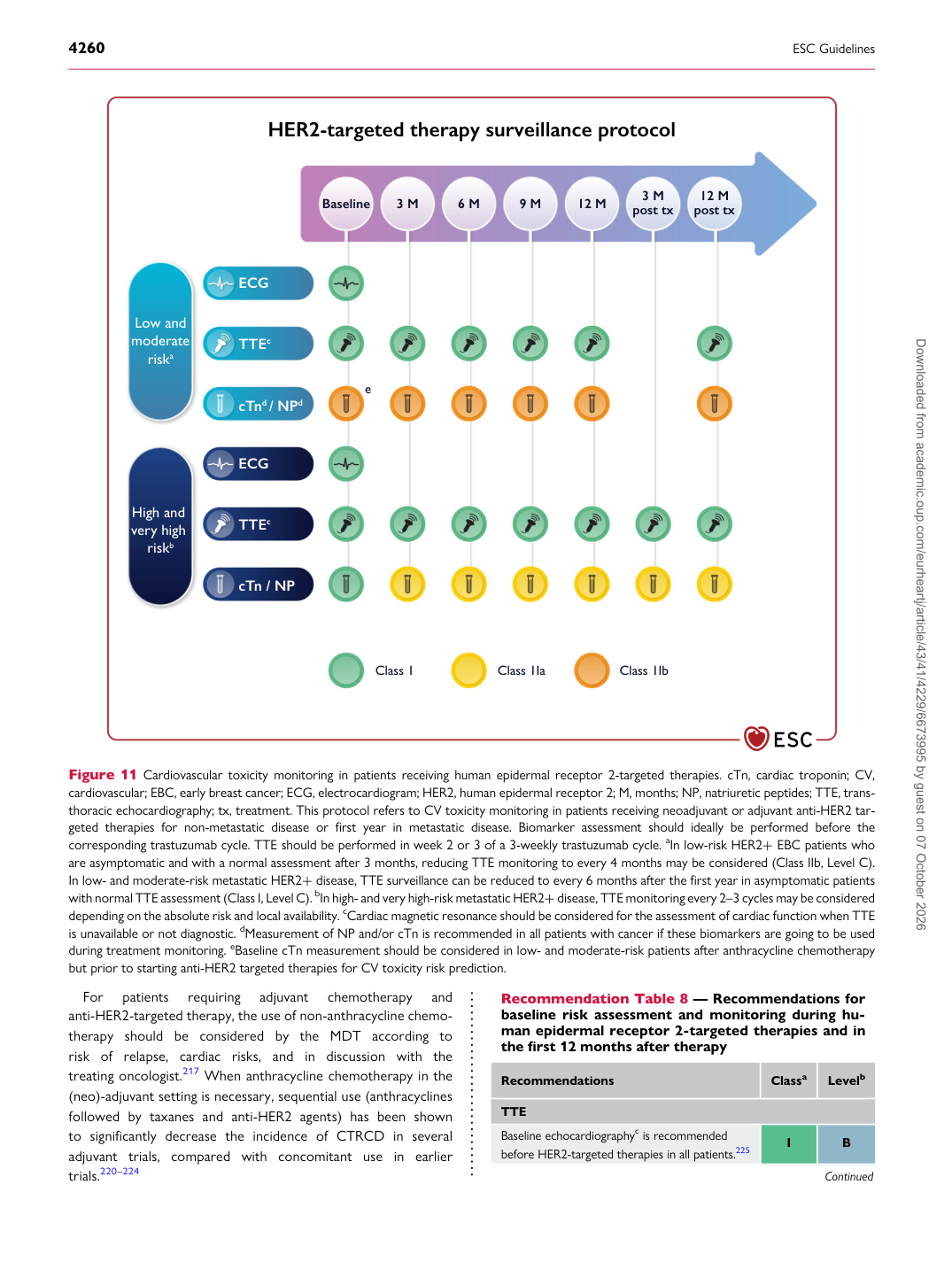
Figure 11 Cardiovascular toxicity monitoring in patients receiving human epidermal receptor 2-targeted therapies. cTn, cardiac troponin; CV, cardiovascular; EBC, early breast cancer; ECG, electrocardiogram; HER2, human epidermal receptor 2; M, months; NP, natriuretic peptides; TTE, transthoracic echocardiography; tx, treatment. This protocol refers to CV toxicity monitoring in patients receiving neoadjuvant or adjuvant anti-HER2 targeted therapies for non-metastatic disease or first year in metastatic disease. Biomarker assessment should ideally be performed before the corresponding trastuzumab cycle. TTE should be performed in week 2 or 3 of a 3-weekly trastuzumab cycle. aIn low-risk HER2+ EBC patients who are asymptomatic and with a normal assessment after 3 months, reducing TTE monitoring to every 4 months may be considered (Class IIb, Level C). In low- and moderate-risk metastatic HER2+ disease, TTE surveillance can be reduced to every 6 months after the first year in asymptomatic patients with normal TTE assessment (Class I, Level C). bIn high- and very high-risk metastatic HER2+ disease, TTE monitoring every 2–3 cycles may be considered depending on the absolute risk and local availability. cCardiac magnetic resonance should be considered for the assessment of cardiac function when TTE is unavailable or not diagnostic. dMeasurement of NP and/or cTn is recommended in all patients with cancer if these biomarkers are going to be used during treatment monitoring. eBaseline cTn measurement should be considered in low- and moderate-risk patients after anthracycline chemotherapy but prior to starting anti-HER2 targeted therapies for CV toxicity risk prediction. Downloaded from academic.oup.com/eurheartj/article/43/41/4229/6673995 by guest on 07 October 2026