p.31 抽出テキスト
5.5 Cancer therapy-related

cardiovascular toxicity monitoring protocols 5.5.1. Anthracycline chemotherapy Anthracycline-induced CTRCD is a dose-dependent and cumulative process of variable onset that may present with symptomatic or asymptomatic CTRCD.4 Figure 10 summarizes the recommended monitoring protocol during anthracycline therapy according to baseline CTRCD risk (Table 4). Clinical assessment combined with cardiac biomarkers (cTn and NP) and TTE (including 3D-LVEF and GLS when available) can identify both symptomatic and asymptomatic CTRCD with a reasonably high negative predictive value. This topic has been extensively reviewed in two recent HFA position statements.53,54 Classifying patients based on their risk of anthracycline-induced CV toxicity has allowed the early implementation of personalized preventive strategies (Section 5.2.1).14 Patients with pre-existing CVD should be treated with guidelinebased medical therapy.14,19,207

5.5.2 HER2-targeted therapies

HER2-targeted therapies are a crucial part of the treatment of patients with HER2-positive invasive BC in both early and metastatic settings. In the neoadjuvant and/or adjuvant settings, drugs currently approved are trastuzumab, pertuzumab, trastuzumab emtansine, and neratinib. In the metastatic setting, trastuzumab, pertuzumab, trastuzumab emtansine, tucatinib, and trastuzumab deruxtecan are currently approved.214–216 Trastuzumab can also be used in patients with HER2-overexpressing metastatic gastric adenocarcinomas in combination with platinum-based chemotherapy and either capecitabine or 5-fluorouracil (5-FU). It is recognized that anti-HER2 therapies may lead to LVD in up to 15–20% of patients and to overt HF if surveillance is missed, or in high- and very high-risk patients.217–220 LV function surveillance based on LVEF and GLS is recommended prior to and every 3 months during HER2-targeted therapies treatment surveillance (Figure 11).22 However, this single algorithm has not been tested in low- or high-risk patients and increased frequency of assessment (according to local availability) is recommended in high-risk patients. The use of cardiac serum biomarkers to identify CTRCD is less well-defined during anti-HER2 treatments.217 Measurement of cTn in BC patients after anthracycline-based chemotherapy but prior to trastuzumab should be considered, as an elevated cTn identifies patients at higher risk of trastuzumab-induced CTRCD. Serial NP measurement was more sensitive than cTn at predicting subsequent declines in LVEF during trastuzumab treatment.74

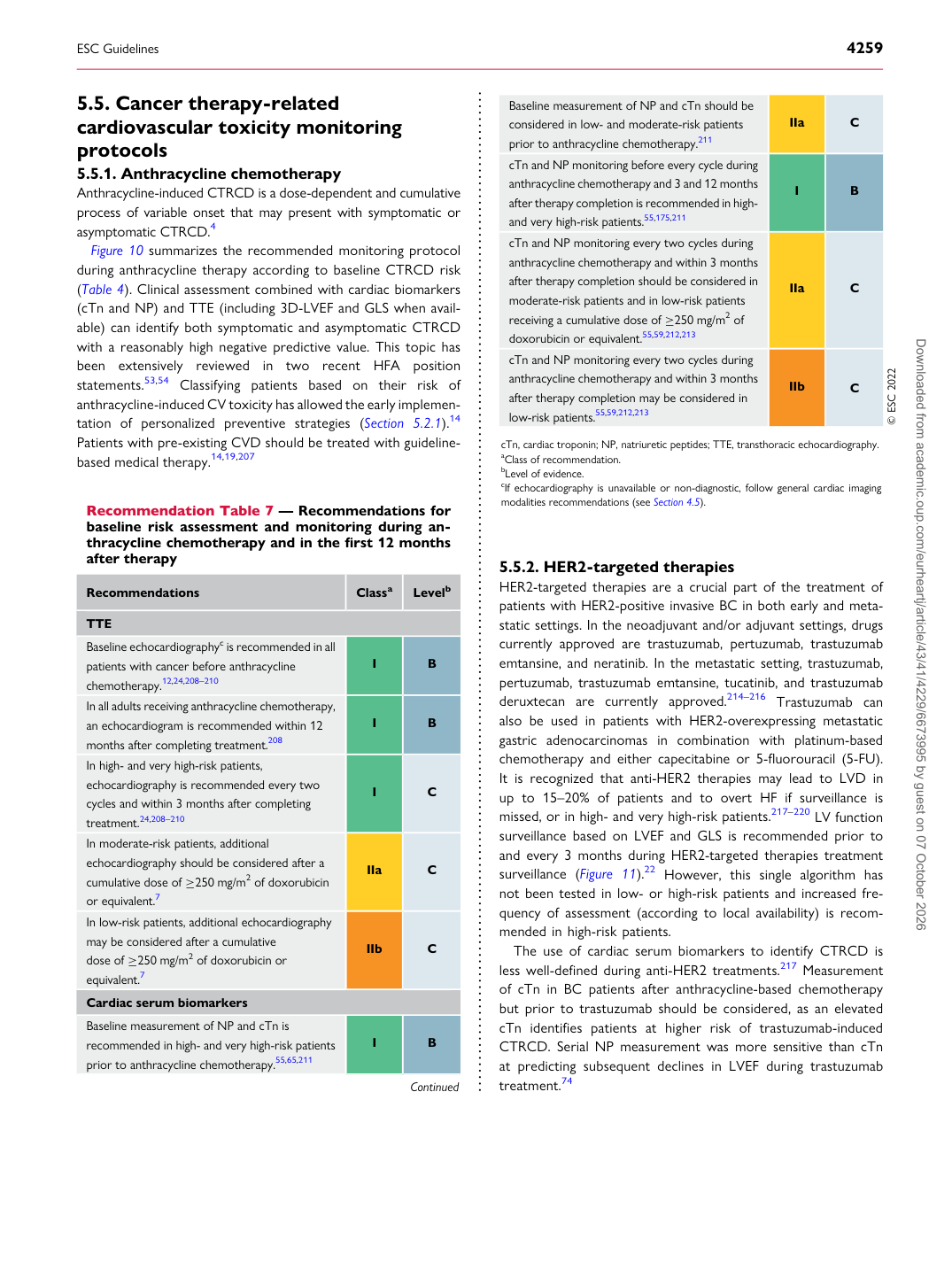
Recommendation Table 7 — Recommendations for baseline risk assessment and monitoring during anthracycline chemotherapy and in the first 12 months after therapy

Recommendations Classa Levelb

TTE Baseline echocardiographyc is recommended in all patients with cancer before anthracycline chemotherapy.12,24,208–210 I B In all adults receiving anthracycline chemotherapy, an echocardiogram is recommended within 12 months after completing treatment.208 I B In high- and very high-risk patients, echocardiography is recommended every two cycles and within 3 months after completing treatment.24,208–210 I C In moderate-risk patients, additional echocardiography should be considered after a cumulative dose of ≥250 mg/m2 of doxorubicin or equivalent.7 IIa C In low-risk patients, additional echocardiography may be considered after a cumulative dose of ≥250 mg/m2 of doxorubicin or equivalent.7 IIb C Cardiac serum biomarkers Baseline measurement of NP and cTn is recommended in high- and very high-risk patients prior to anthracycline chemotherapy.55,65,211 I B

Continued Baseline measurement of NP and cTn should be

considered in low- and moderate-risk patients prior to anthracycline chemotherapy.211 IIa C cTn and NP monitoring before every cycle during anthracycline chemotherapy and 3 and 12 months after therapy completion is recommended in highand very high-risk patients.55,175,211 I B cTn and NP monitoring every two cycles during anthracycline chemotherapy and within 3 months after therapy completion should be considered in moderate-risk patients and in low-risk patients receiving a cumulative dose of ≥250 mg/m2 of doxorubicin or equivalent.55,59,212,213 IIa C cTn and NP monitoring every two cycles during anthracycline chemotherapy and within 3 months after therapy completion may be considered in low-risk patients.55,59,212,213 IIb C © ESC 2022

cTn, cardiac troponin; NP, natriuretic peptides; TTE, transthoracic echocardiography. aClass of recommendation. bLevel of evidence. cIf echocardiography is unavailable or non-diagnostic, follow general cardiac imaging modalities recommendations (see Section 4.5). Downloaded from academic.oup.com/eurheartj/article/43/41/4229/6673995 by guest on 07 October 2026