p.28 抽出テキスト
dyslipidaemia,140 and underlying CVD and modifiable comorbidities should be managed according to appropriate 2021 ESC Guidelines on CVD prevention in clinical practice (Figure 9).19 Special attention should also be paid to the polypharmacy frequently seen in patients with cancer, reducing the use of drugs that may interfere with cancer therapies to the essential and actively monitoring their CV side effects and drug–drug interactions.141 Electrolyte imbalances such as hypokalaemia and hypomagnesaemia should be corrected. The CV risk management plan should be shared with the cancer specialist team, the primary care physician, and the patient to coordinate treatment strategies.

5.2 Primary prevention strategies

Primary prevention of CTR-CVT aims to avoid or minimize the development of CV damage due to therapy in patients without CVD12,142 and requires a multidisciplinary team (MDT) discussion between oncologists and cardiologists for complex patients with cancer with multiple comorbidities.4,21,22,43,143,144

5.2.1 Primary prevention of cancer

therapy-related cardiovascular toxicity during anthracycline chemotherapy Neurohormonal therapies during anthracycline chemotherapy (with or without subsequent trastuzumab treatment) reduced the risk of significant LVEF decline during follow-up in several small randomized controlled trials (RCTs) (Supplementary data, Table S10).145–154 Recent meta-analyses including patients with cancer treated with anthracycline chemotherapy and HER2-targeted therapies reported that renin–angiotensin–aldosterone system blockers, beta-blockers, and mineralocorticoid receptor antagonists have a significant benefit in preventing LVEF reduction, but no statistical differences in the incidence of overt HF or other clinical outcomes were demonstrated (Supplementary data, Table S11).155–160 This may be due, in part, to the fact that most trials included patients with a low baseline CTRCD risk and therefore larger RCTs are needed in high-risk populations. From the oncological perspective, some strategies that have been investigated include managing anthracycline-related toxicity by adjusting the infusion time and dose intensity.161 Dexrazoxane and liposomal anthracyclines are currently approved in patients with high and very high CTRCD risk or who have already received high cumulative anthracyclines doses.158,162–167 Dexrazoxane is protective against anthracycline-induced CTRCD. Currently, dexrazoxane is formally approved in adult patients with advanced or metastatic BC who have already received a minimum cumulative anthracycline dose of 300 mg/m2 of doxorubicin or equivalent (Table 5; Supplementary data, Table S12).163 In clinical practice, dexrazoxane infusion (dosage ratio dexrazoxane/doxorubicin is 10/1; e.g. 500 mg/m2 dexrazoxane per 50 mg/m2 doxorubicin) should be considered (at least 30 min prior to each anthracycline cycle) in adult patients with cancer scheduled to receive a high total cumulative anthracycline dose for curative treatment, and in patients with high and very high CTRCD risk (including those with pre-existing HF or low-normal or reduced LVEF) where anthracycline chemotherapy is deemed essential.163 Pegylated and non-pegylated liposomal doxorubicin164,165,168

modify pharmacokinetics and tissue distribution without compromising antitumour efficacy. Pegylated and non-pegylated liposomal doxorubicin are approved for metastatic BC and pegylated liposomal doxorubicin is also approved for advanced ovarian cancer, acquired immune deficiency syndrome-related Kaposi sarcoma, and MM. In a recent meta-analysis of 19 trials, in both the adjuvant and metastatic context, liposomal doxorubicin was reported to be less cardiotoxic than conventional doxorubicin.165 Liposomal daunorubicin is also available for acute leukaemia patients in place of daunorubicin when pre-existing LVD is present.164,165

5.2.2 Primary prevention of radiation-induced

cardiovascular toxicity Primary prevention of RT-induced damage to the CV system depends on technological advances that allow improved targeting of RT delivery, thereby maintaining or increasing oncological efficacy while reducing CTR-CVT.169,170 Modern techniques strive to minimize the mean heart dose (MHD), either by shaping the dose distribution (intensity-modulated RT) or by using respiratory management (gating or breath-hold).171,172 Proton therapy offers the potential to further decrease exposure to surrounding healthy organs.173 However, complete cardiac avoidance is not always possible due to the proximity of the tumour (e.g. central lung tumours, mediastinal lymphomas, irradiation of the internal mammary chain in BC). In patients where RT only has a consolidating role and the risk of RT-induced CV injury is very high (e.g. due to baseline risk factors), a MDT is needed to consider the risk/benefit of RT.171,174 There are no proven medical therapies to prevent RT-induced CV toxicity. One component of RT-induced CV toxicity is accelerating pre-existing CAD, and therefore tight control of CVRFs is recommended.

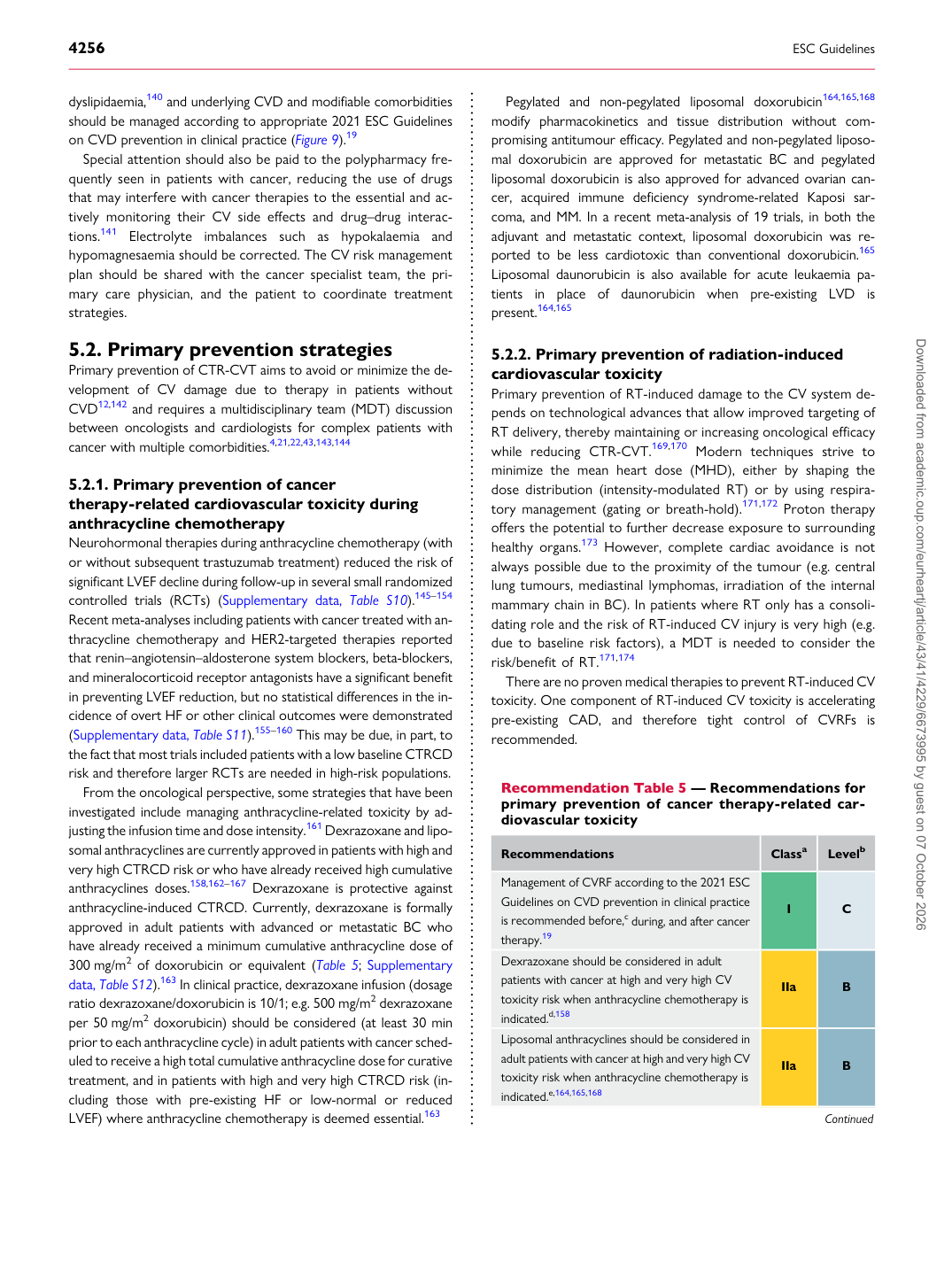
Recommendation Table 5 — Recommendations for primary prevention of cancer therapy-related cardiovascular toxicity

Recommendations Classa Levelb

Management of CVRF according to the 2021 ESC Guidelines on CVD prevention in clinical practice is recommended before,c during, and after cancer therapy.19 I C Dexrazoxane should be considered in adult patients with cancer at high and very high CV toxicity risk when anthracycline chemotherapy is indicated.d,158 IIa B Liposomal anthracyclines should be considered in adult patients with cancer at high and very high CV toxicity risk when anthracycline chemotherapy is indicated.e,164,165,168 IIa B

Continued Downloaded from academic.oup.com/eurheartj/article/43/41/4229/6673995 by guest on 07 October 2026