p.26 抽出テキスト
CRF—typically measured as the peak rate of oxygen consumption110,111 or metabolic equivalents111,112 during exercise—is one of the most robust predictors of CV health and longevity,113,114 and improves risk classification.115–121 Evidence for CPET pretreatment is limited to pre-operative risk stratification particularly for patients with lung,122 colon,123 and rectal124 cancers. Whether CPET performed prior to cardiotoxic cancer therapies is prognostic of future CV events is unknown.

4.7 Cardiovascular risk evaluation

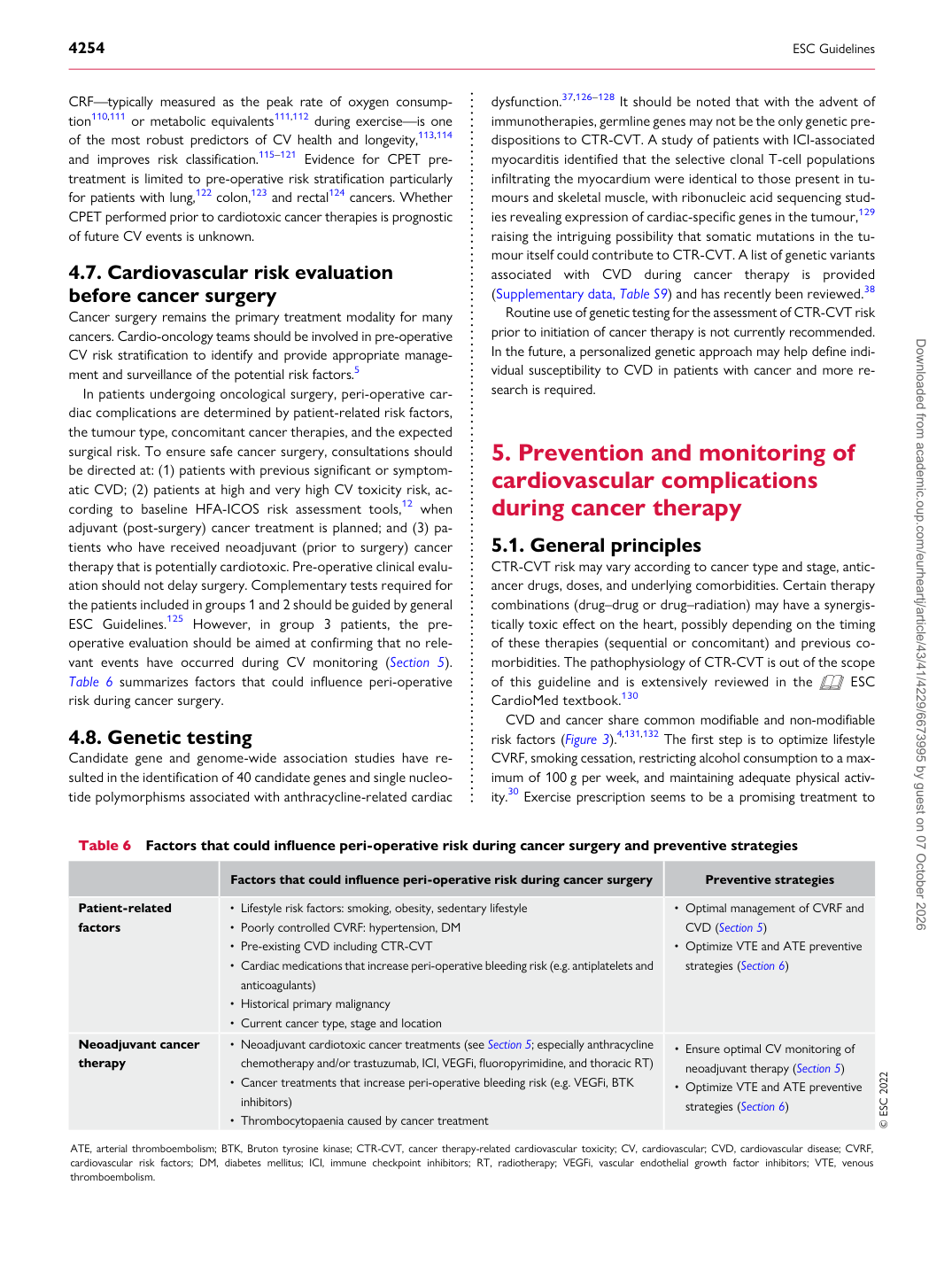
before cancer surgery Cancer surgery remains the primary treatment modality for many cancers. Cardio-oncology teams should be involved in pre-operative CV risk stratification to identify and provide appropriate management and surveillance of the potential risk factors.5 In patients undergoing oncological surgery, peri-operative cardiac complications are determined by patient-related risk factors, the tumour type, concomitant cancer therapies, and the expected surgical risk. To ensure safe cancer surgery, consultations should be directed at: (1) patients with previous significant or symptomatic CVD; (2) patients at high and very high CV toxicity risk, according to baseline HFA-ICOS risk assessment tools,12 when adjuvant (post-surgery) cancer treatment is planned; and (3) patients who have received neoadjuvant (prior to surgery) cancer therapy that is potentially cardiotoxic. Pre-operative clinical evaluation should not delay surgery. Complementary tests required for the patients included in groups 1 and 2 should be guided by general ESC Guidelines.125 However, in group 3 patients, the preoperative evaluation should be aimed at confirming that no relevant events have occurred during CV monitoring (Section 5). Table 6 summarizes factors that could influence peri-operative risk during cancer surgery.

4.8 Genetic testing

Candidate gene and genome-wide association studies have resulted in the identification of 40 candidate genes and single nucleotide polymorphisms associated with anthracycline-related cardiac dysfunction.37,126–128 It should be noted that with the advent of immunotherapies, germline genes may not be the only genetic predispositions to CTR-CVT. A study of patients with ICI-associated myocarditis identified that the selective clonal T-cell populations infiltrating the myocardium were identical to those present in tumours and skeletal muscle, with ribonucleic acid sequencing studies revealing expression of cardiac-specific genes in the tumour,129

raising the intriguing possibility that somatic mutations in the tumour itself could contribute to CTR-CVT. A list of genetic variants associated with CVD during cancer therapy is provided (Supplementary data, Table S9) and has recently been reviewed.38 Routine use of genetic testing for the assessment of CTR-CVT risk prior to initiation of cancer therapy is not currently recommended. In the future, a personalized genetic approach may help define individual susceptibility to CVD in patients with cancer and more research is required.

5 Prevention and monitoring of

cardiovascular complications during cancer therapy

5.1 General principles

CTR-CVT risk may vary according to cancer type and stage, anticancer drugs, doses, and underlying comorbidities. Certain therapy combinations (drug–drug or drug–radiation) may have a synergistically toxic effect on the heart, possibly depending on the timing of these therapies (sequential or concomitant) and previous comorbidities. The pathophysiology of CTR-CVT is out of the scope of this guideline and is extensively reviewed in the ESC CardioMed textbook.130 CVD and cancer share common modifiable and non-modifiable risk factors (Figure 3).4,131,132 The first step is to optimize lifestyle CVRF, smoking cessation, restricting alcohol consumption to a maximum of 100 g per week, and maintaining adequate physical activity.30 Exercise prescription seems to be a promising treatment to

Table 6 Factors that could influence peri-operative risk during cancer surgery and preventive strategies

Factors that could influence peri-operative risk during cancer surgery Preventive strategies

Patient-related factors • Lifestyle risk factors: smoking, obesity, sedentary lifestyle

• Poorly controlled CVRF: hypertension, DM • Pre-existing CVD including CTR-CVT • Cardiac medications that increase peri-operative bleeding risk (e.g. antiplatelets and anticoagulants) • Historical primary malignancy • Current cancer type, stage and location • Optimal management of CVRF and

CVD (Section 5) • Optimize VTE and ATE preventive

strategies (Section 6)

Neoadjuvant cancer therapy • Neoadjuvant cardiotoxic cancer treatments (see Section 5; especially anthracycline

chemotherapy and/or trastuzumab, ICI, VEGFi, fluoropyrimidine, and thoracic RT) • Cancer treatments that increase peri-operative bleeding risk (e.g. VEGFi, BTK inhibitors) • Thrombocytopaenia caused by cancer treatment • Ensure optimal CV monitoring of

neoadjuvant therapy (Section 5) • Optimize VTE and ATE preventive

strategies (Section 6) © ESC 2022

ATE, arterial thromboembolism; BTK, Bruton tyrosine kinase; CTR-CVT, cancer therapy-related cardiovascular toxicity; CV, cardiovascular; CVD, cardiovascular disease; CVRF, cardiovascular risk factors; DM, diabetes mellitus; ICI, immune checkpoint inhibitors; RT, radiotherapy; VEGFi, vascular endothelial growth factor inhibitors; VTE, venous thromboembolism. Downloaded from academic.oup.com/eurheartj/article/43/41/4229/6673995 by guest on 07 October 2026