p.111 抽出テキスト
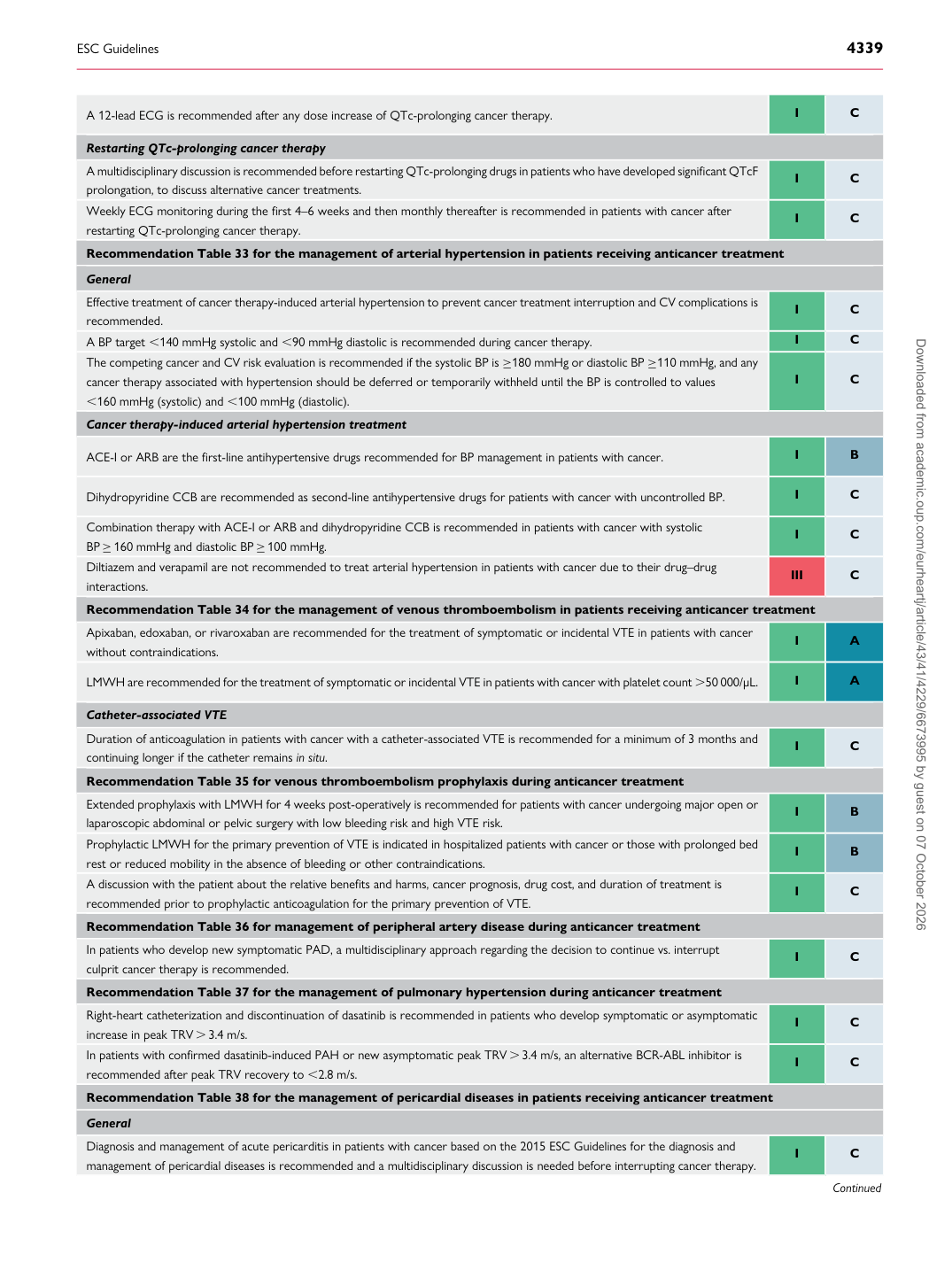
A 12-lead ECG is recommended after any dose increase of QTc-prolonging cancer therapy. I C

Restarting QTc-prolonging cancer therapy A multidisciplinary discussion is recommended before restarting QTc-prolonging drugs in patients who have developed significant QTcF prolongation, to discuss alternative cancer treatments. I C Weekly ECG monitoring during the first 4–6 weeks and then monthly thereafter is recommended in patients with cancer after restarting QTc-prolonging cancer therapy. I C Recommendation Table 33 for the management of arterial hypertension in patients receiving anticancer treatment General Effective treatment of cancer therapy-induced arterial hypertension to prevent cancer treatment interruption and CV complications is recommended. I C A BP target ,140 mmHg systolic and ,90 mmHg diastolic is recommended during cancer therapy. I C The competing cancer and CV risk evaluation is recommended if the systolic BP is ≥180 mmHg or diastolic BP ≥110 mmHg, and any cancer therapy associated with hypertension should be deferred or temporarily withheld until the BP is controlled to values ,160 mmHg (systolic) and ,100 mmHg (diastolic). I C Cancer therapy-induced arterial hypertension treatment

ACE-I or ARB are the first-line antihypertensive drugs recommended for BP management in patients with cancer. I B

Dihydropyridine CCB are recommended as second-line antihypertensive drugs for patients with cancer with uncontrolled BP. I C

Combination therapy with ACE-I or ARB and dihydropyridine CCB is recommended in patients with cancer with systolic BP ≥160 mmHg and diastolic BP ≥100 mmHg. I C Diltiazem and verapamil are not recommended to treat arterial hypertension in patients with cancer due to their drug–drug interactions. III C Recommendation Table 34 for the management of venous thromboembolism in patients receiving anticancer treatment Apixaban, edoxaban, or rivaroxaban are recommended for the treatment of symptomatic or incidental VTE in patients with cancer without contraindications. I A

LMWH are recommended for the treatment of symptomatic or incidental VTE in patients with cancer with platelet count .50 000/μL. I A

Catheter-associated VTE Duration of anticoagulation in patients with cancer with a catheter-associated VTE is recommended for a minimum of 3 months and continuing longer if the catheter remains in situ. I C Recommendation Table 35 for venous thromboembolism prophylaxis during anticancer treatment Extended prophylaxis with LMWH for 4 weeks post-operatively is recommended for patients with cancer undergoing major open or laparoscopic abdominal or pelvic surgery with low bleeding risk and high VTE risk. I B Prophylactic LMWH for the primary prevention of VTE is indicated in hospitalized patients with cancer or those with prolonged bed rest or reduced mobility in the absence of bleeding or other contraindications. I B A discussion with the patient about the relative benefits and harms, cancer prognosis, drug cost, and duration of treatment is recommended prior to prophylactic anticoagulation for the primary prevention of VTE. I C Recommendation Table 36 for management of peripheral artery disease during anticancer treatment In patients who develop new symptomatic PAD, a multidisciplinary approach regarding the decision to continue vs. interrupt culprit cancer therapy is recommended. I C Recommendation Table 37 for the management of pulmonary hypertension during anticancer treatment Right-heart catheterization and discontinuation of dasatinib is recommended in patients who develop symptomatic or asymptomatic increase in peak TRV . 3.4 m/s. I C In patients with confirmed dasatinib-induced PAH or new asymptomatic peak TRV . 3.4 m/s, an alternative BCR-ABL inhibitor is recommended after peak TRV recovery to ,2.8 m/s. I C Recommendation Table 38 for the management of pericardial diseases in patients receiving anticancer treatment General Diagnosis and management of acute pericarditis in patients with cancer based on the 2015 ESC Guidelines for the diagnosis and management of pericardial diseases is recommended and a multidisciplinary discussion is needed before interrupting cancer therapy. I C

Continued Downloaded from academic.oup.com/eurheartj/article/43/41/4229/6673995 by guest on 07 October 2026