p.11 抽出テキスト
minimizing CTR-CVT across the entire continuum of cancer care.5 Before initiation of cancer therapies with a known CV toxicity profile, the cardio-oncology team should identify and treat CV risk factors (CVRF) and pre-existing CVDs and define an appropriate prevention and surveillance plan for early identification and appropriate management of potential CV complications (Figure 2). Another important aspect is the participation in interdisciplinary discussions regarding the benefits and risks of certain cancer treatments and their continuation or interruption should side effects become apparent. After cancer treatment has been completed, the focus shifts to co-ordination of long-term follow-up and treatment. For patients on long-term cancer therapies with CV toxicity risk, surveillance should continue until the treatment is finished.6–8 There is also the need for re-assessment of CV risks in patients requiring treatment for secondary malignancies.

2.3 General principles of

cardio-oncology A guiding principle of cardio-oncology is the integration of clinical disciplines. Cardio-oncology providers must have knowledge of the broad scope of cardiology, oncology, and haematology management.5 Recommendations are formed regarding the most permissible (from a

Time

Baseline

risk Du

D ring cardiotoxic

cancer thera p

p

p y y y

p

p

p Long-term foll f ow-up after cancer treatment

Primary and secondary prevention strategies Cancer treatment

surveillance Early CTR-CVT management Cancer survivorship programmes

Low risk

High risk

CTR-CVT CTR-CVT

risk risk

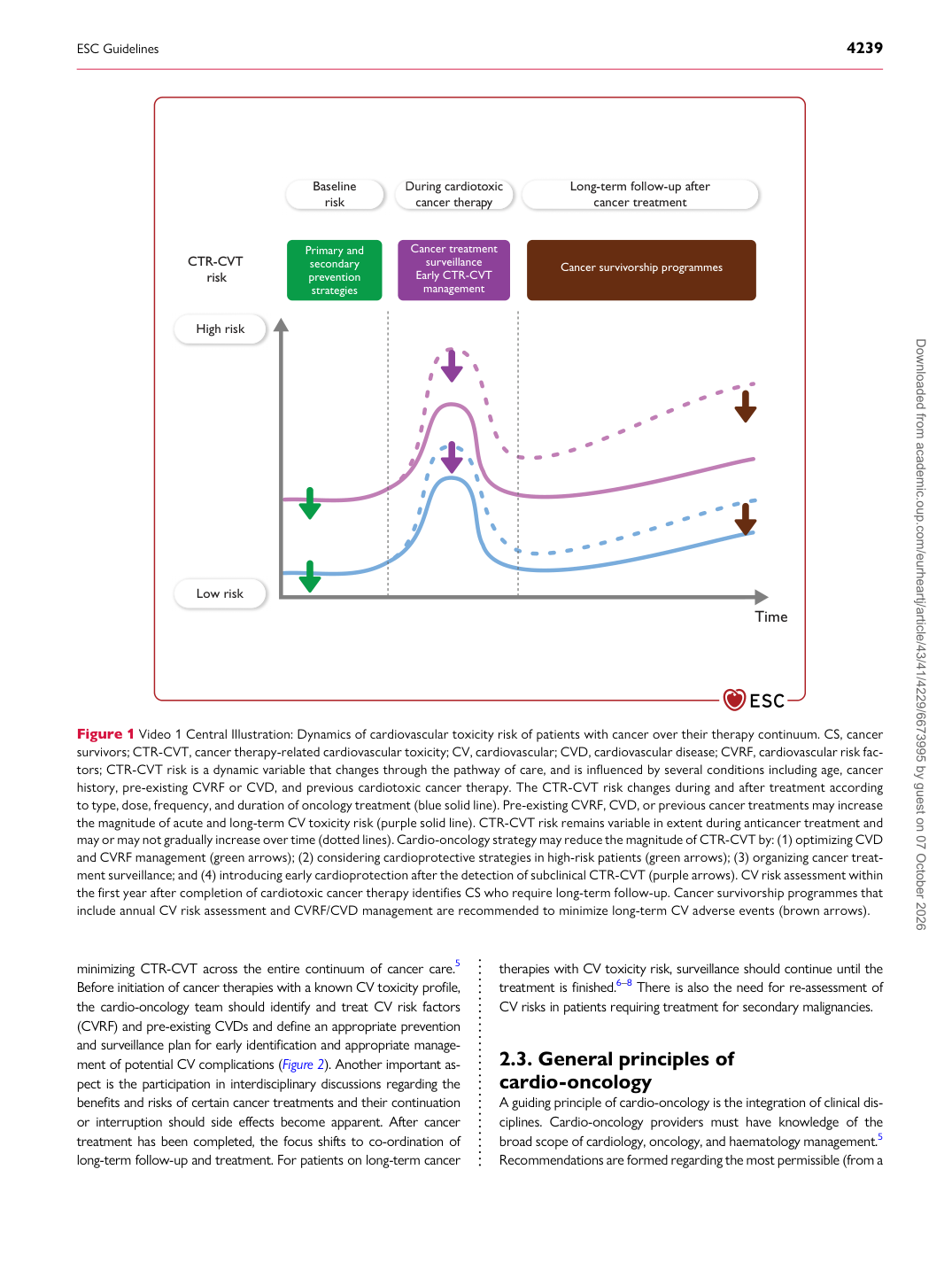
Figure 1 Video 1 Central Illustration: Dynamics of cardiovascular toxicity risk of patients with cancer over their therapy continuum. CS, cancer survivors; CTR-CVT, cancer therapy-related cardiovascular toxicity; CV, cardiovascular; CVD, cardiovascular disease; CVRF, cardiovascular risk factors; CTR-CVT risk is a dynamic variable that changes through the pathway of care, and is influenced by several conditions including age, cancer history, pre-existing CVRF or CVD, and previous cardiotoxic cancer therapy. The CTR-CVT risk changes during and after treatment according to type, dose, frequency, and duration of oncology treatment (blue solid line). Pre-existing CVRF, CVD, or previous cancer treatments may increase the magnitude of acute and long-term CV toxicity risk (purple solid line). CTR-CVT risk remains variable in extent during anticancer treatment and may or may not gradually increase over time (dotted lines). Cardio-oncology strategy may reduce the magnitude of CTR-CVT by: (1) optimizing CVD and CVRF management (green arrows); (2) considering cardioprotective strategies in high-risk patients (green arrows); (3) organizing cancer treatment surveillance; and (4) introducing early cardioprotection after the detection of subclinical CTR-CVT (purple arrows). CV risk assessment within the first year after completion of cardiotoxic cancer therapy identifies CS who require long-term follow-up. Cancer survivorship programmes that include annual CV risk assessment and CVRF/CVD management are recommended to minimize long-term CV adverse events (brown arrows). Downloaded from academic.oup.com/eurheartj/article/43/41/4229/6673995 by guest on 07 October 2026