p.103 抽出テキスト
CVRF should be offered to patients with cancer, in order to reduce the burden of complications during and after anticancer therapy. Patients should receive guidance to recognize and to report signs and symptoms of CVD, in order to receive prompt and effective treatment, ideally without interfering with their cancer treatment. Patients should also be advised not to stop cardioprotective therapies without medical guidance, even if they recover their cardiac function. To help in this complex task, leaflets specifically designed for this context may be used,832,833 eventually with the aid of digital tools (Figure 47).

11 The role of scientific societies

in the promotion and development of cardio-oncology in modern medicine

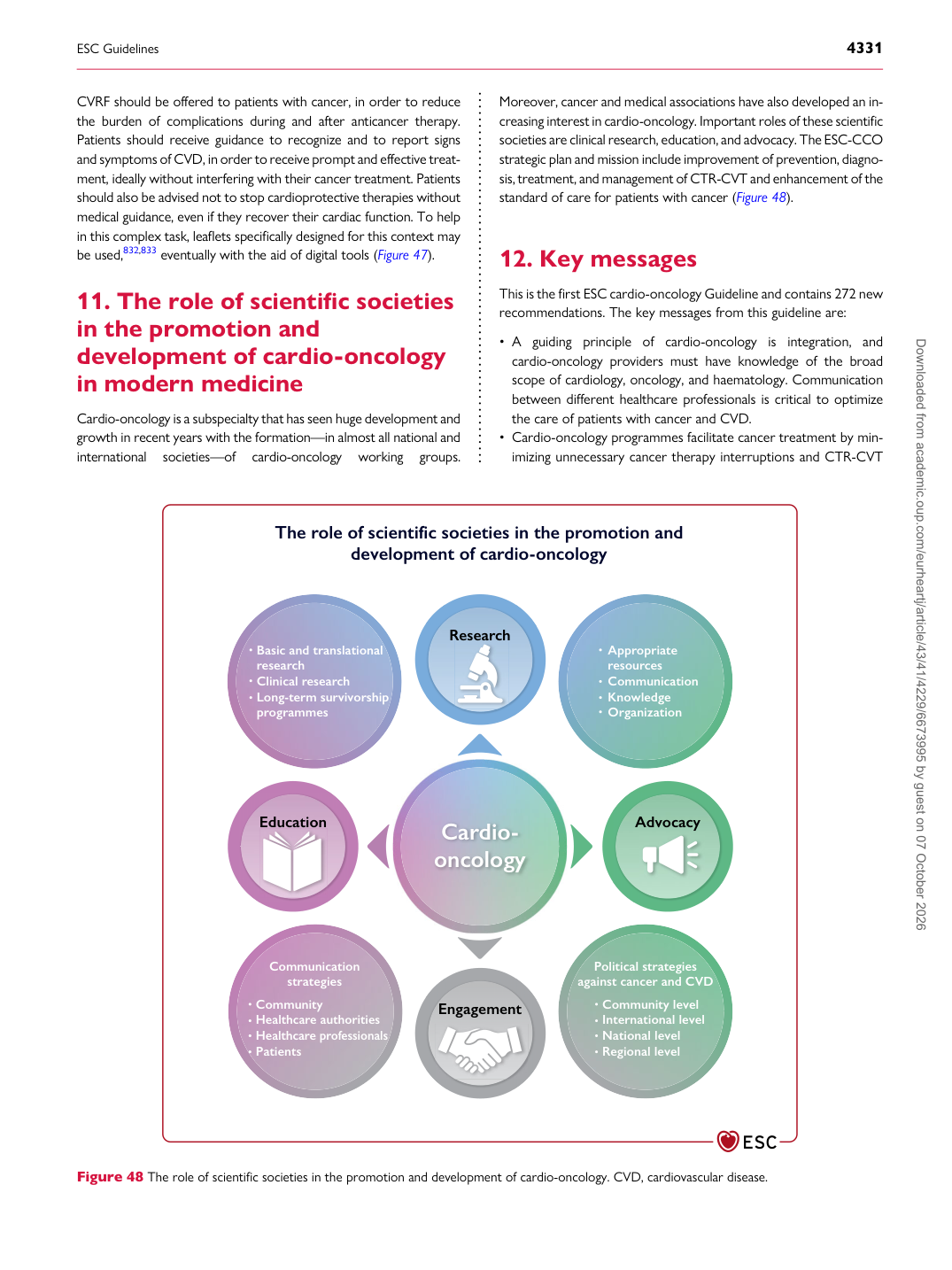
Cardio-oncology is a subspecialty that has seen huge development and growth in recent years with the formation—in almost all national and international societies—of cardio-oncology working groups. Moreover, cancer and medical associations have also developed an increasing interest in cardio-oncology. Important roles of these scientific societies are clinical research, education, and advocacy. The ESC-CCO strategic plan and mission include improvement of prevention, diagnosis, treatment, and management of CTR-CVT and enhancement of the standard of care for patients with cancer (Figure 48).

12 Key messages

This is the first ESC cardio-oncology Guideline and contains 272 new recommendations. The key messages from this guideline are: • A guiding principle of cardio-oncology is integration, and cardio-oncology providers must have knowledge of the broad scope of cardiology, oncology, and haematology. Communication between different healthcare professionals is critical to optimize the care of patients with cancer and CVD. • Cardio-oncology programmes facilitate cancer treatment by minimizing unnecessary cancer therapy interruptions and CTR-CVT

The role of scientific societies in the promotion and

development of cardio-oncology

Cardiooncology Advocacy

Research

Education

Engagement

Basic and translational research Clinical research Long-term survivorship programmes Appropriate resources Communication Knowledge Organization

Community level International level National level Regional level

Political strategies against cancer and CVD

Community Healthcare authorities Healthcare professionals Patients

Communication

strategies

Figure 48 The role of scientific societies in the promotion and development of cardio-oncology. CVD, cardiovascular disease. Downloaded from academic.oup.com/eurheartj/article/43/41/4229/6673995 by guest on 07 October 2026