p.7 抽出テキスト
....................... indication. (iv) Finally, the encouraging preliminary experience with transcatheter tricuspid valve interventions (TTVI) suggests a potential role of this treatment in inoperable patients, although this needs to be confirmed by further evaluation.

The new evidence described above made a revision of the recommendations necessary. 2.2 Methodology

In preparation of the 2021 VHD Guidelines, a methodology group has been created for the first time, to assist the Task Force for the collection and interpretation of the evidence supporting specific recommendations. The group was constituted of two European Society of Cardiology (ESC) and two European Association for Cardio- Thoracic Surgery (EACTS) delegates who were also members of the

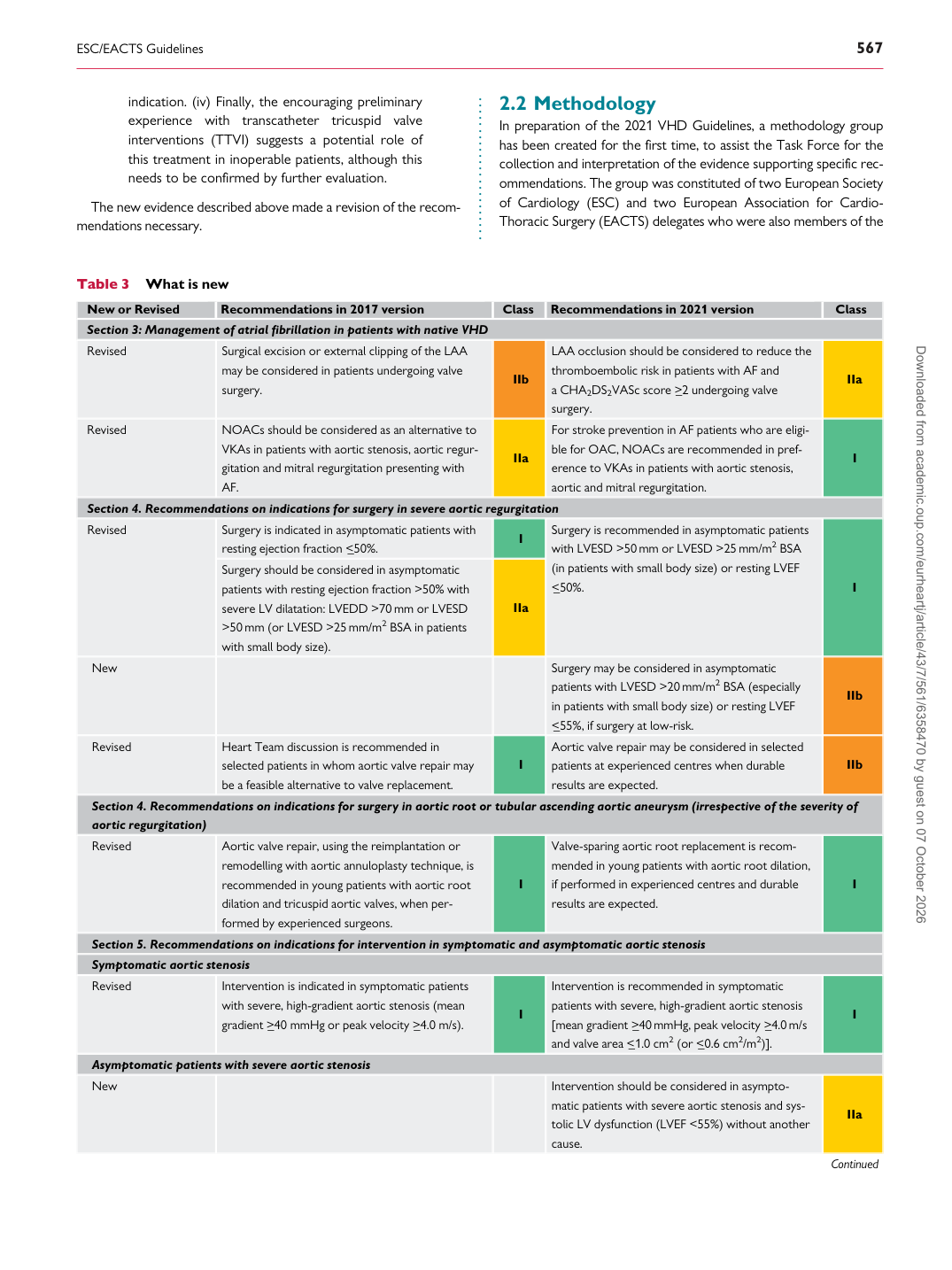
Table 3 What is new

New or Revised Recommendations in 2017 version Class Recommendations in 2021 version Class Section 3: Management of atrial fibrillation in patients with native VHD Revised Surgical excision or external clipping of the LAA

may be considered in patients undergoing valve surgery. IIb LAA occlusion should be considered to reduce the

thromboembolic risk in patients with AF and a CHA2DS2VASc score >_2 undergoing valve surgery. IIa

Revised NOACs should be considered as an alternative to

VKAs in patients with aortic stenosis, aortic regurgitation and mitral regurgitation presenting with AF. IIa For stroke prevention in AF patients who are eligi-

ble for OAC, NOACs are recommended in preference to VKAs in patients with aortic stenosis, aortic and mitral regurgitation. I

Section 4. Recommendations on indications for surgery in severe aortic regurgitation Revised Surgery is indicated in asymptomatic patients with

resting ejection fraction <_50%. I Surgery is recommended in asymptomatic patients

with LVESD >50 mm or LVESD >25 mm/m2 BSA (in patients with small body size) or resting LVEF

<_50%. I Surgery should be considered in asymptomatic patients with resting ejection fraction >50% with severe LV dilatation: LVEDD >70 mm or LVESD >50 mm (or LVESD >25 mm/m2 BSA in patients with small body size). IIa

New Surgery may be considered in asymptomatic

patients with LVESD >20 mm/m2 BSA (especially in patients with small body size) or resting LVEF <_55%, if surgery at low-risk. IIb

Revised Heart Team discussion is recommended in selected patients in whom aortic valve repair may

be a feasible alternative to valve replacement. I Aortic valve repair may be considered in selected patients at experienced centres when durable

results are expected. IIb

Section 4. Recommendations on indications for surgery in aortic root or tubular ascending aortic aneurysm (irrespective of the severity of aortic regurgitation) Revised Aortic valve repair, using the reimplantation or

remodelling with aortic annuloplasty technique, is recommended in young patients with aortic root dilation and tricuspid aortic valves, when performed by experienced surgeons. I Valve-sparing aortic root replacement is recom-

mended in young patients with aortic root dilation, if performed in experienced centres and durable results are expected. I

Section 5. Recommendations on indications for intervention in symptomatic and asymptomatic aortic stenosis Symptomatic aortic stenosis Revised Intervention is indicated in symptomatic patients with severe, high-gradient aortic stenosis (mean

gradient >_40 mmHg or peak velocity >_4.0 m/s). I Intervention is recommended in symptomatic patients with severe, high-gradient aortic stenosis

[mean gradient >_40 mmHg, peak velocity >_4.0 m/s and valve area <_1.0 cm2 (or <_0.6 cm2/m2)]. I

Asymptomatic patients with severe aortic stenosis New Intervention should be considered in asympto-

matic patients with severe aortic stenosis and systolic LV dysfunction (LVEF <55%) without another cause. IIa

Continued Downloaded from academic.oup.com/eurheartj/article/43/7/561/6358470 by guest on 07 October 2026