p.31 抽出テキスト
...................................................... 6.2.2 Medical therapy Optimal medical therapy in line with the guidelines for the management of heart failure247 should be the first and essential step in the management of all patients with SMR and should include replacement of ACEI or ARB with sacubitril/valsartan, sodium-glucose co-transporter 2 inhibitors and/or ivabradine, whenever indicated.247,327

Indications for cardiac resynchronization therapy (CRT) should be evaluated in accordance with related guidelines.247 If symptoms persist after optimization of conventional heart failure therapy, options for mitral valve intervention should be promptly evaluated before further deterioration of LV systolic function or cardiac remodelling occur.

6.2.3 Indications for intervention Chronic SMR is associated with impaired prognosis321,328 and its interventional management is complex (see recommendations on indications for mitral valve intervention in chronic severe SMR, and Figure 6). The detailed analysis of the available level of evidence made by the methodology group of the task force is available in Supplementary Section 5. The importance of decision making by a multidisciplinary Heart Team needs to be emphasized in this setting. The Heart Team, including a heart failure specialist, should optimize guideline-directed medical therapy (GDMT) and consider the indications of electrophysiological, transcatheter and surgical interventions, their priority and order of implementation.

The evidence supporting surgical intervention remains limited. Mitral valve surgery is recommended in patients with severe SMR undergoing CABG or other cardiac surgery.329,330 The surgical approach has to be tailored to the individual patient.247,331 In selected patients without advanced LV remodelling, mitral valve repair with an undersized complete rigid ring restores valve competence, improves symptoms, and results in reverse LV remodelling.331 Additional valvular/subvalvular techniques or chordal sparing valve replacement may be considered in patients with echocardiographic predictors of repair failure.332 Valve replacement avoids recurrence of mitral regurgitation, although this does not translate into better LV reverse

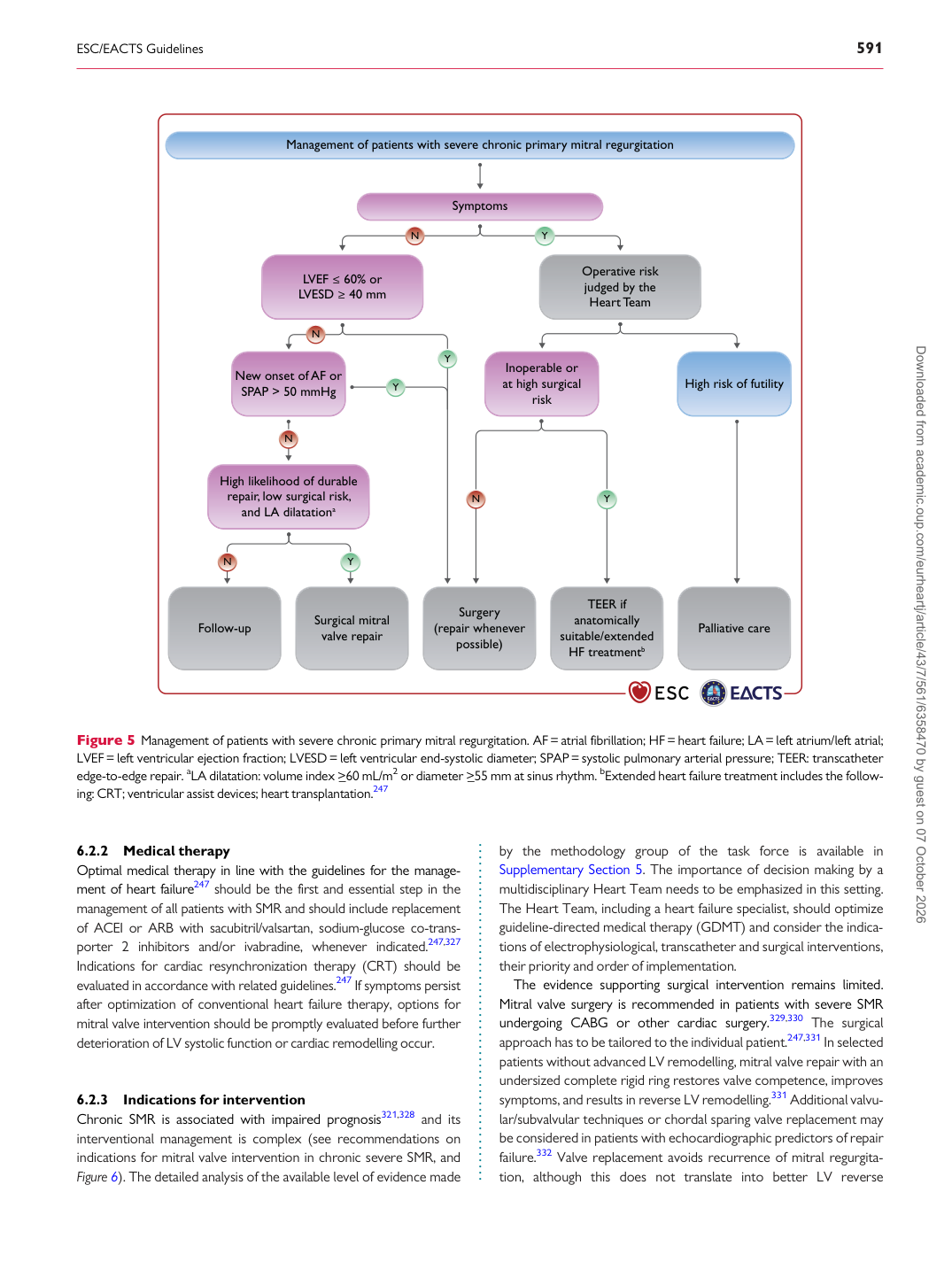
Symptoms

Management of patients with severe chronic primary mitral regurgitation

LVEF ≤ 60% or LVESD ≥ 40 mm Operative risk

judged by the Heart Team

N Y

Follow-up Surgical mitral

valve repair Surgery (repair whenever

possible) TEER if anatomically suitable/extended

HF treatmentb Palliative care

New onset of AF or SPAP > 50 mmHg

High likelihood of durable repair, low surgical risk,

and LA dilatationa

N

Y N Y

Y Inoperable or at high surgical

risk High risk of futility

Y N

N

Figure 5 Management of patients with severe chronic primary mitral regurgitation. AF= atrial fibrillation; HF= heart failure; LA= left atrium/left atrial; LVEF= left ventricular ejection fraction; LVESD= left ventricular end-systolic diameter; SPAP= systolic pulmonary arterial pressure; TEER: transcatheter edge-to-edge repair. aLA dilatation: volume index >_60 mL/m2 or diameter >_55 mm at sinus rhythm. bExtended heart failure treatment includes the following: CRT; ventricular assist devices; heart transplantation.247 Downloaded from academic.oup.com/eurheartj/article/43/7/561/6358470 by guest on 07 October 2026