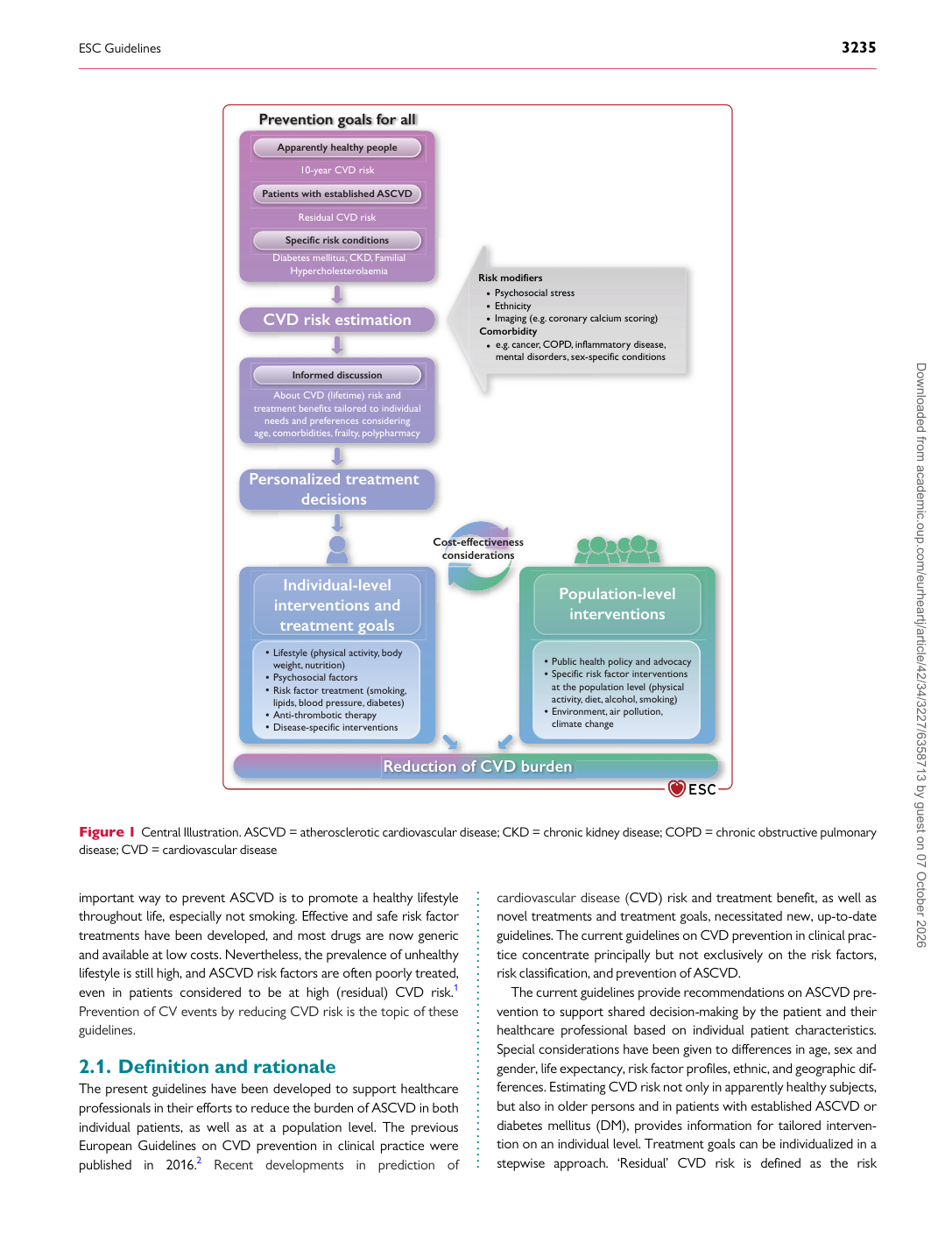
p.9 抽出テキスト
............................................. important way to prevent ASCVD is to promote a healthy lifestyle throughout life, especially not smoking. Effective and safe risk factor treatments have been developed, and most drugs are now generic and available at low costs. Nevertheless, the prevalence of unhealthy lifestyle is still high, and ASCVD risk factors are often poorly treated, even in patients considered to be at high (residual) CVD risk.1

Prevention of CV events by reducing CVD risk is the topic of these guidelines.

2.1 Definition and rationale

The present guidelines have been developed to support healthcare professionals in their efforts to reduce the burden of ASCVD in both individual patients, as well as at a population level. The previous European Guidelines on CVD prevention in clinical practice were published in 2016.2 Recent developments in prediction of cardiovascular disease (CVD) risk and treatment benefit, as well as novel treatments and treatment goals, necessitated new, up-to-date guidelines. The current guidelines on CVD prevention in clinical practice concentrate principally but not exclusively on the risk factors, risk classification, and prevention of ASCVD.

The current guidelines provide recommendations on ASCVD prevention to support shared decision-making by the patient and their healthcare professional based on individual patient characteristics. Special considerations have been given to differences in age, sex and gender, life expectancy, risk factor profiles, ethnic, and geographic differences. Estimating CVD risk not only in apparently healthy subjects, but also in older persons and in patients with established ASCVD or diabetes mellitus (DM), provides information for tailored intervention on an individual level. Treatment goals can be individualized in a stepwise approach. ‘Residual’ CVD risk is defined as the risk

Prevention goals for all

Reduction of CVD burden

About CVD (lifetime) risk and treatment benefits tailored to individual needs and preferences considering age, comorbidities, frailty, polypharmacy

Informed discussion

Diabetes mellitus, CKD, Familial

Hypercholesterolaemia

Specific risk conditions

Residual CVD risk

Patients with established ASCVD

10-year CVD risk

Apparently healthy people

CVD risk estimation

Individual-level interventions and

treatment goals

Lifestyle (physical activity, body weight, nutrition) Psychosocial factors Risk factor treatment (smoking, lipids, blood pressure, diabetes) Anti-thrombotic therapy Disease-specific interventions Cost-effectiveness

considerations

Risk modifiers

Comorbidity

e.g. cancer, COPD, inflammatory disease, mental disorders, sex-specific conditions

Psychosocial stress Ethnicity Imaging (e.g. coronary calcium scoring)

Population-level

interventions

Public health policy and advocacy Specific risk factor interventions at the population level (physical activity, diet, alcohol, smoking) Environment, air pollution, climate change

Personalized treatment

decisions

Figure 1 Central Illustration. ASCVD = atherosclerotic cardiovascular disease; CKD = chronic kidney disease; COPD = chronic obstructive pulmonary disease; CVD = cardiovascular disease Downloaded from academic.oup.com/eurheartj/article/42/34/3227/6358713 by guest on 07 October 2026