p.8 抽出テキスト
......................................................................................... for digital applications (smartphones, etc.). These versions are abridged and thus, for more detailed information, the user should always access to the full text version of the guidelines, which is freely available via the ESC website and hosted on the EHJ website. The National Cardiac Societies of the ESC are encouraged to endorse, adopt, translate, and implement all ESC Guidelines. Implementation programmes are needed because it has been shown that the outcome of disease may be favourably influenced by the thorough application of clinical recommendations.

Health professionals are encouraged to take the ESC Guidelines fully into account when exercising their clinical judgement, as well as in the determination and the implementation of preventive, diagnostic, or therapeutic medical strategies. However, the ESC Guidelines do not override in any way whatsoever the individual responsibility of health professionals to make appropriate and accurate decisions in consideration of each patient’s health condition and in consultation with that patient or the patient’s caregiver where appropriate and/or necessary. It is also the health professional’s responsibility to verify the rules and regulations applicable in each country to drugs and devices at the time of prescription.

2 Introduction

Pacing is an important part of electrophysiology and of cardiology in general. Whereas some of the situations requiring pacing are clear and have not changed over the years, many others have evolved and have been the subject of extensive recent research, such as pacing after syncope (section 5), pacing following transcatheter aortic valve implantation (TAVI; section 8), cardiac resynchronization therapy (CRT) for heart failure (HF) and for prevention of pacing-induced cardiomyopathy (section 6), and pacing in various infiltrative and inflammatory diseases of the heart, as well as in different cardiomyopathies (section 8). Other novel topics include new diagnostic tools for decision-making on pacing (section 4), as well as a whole new area of pacing the His bundle and the left bundle branch (section 7). In addition, attention has increased in other areas, such as how to systematically minimize procedural risk and avoid complications of cardiac pacing (section 9), how to manage patients with pacemakers in special situations, such as when magnetic resonance imaging (MRI) or irradiation are needed (section 11), how to follow patients with a pacemaker with emphasis on the use of remote monitoring, and how to include shared decision-making in caring for this patient population (section 12). The last pacing guidelines of the European Society of Cardiology (ESC) were published in 2013; therefore, a new set of guidelines was felt to be timely and necessary. To address these topics, a Task Force was established to create the new guidelines. As well as receiving the input of leading experts in the field of pacing, the Task Force was enhanced by representatives from the Association for Acute CardioVascular Care, the Heart Failure Association, the European Association of Cardiothoracic Surgery, the European Association of Percutaneous Cardiovascular Interventions, the ESC Working Group on Myocardial and Pericardial Diseases, as well as the Association of Cardiovascular Nursing & Allied Professions.

2.1 Evidence review

This document is divided into sections, each with a section coordinator and several authors. They were asked to thoroughly review the recent literature on their topics, and to come up with recommendations and grade them by classification as well as by level of evidence. Where data seemed controversial, a methodologist (Dipak Kotecha) was asked to evaluate the strength of the evidence and to assist in determining the class of recommendation and level of evidence. All recommendations were voted on by all authors of the document and were accepted only if supported by at least 75% of the co-authors. The leaders (Jens Cosedis Nielsen and Michael Glikson) and the coordinators of this document (Yoav Michowitz and Mads Brix Kronborg) were responsible for alignment of the recommendations between sections, and several members of the writing committee were responsible for overlap with other ESC Guidelines, such as the HF guidelines and the valvular heart disease guidelines.

2.2 Relationships with industry

All work in this document was voluntary and all co-authors were required to declare and prove that they do not have conflicts of interests, as defined recently by the Scientific Guideline Committee of the ESC and the ESC board.

2.3 What is new in these guidelines

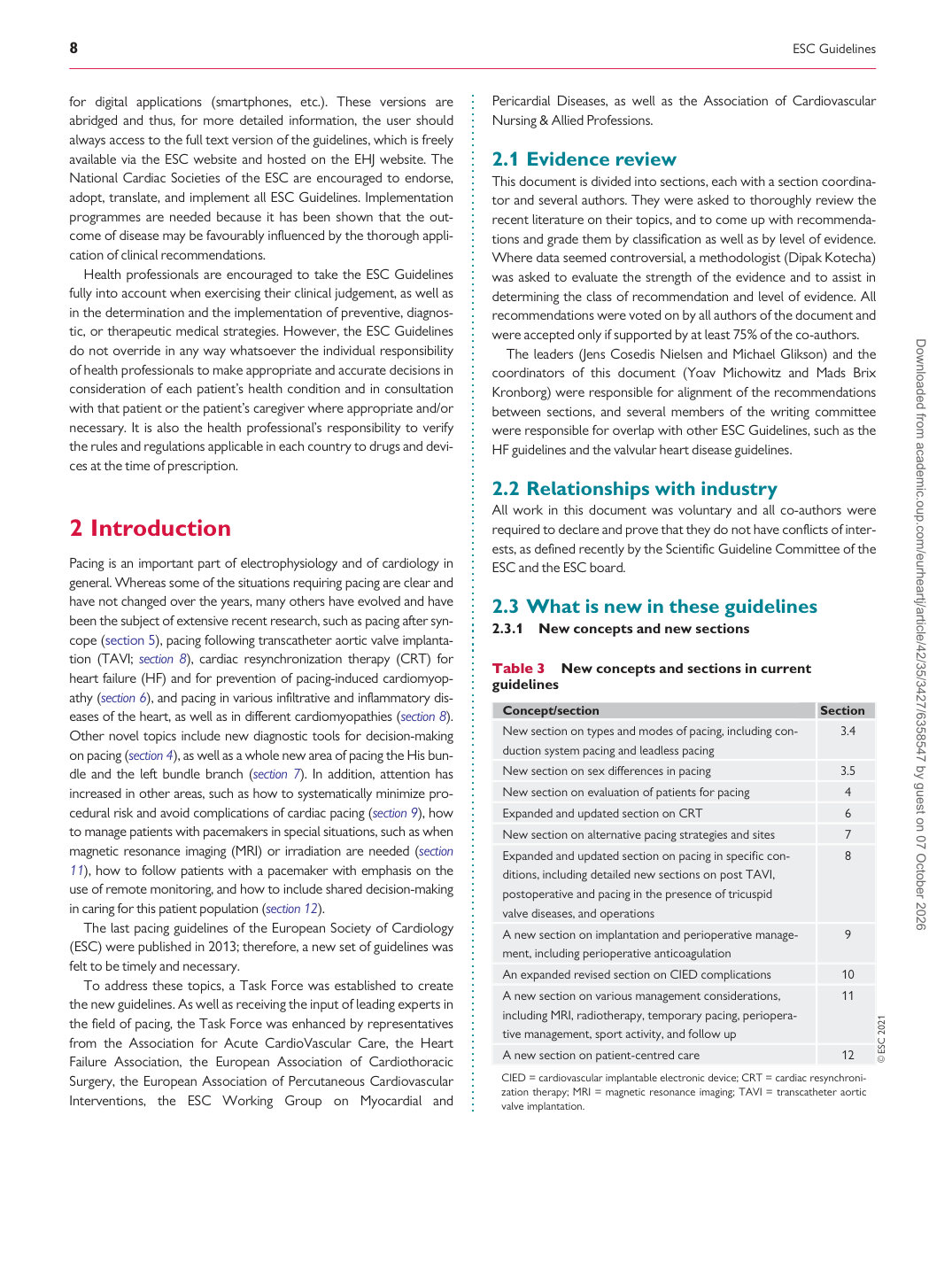
2.3.1 New concepts and new sections

Table 3 New concepts and sections in current guidelines

Concept/section Section New section on types and modes of pacing, including conduction system pacing and leadless pacing

3.4 New section on sex differences in pacing 3.5 New section on evaluation of patients for pacing 4 Expanded and updated section on CRT 6 New section on alternative pacing strategies and sites 7 Expanded and updated section on pacing in specific conditions, including detailed new sections on post TAVI, postoperative and pacing in the presence of tricuspid valve diseases, and operations

8 A new section on implantation and perioperative manage-

ment, including perioperative anticoagulation

9 An expanded revised section on CIED complications 10 A new section on various management considerations, including MRI, radiotherapy, temporary pacing, perioperative management, sport activity, and follow up

11 A new section on patient-centred care 12 CIED = cardiovascular implantable electronic device; CRT = cardiac resynchronization therapy; MRI = magnetic resonance imaging; TAVI = transcatheter aortic valve implantation. ESC 2021

.............................................................................. Downloaded from academic.oup.com/eurheartj/article/42/35/3427/6358547 by guest on 07 October 2026