p.7 抽出テキスト
.................................... real or potential sources of conflicts of interest. Their declarations of interest were reviewed according to the ESC declaration of interest rules and can be found on the ESC website (http://www.escardio.org/ guidelines) and have been compiled in a report and published in a supplementary document simultaneously with the guidelines.

This process ensures transparency and prevents potential biases in the development and review processes. Any changes in declarations of interest that arose during the writing period were notified to the ESC and updated. The Task Force received its entire financial support from the ESC without any involvement from the healthcare industry. The ESC CPG supervises and coordinates the preparation of new guidelines. The Committee is also responsible for the endorsement process of these Guidelines. The ESC Guidelines undergo extensive review by the CPG and external experts. After appropriate revisions, the guidelines are signed-off by all the experts involved in the Task Force. The finalized document is signed-off by the CPG for publication in the European Heart Journal. The guidelines were developed after careful consideration of the scientific and medical knowledge and the evidence available at the time of their dating.

The task of developing ESC Guidelines also includes the creation of educational tools and implementation programmes for the recommendations including condensed pocket guideline versions, summary slides, summary cards for non-specialists, and an electronic version

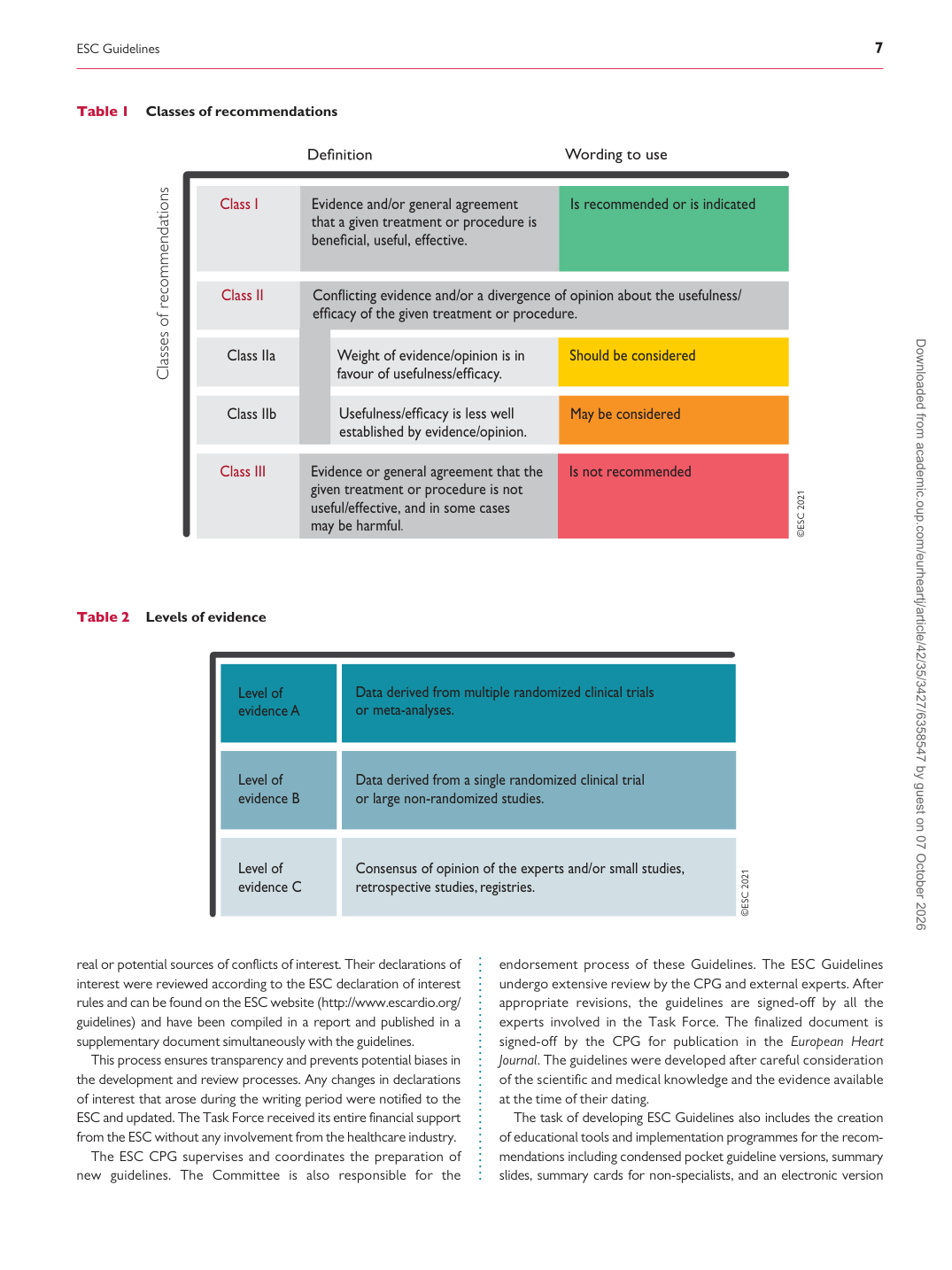
Table 1 Classes of recommendations

©ESC 2021

Classes of recommendations Class I Evidence and/or general agreement that a given treatment or procedure is Is recommended or is indicated

Wording to use

Class III Evidence or general agreement that the given treatment or procedure is not useful/effective, and in some cases may be harmful. Is not recommended

Class IIb

established by evidence/opinion. May be considered

Class IIa Weight of evidence/opinion is in Should be considered

Class II

Table 2 Levels of evidence

Level of evidence A Data derived from multiple randomized clinical trials or meta-analyses.

Level of evidence B Data derived from a single randomized clinical trial or large non-randomized studies.

Level of evidence C Consensus of opinion of the experts and/or small studies, retrospective studies, registries. ©ESC 2021 Downloaded from academic.oup.com/eurheartj/article/42/35/3427/6358547 by guest on 07 October 2026