p.64 抽出テキスト
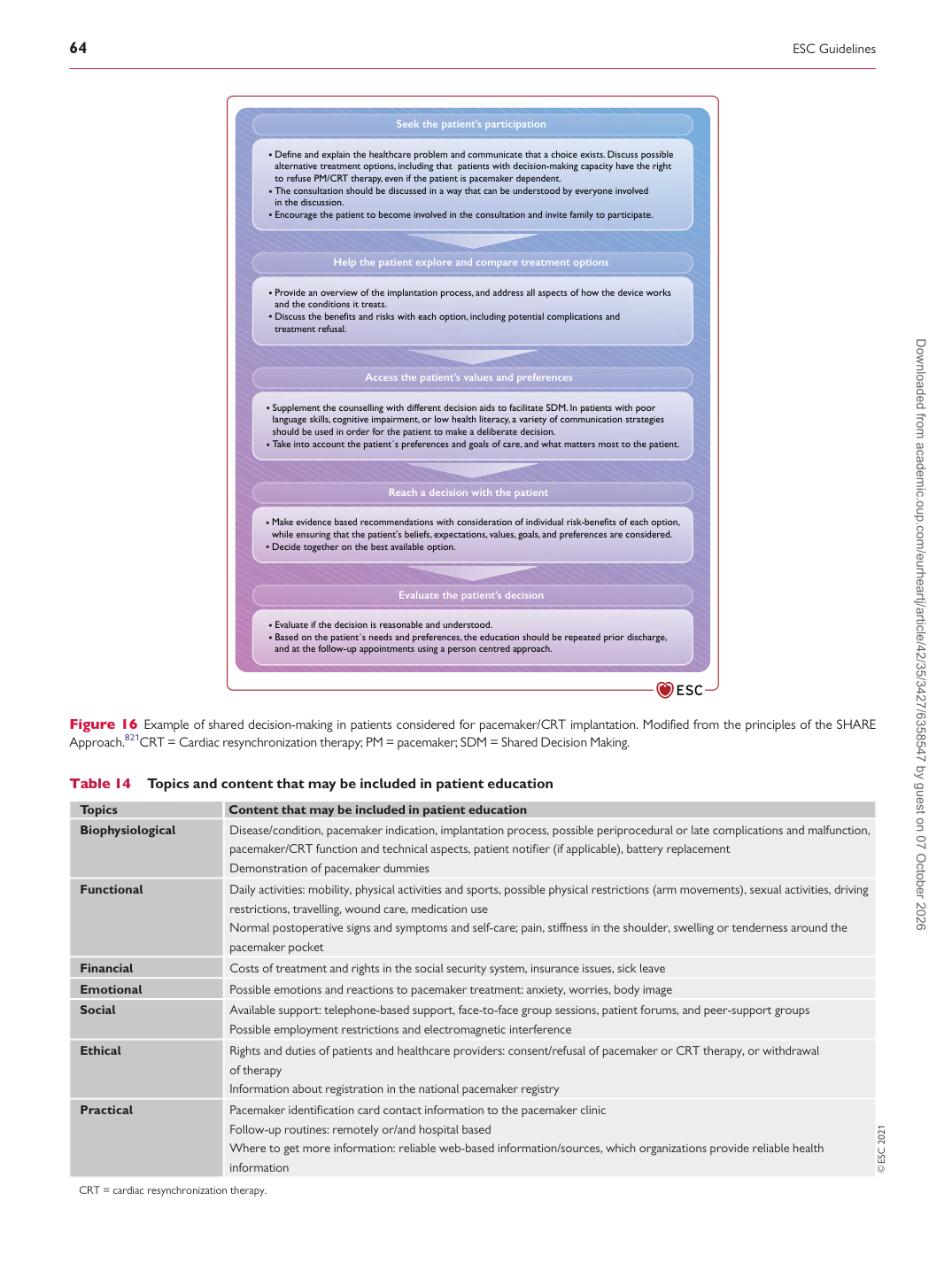
Seek the patient’s participation

Define and explain the healthcare problem and communicate that a choice exists. Discuss possible alternative treatment options, including that  patients with decision-making capacity have the right to refuse PM/CRT therapy, even if the patient is pacemaker dependent. The consultation should be discussed in a way that can be understood by everyone involved in the discussion. Encourage the patient to become involved in the consultation and invite family to participate.

Help the patient explore and compare treatment options

Provide an overview of the implantation process, and address all aspects of how the device works and the conditions it treats. Discuss the benefits and risks with each option, including potential complications and treatment refusal.

Access the patient’s values and preferences

Supplement the counselling with different decision aids to facilitate SDM. In patients with poor language skills, cognitive impairment, or low health literacy, a variety of communication strategies should be used in order for the patient to make a deliberate decision. Take into account the patient ́s preferences and goals of care, and what matters most to the patient.

Reach a decision with the patient

Make evidence based recommendations with consideration of individual risk-benefits of each option, while ensuring that the patient's beliefs, expectations, values, goals, and preferences are considered. Decide together on the best available option.

Evaluate the patient’s decision

Evaluate if the decision is reasonable and understood. Based on the patient ́s needs and preferences, the education should be repeated prior discharge, and at the follow-up appointments using a person centred approach.

Figure 16 Example of shared decision-making in patients considered for pacemaker/CRT implantation. Modified from the principles of the SHARE Approach.821CRT = Cardiac resynchronization therapy; PM = pacemaker; SDM = Shared Decision Making.

Table 14 Topics and content that may be included in patient education

Topics Content that may be included in patient education Biophysiological Disease/condition, pacemaker indication, implantation process, possible periprocedural or late complications and malfunction,

pacemaker/CRT function and technical aspects, patient notifier (if applicable), battery replacement Demonstration of pacemaker dummies

Functional Daily activities: mobility, physical activities and sports, possible physical restrictions (arm movements), sexual activities, driving

restrictions, travelling, wound care, medication use Normal postoperative signs and symptoms and self-care; pain, stiffness in the shoulder, swelling or tenderness around the pacemaker pocket

Financial Costs of treatment and rights in the social security system, insurance issues, sick leave Emotional Possible emotions and reactions to pacemaker treatment: anxiety, worries, body image Social Available support: telephone-based support, face-to-face group sessions, patient forums, and peer-support groups Possible employment restrictions and electromagnetic interference Ethical Rights and duties of patients and healthcare providers: consent/refusal of pacemaker or CRT therapy, or withdrawal

of therapy Information about registration in the national pacemaker registry

Practical Pacemaker identification card contact information to the pacemaker clinic

Follow-up routines: remotely or/and hospital based Where to get more information: reliable web-based information/sources, which organizations provide reliable health information

CRT = cardiac resynchronization therapy. ESC 2021 Downloaded from academic.oup.com/eurheartj/article/42/35/3427/6358547 by guest on 07 October 2026