p.40 抽出テキスト
...................................................................................... regurgitation, or RV systolic function is important in identifying potential non-responders that may need additional treatment (mitral valve intervention, for example).

Alternatives to conventional coronary sinus pacing for CRT (epicardial, endocardial) are described in section 6.1 in the Supplementary data.

7 Alternative pacing strategies

and sites

Alternative RV pacing sites (as opposed to RVA pacing) include pacing from the RV outflow tract (RVOT), the mid and high RV septum (RVS), HBP, para-Hisian pacing, and left bundle branch area pacing, which includes LV septal pacing and left bundle branch pacing.

7.1 Septal pacing

Since the 2013 ESC Guidelines,33 two randomized trials found no difference in clinical outcomes between RVS and RVA pacing in the setting of AVB417 or CRT,418 respectively. A meta-analysis reported an echocardiographic benefit of RVS pacing in patients with pre-existing reduced LVEF.419 In an observational study, RVS pacing was associated with a lower risk of perforation.420 However, true RVS pacing is not easily obtained and ascertained,421 and neither beneficial nor harmful effects of RVS pacing compared with RVA pacing have been shown on relevant clinical endpoints (Supplementary Table 9). Current evidence does not support systematically recommending either RVS or RVA pacing for all patients. 7.2 His bundle pacing

HBP was first reported in humans in 2000,199 and is steadily gaining interest for providing a more physiological alternative to RV pacing. It may also correct intraventricular conduction delay in a subset of patients, thereby providing an alternative to biventricular pacing for treating HF. The advent of new tools has greatly facilitated implantation, which has become routine in a growing number of centres. HBP is used in lieu of RV pacing, in lieu of biventricular pacing, and as Hisoptimized CRT (HOT-CRT),319 which exploits a synergistic effect between HBP and RV pacing, LV pacing, or biventricular pacing to improve synchrony. There is growing evidence, mainly from observational studies, that HBP may be safe and effective in these settings (Supplementary Table 10), although large RCTs and long-term followup are still lacking.422 With more data on safety and effectiveness, HBP is likely to play a growing role in pacing therapy in the future.

7.2.1 Implantation and follow-up The use of guiding catheters to deliver leads has facilitated implantation, with success rates exceeding 80%.422 In an international registry, implant success was 87% after a learning curve of 40 cases.423 Selective HBP is easily recognized by an isoelectric interval (corresponding to the HV) between the pacing spike and QRS onset, whereas with non-selective HBP, a ‘pseudo-delta’ wave is observed due to capture of local myocardium.424 In addition, correction of BBB may be observed (Figure 11). It is important to distinguish nonselective HBP from para-Hisian pacing (where there is no capture of conduction tissue) by evaluating transitions in QRS morphology by reducing pacing output or with pacing manoeuvres.425

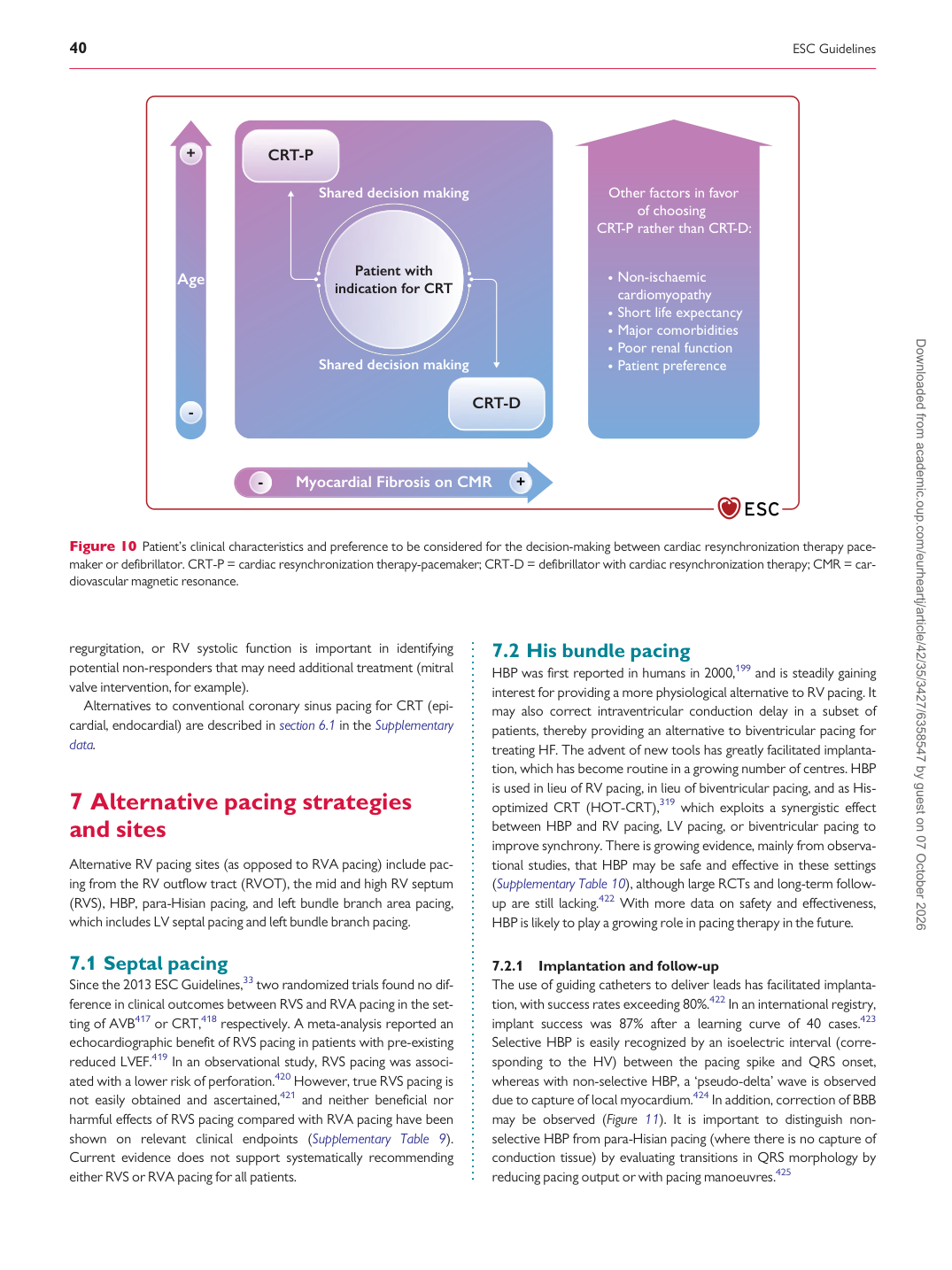
Patient with indication for CRT

CRT-P

CRT-D

+ - Myocardial Fibrosis on CMR

Age

-

+

Other factors in favor of choosing CRT-P rather than CRT-D:

Non-ischaemic cardiomyopathy Short life expectancy Major comorbidities Poor renal function Patient preference

Shared decision making

Shared decision making

Age

-

+

Figure 10 Patient’s clinical characteristics and preference to be considered for the decision-making between cardiac resynchronization therapy pacemaker or defibrillator. CRT-P = cardiac resynchronization therapy-pacemaker; CRT-D = defibrillator with cardiac resynchronization therapy; CMR = cardiovascular magnetic resonance. Downloaded from academic.oup.com/eurheartj/article/42/35/3427/6358547 by guest on 07 October 2026