p.36 抽出テキスト
............................................. hospitalization for HF and a modest improvement in LVEF compared with RV pacing, but not in 6-min walked distance and quality of life assessed by means of the Minnesota Living with Heart Failure questionnaire.315 In the APAF-CRT RCT, 102 elderly patients (mean age 72 years) with permanent AF, a narrow QRS (<_110 ms), and at least one hospitalization for HF in the previous year were randomized to AVJ ablation and CRT or to pharmacological rate control therapy.195

After a median follow-up of 16 months, the primary composite outcome of HF death, hospitalization due to HF, or worsening HF had occurred in 10 patients (20%) in the ablation (AVJ) plus CRT arm and in 20 patients (38%) in the drug control arm (HR 0.38; P = 0.013). The results were mostly driven by a reduction in hospitalization for HF. The HR was 0.18 (P = 0.01) in patients with LVEF <_35% and 0.62 (P = 0.36) in those with LVEF >35%. Furthermore, patients undergoing AVJ ablation and CRT had a 36% reduction in the specific symptoms and physical limitations of AF at 1-year follow-up (P = 0.004). In contrast to the main composite endpoint, the greatest symptomatic improvements were observed in patients with LVEF >35% (P = 0.0003).

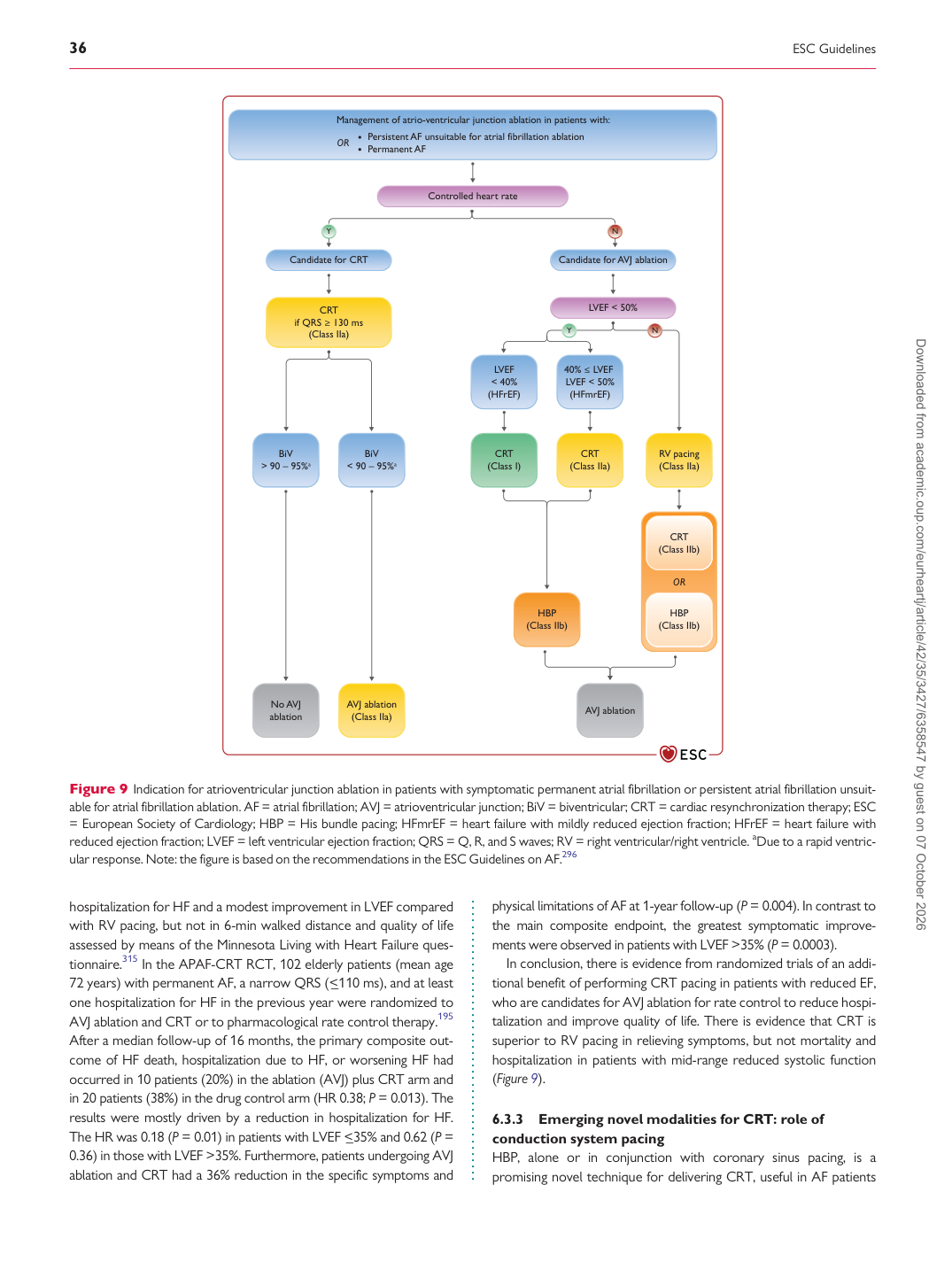
In conclusion, there is evidence from randomized trials of an additional benefit of performing CRT pacing in patients with reduced EF, who are candidates for AVJ ablation for rate control to reduce hospitalization and improve quality of life. There is evidence that CRT is superior to RV pacing in relieving symptoms, but not mortality and hospitalization in patients with mid-range reduced systolic function (Figure 9).

6.3.3 Emerging novel modalities for CRT: role of conduction system pacing HBP, alone or in conjunction with coronary sinus pacing, is a promising novel technique for delivering CRT, useful in AF patients

OR

Controlled heart rate

Candidate for CRT Candidate for AVJ ablation

Management of atrio-ventricular junction ablation in patients with:

Y N

Persistent AF unsuitable for atrial fibrillation ablation Permanent AF OR

CRT if QRS ≥ 130 ms

(Class IIa)

BiV > 90 – 95%a BiV < 90 – 95%a

No AVJ ablation AVJ ablation

(Class IIa) CRT (Class I) CRT (Class IIa) CRT (Class IIb)

LVEF < 40% (HFrEF) 40% ≤LVEF LVEF < 50%

(HFmrEF)

LVEF < 50%

HBP (Class IIb)

AVJ ablation

Y N

RV pacing (Class IIa)

HBP (Class IIb)

Figure 9 Indication for atrioventricular junction ablation in patients with symptomatic permanent atrial fibrillation or persistent atrial fibrillation unsuitable for atrial fibrillation ablation. AF = atrial fibrillation; AVJ = atrioventricular junction; BiV = biventricular; CRT = cardiac resynchronization therapy; ESC = European Society of Cardiology; HBP = His bundle pacing; HFmrEF = heart failure with mildly reduced ejection fraction; HFrEF = heart failure with reduced ejection fraction; LVEF = left ventricular ejection fraction; QRS = Q, R, and S waves; RV = right ventricular/right ventricle. aDue to a rapid ventricular response. Note: the figure is based on the recommendations in the ESC Guidelines on AF.296 Downloaded from academic.oup.com/eurheartj/article/42/35/3427/6358547 by guest on 07 October 2026