p.12 抽出テキスト
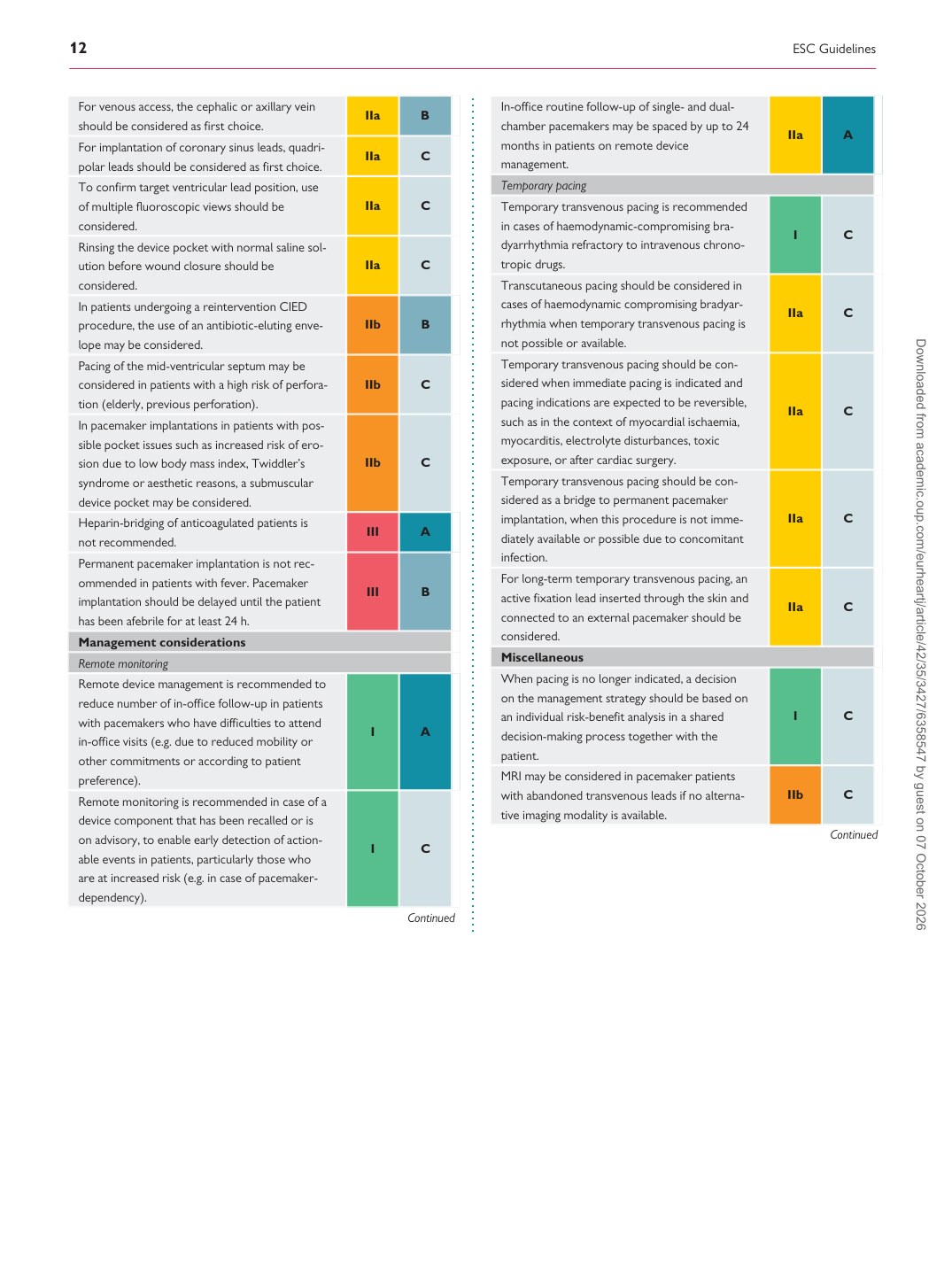
For venous access, the cephalic or axillary vein should be considered as first choice. IIa B For implantation of coronary sinus leads, quadripolar leads should be considered as first choice. IIa C To confirm target ventricular lead position, use of multiple fluoroscopic views should be considered. IIa C Rinsing the device pocket with normal saline solution before wound closure should be considered. IIa C In patients undergoing a reintervention CIED procedure, the use of an antibiotic-eluting envelope may be considered. IIb B Pacing of the mid-ventricular septum may be considered in patients with a high risk of perforation (elderly, previous perforation). IIb C In pacemaker implantations in patients with possible pocket issues such as increased risk of erosion due to low body mass index, Twiddler’s syndrome or aesthetic reasons, a submuscular device pocket may be considered. IIb C Heparin-bridging of anticoagulated patients is not recommended. III A Permanent pacemaker implantation is not recommended in patients with fever. Pacemaker implantation should be delayed until the patient has been afebrile for at least 24 h. III B Management considerations Remote monitoring Remote device management is recommended to reduce number of in-office follow-up in patients with pacemakers who have difficulties to attend in-office visits (e.g. due to reduced mobility or other commitments or according to patient preference). I A Remote monitoring is recommended in case of a device component that has been recalled or is on advisory, to enable early detection of actionable events in patients, particularly those who are at increased risk (e.g. in case of pacemakerdependency). I C

Continued In-office routine follow-up of single- and dual-

chamber pacemakers may be spaced by up to 24 months in patients on remote device management. IIa A Temporary pacing Temporary transvenous pacing is recommended in cases of haemodynamic-compromising bradyarrhythmia refractory to intravenous chronotropic drugs. I C Transcutaneous pacing should be considered in cases of haemodynamic compromising bradyarrhythmia when temporary transvenous pacing is not possible or available. IIa C Temporary transvenous pacing should be considered when immediate pacing is indicated and pacing indications are expected to be reversible, such as in the context of myocardial ischaemia, myocarditis, electrolyte disturbances, toxic exposure, or after cardiac surgery. IIa C Temporary transvenous pacing should be considered as a bridge to permanent pacemaker implantation, when this procedure is not immediately available or possible due to concomitant infection. IIa C For long-term temporary transvenous pacing, an active fixation lead inserted through the skin and connected to an external pacemaker should be considered. IIa C Miscellaneous When pacing is no longer indicated, a decision on the management strategy should be based on an individual risk-benefit analysis in a shared decision-making process together with the patient. I C MRI may be considered in pacemaker patients with abandoned transvenous leads if no alternative imaging modality is available. IIb C

Continued

..................................................................................................................................... Downloaded from academic.oup.com/eurheartj/article/42/35/3427/6358547 by guest on 07 October 2026