p.11 抽出テキスト
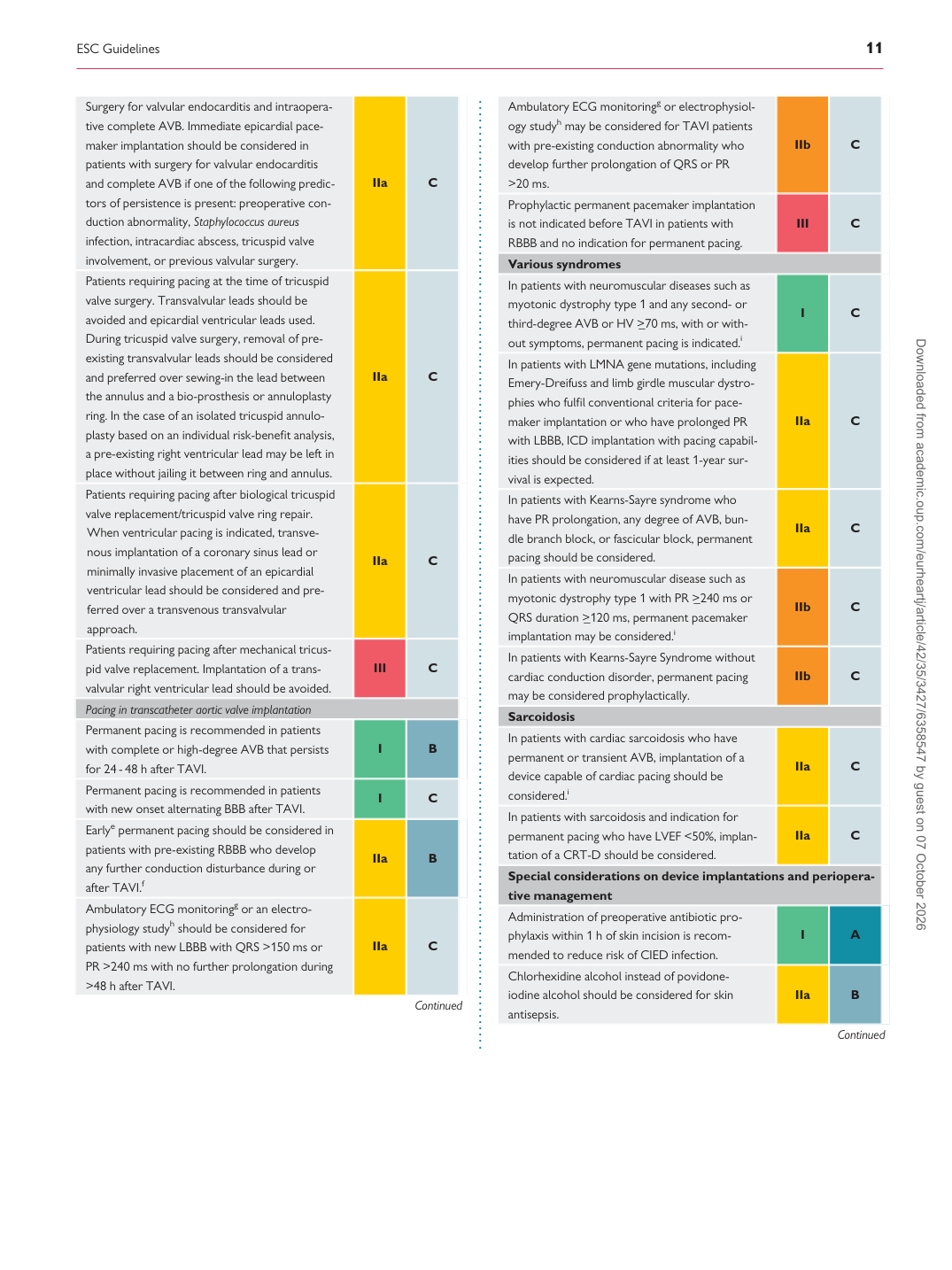
Surgery for valvular endocarditis and intraoperative complete AVB. Immediate epicardial pacemaker implantation should be considered in patients with surgery for valvular endocarditis and complete AVB if one of the following predictors of persistence is present: preoperative conduction abnormality, Staphylococcus aureus infection, intracardiac abscess, tricuspid valve involvement, or previous valvular surgery. IIa C Patients requiring pacing at the time of tricuspid valve surgery. Transvalvular leads should be avoided and epicardial ventricular leads used. During tricuspid valve surgery, removal of preexisting transvalvular leads should be considered and preferred over sewing-in the lead between the annulus and a bio-prosthesis or annuloplasty ring. In the case of an isolated tricuspid annuloplasty based on an individual risk-benefit analysis, a pre-existing right ventricular lead may be left in place without jailing it between ring and annulus. IIa C Patients requiring pacing after biological tricuspid valve replacement/tricuspid valve ring repair. When ventricular pacing is indicated, transvenous implantation of a coronary sinus lead or minimally invasive placement of an epicardial ventricular lead should be considered and preferred over a transvenous transvalvular approach. IIa C Patients requiring pacing after mechanical tricuspid valve replacement. Implantation of a transvalvular right ventricular lead should be avoided. III C Pacing in transcatheter aortic valve implantation Permanent pacing is recommended in patients with complete or high-degree AVB that persists for 24 - 48 h after TAVI. I B Permanent pacing is recommended in patients with new onset alternating BBB after TAVI. I C Earlye permanent pacing should be considered in patients with pre-existing RBBB who develop any further conduction disturbance during or after TAVI.f IIa B Ambulatory ECG monitoringg or an electrophysiology studyh should be considered for patients with new LBBB with QRS >150 ms or PR >240 ms with no further prolongation during >48 h after TAVI. IIa C

Continued Ambulatory ECG monitoringg or electrophysiol-

ogy studyh may be considered for TAVI patients with pre-existing conduction abnormality who develop further prolongation of QRS or PR >20 ms. IIb C Prophylactic permanent pacemaker implantation is not indicated before TAVI in patients with RBBB and no indication for permanent pacing. III C Various syndromes In patients with neuromuscular diseases such as myotonic dystrophy type 1 and any second- or third-degree AVB or HV >_70 ms, with or without symptoms, permanent pacing is indicated.i I C In patients with LMNA gene mutations, including Emery-Dreifuss and limb girdle muscular dystrophies who fulfil conventional criteria for pacemaker implantation or who have prolonged PR with LBBB, ICD implantation with pacing capabilities should be considered if at least 1-year survival is expected. IIa C In patients with Kearns-Sayre syndrome who have PR prolongation, any degree of AVB, bundle branch block, or fascicular block, permanent pacing should be considered. IIa C In patients with neuromuscular disease such as myotonic dystrophy type 1 with PR >_240 ms or QRS duration >_120 ms, permanent pacemaker implantation may be considered.i IIb C In patients with Kearns-Sayre Syndrome without cardiac conduction disorder, permanent pacing may be considered prophylactically. IIb C Sarcoidosis In patients with cardiac sarcoidosis who have permanent or transient AVB, implantation of a device capable of cardiac pacing should be considered.i IIa C In patients with sarcoidosis and indication for permanent pacing who have LVEF <50%, implantation of a CRT-D should be considered. IIa C Special considerations on device implantations and perioperative management Administration of preoperative antibiotic prophylaxis within 1 h of skin incision is recommended to reduce risk of CIED infection. I A Chlorhexidine alcohol instead of povidoneiodine alcohol should be considered for skin antisepsis. IIa B

Continued ....................................................................................................................................................... Downloaded from academic.oup.com/eurheartj/article/42/35/3427/6358547 by guest on 07 October 2026