p.10 抽出テキスト
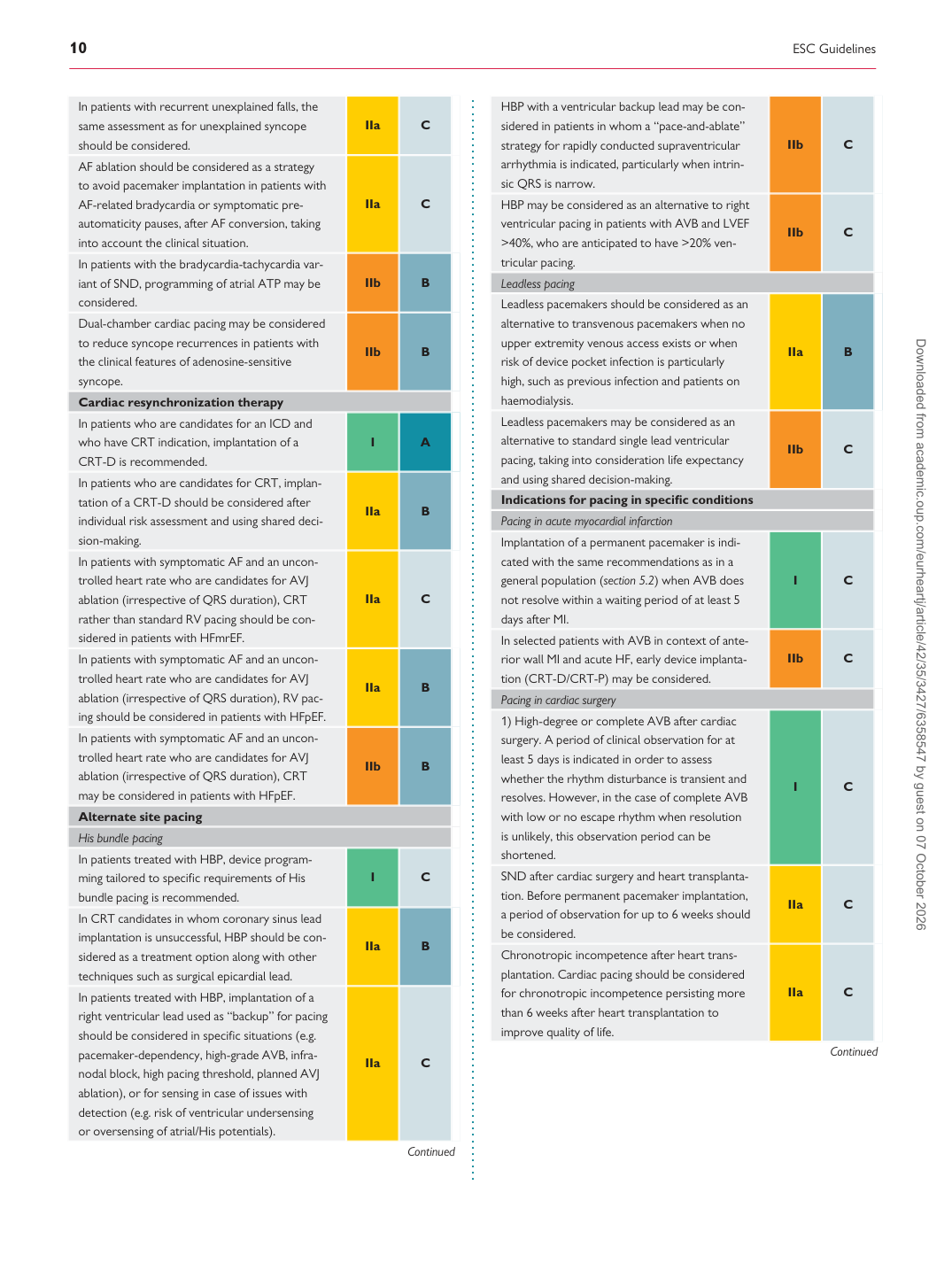
In patients with recurrent unexplained falls, the same assessment as for unexplained syncope should be considered. IIa C AF ablation should be considered as a strategy to avoid pacemaker implantation in patients with AF-related bradycardia or symptomatic preautomaticity pauses, after AF conversion, taking into account the clinical situation. IIa C In patients with the bradycardia-tachycardia variant of SND, programming of atrial ATP may be considered. IIb B Dual-chamber cardiac pacing may be considered to reduce syncope recurrences in patients with the clinical features of adenosine-sensitive syncope. IIb B Cardiac resynchronization therapy In patients who are candidates for an ICD and who have CRT indication, implantation of a CRT-D is recommended. I A In patients who are candidates for CRT, implantation of a CRT-D should be considered after individual risk assessment and using shared decision-making. IIa B In patients with symptomatic AF and an uncontrolled heart rate who are candidates for AVJ ablation (irrespective of QRS duration), CRT rather than standard RV pacing should be considered in patients with HFmrEF. IIa C In patients with symptomatic AF and an uncontrolled heart rate who are candidates for AVJ ablation (irrespective of QRS duration), RV pacing should be considered in patients with HFpEF. IIa B In patients with symptomatic AF and an uncontrolled heart rate who are candidates for AVJ ablation (irrespective of QRS duration), CRT may be considered in patients with HFpEF. IIb B Alternate site pacing His bundle pacing In patients treated with HBP, device programming tailored to specific requirements of His bundle pacing is recommended. I C In CRT candidates in whom coronary sinus lead implantation is unsuccessful, HBP should be considered as a treatment option along with other techniques such as surgical epicardial lead. IIa B In patients treated with HBP, implantation of a right ventricular lead used as “backup” for pacing should be considered in specific situations (e.g. pacemaker-dependency, high-grade AVB, infranodal block, high pacing threshold, planned AVJ ablation), or for sensing in case of issues with detection (e.g. risk of ventricular undersensing or oversensing of atrial/His potentials). IIa C

Continued HBP with a ventricular backup lead may be con-

sidered in patients in whom a “pace-and-ablate” strategy for rapidly conducted supraventricular arrhythmia is indicated, particularly when intrinsic QRS is narrow. IIb C HBP may be considered as an alternative to right ventricular pacing in patients with AVB and LVEF >40%, who are anticipated to have >20% ventricular pacing. IIb C Leadless pacing Leadless pacemakers should be considered as an alternative to transvenous pacemakers when no upper extremity venous access exists or when risk of device pocket infection is particularly high, such as previous infection and patients on haemodialysis. IIa B Leadless pacemakers may be considered as an alternative to standard single lead ventricular pacing, taking into consideration life expectancy and using shared decision-making. IIb C Indications for pacing in specific conditions Pacing in acute myocardial infarction Implantation of a permanent pacemaker is indicated with the same recommendations as in a general population (section 5.2) when AVB does not resolve within a waiting period of at least 5 days after MI. I C In selected patients with AVB in context of anterior wall MI and acute HF, early device implantation (CRT-D/CRT-P) may be considered. IIb C Pacing in cardiac surgery 1) High-degree or complete AVB after cardiac surgery. A period of clinical observation for at least 5 days is indicated in order to assess whether the rhythm disturbance is transient and resolves. However, in the case of complete AVB with low or no escape rhythm when resolution is unlikely, this observation period can be shortened. I C SND after cardiac surgery and heart transplantation. Before permanent pacemaker implantation, a period of observation for up to 6 weeks should be considered. IIa C Chronotropic incompetence after heart transplantation. Cardiac pacing should be considered for chronotropic incompetence persisting more than 6 weeks after heart transplantation to improve quality of life. IIa C

Continued

............................................................................................................................................................................ Downloaded from academic.oup.com/eurheartj/article/42/35/3427/6358547 by guest on 07 October 2026