p.95 抽出テキスト
.................................... 18 Quality indicators

QIs are tools that may be used to evaluate care quality, including that of processes of care and clinical outcomes.995 They may also serve as a mechanism for enhancing adherence to guideline recommendations, through quality assurance endeavours and benchmarking of care providers.996 As such, the role of QIs in driving quality improvement is increasingly recognized and attracts interest from healthcare authorities, professional organizations, payers, and the public.997 The ESC recognizes the need for measuring and reporting quality and outcomes of CV care. The methodology by which the ESC QIs are developed has been published997 and, to date, a suite of QIs for an initial tranche of CV conditions has been produced.998,999 To facilitate quality improvement initiatives, the disease-specific ESC QIs are included in corresponding ESC Clinical Practice Guidelines.7,1000 This is further enhanced by way of their integration in the ESC registries, such as the EURObservational Research Programme (EORP) and the European Unified Registries On Heart Care Evaluation and Randomized Trials (EuroHeart) project.1001

For patients with HF, QIs may help healthcare providers to simultaneously operationalize discrete guideline recommendations and enable the discrimination between missed opportunities and appropriate care. Furthermore, QIs allow the capture of patients’

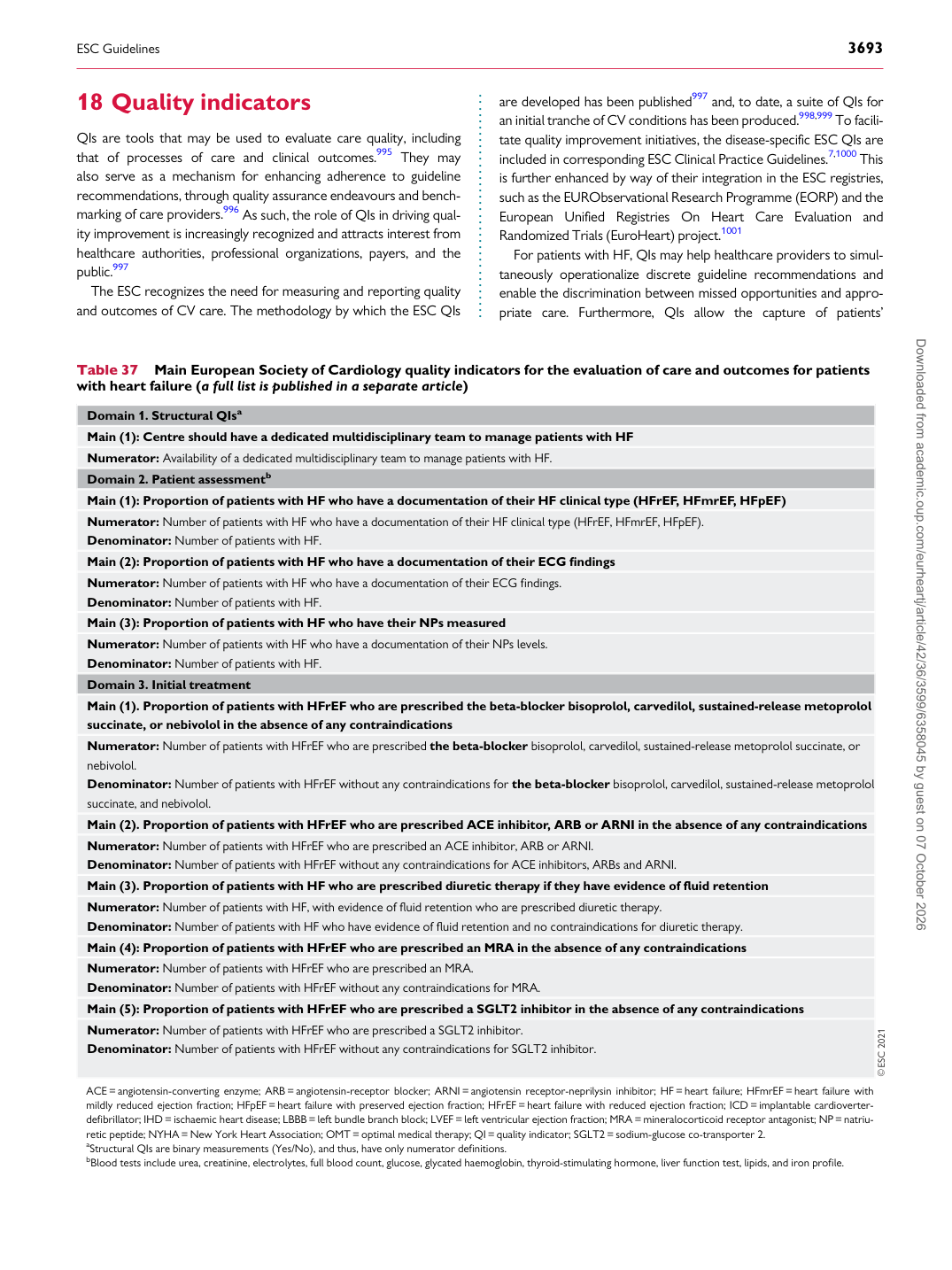
Table 37 Main European Society of Cardiology quality indicators for the evaluation of care and outcomes for patients with heart failure (a full list is published in a separate article)

Domain 1. Structural QIsa Main (1): Centre should have a dedicated multidisciplinary team to manage patients with HF Numerator: Availability of a dedicated multidisciplinary team to manage patients with HF. Domain 2. Patient assessmentb Main (1): Proportion of patients with HF who have a documentation of their HF clinical type (HFrEF, HFmrEF, HFpEF) Numerator: Number of patients with HF who have a documentation of their HF clinical type (HFrEF, HFmrEF, HFpEF). Denominator: Number of patients with HF. Main (2): Proportion of patients with HF who have a documentation of their ECG findings Numerator: Number of patients with HF who have a documentation of their ECG findings. Denominator: Number of patients with HF. Main (3): Proportion of patients with HF who have their NPs measured Numerator: Number of patients with HF who have a documentation of their NPs levels. Denominator: Number of patients with HF. Domain 3. Initial treatment Main (1). Proportion of patients with HFrEF who are prescribed the beta-blocker bisoprolol, carvedilol, sustained-release metoprolol succinate, or nebivolol in the absence of any contraindications Numerator: Number of patients with HFrEF who are prescribed the beta-blocker bisoprolol, carvedilol, sustained-release metoprolol succinate, or nebivolol. Denominator: Number of patients with HFrEF without any contraindications for the beta-blocker bisoprolol, carvedilol, sustained-release metoprolol succinate, and nebivolol. Main (2). Proportion of patients with HFrEF who are prescribed ACE inhibitor, ARB or ARNI in the absence of any contraindications Numerator: Number of patients with HFrEF who are prescribed an ACE inhibitor, ARB or ARNI. Denominator: Number of patients with HFrEF without any contraindications for ACE inhibitors, ARBs and ARNI. Main (3). Proportion of patients with HF who are prescribed diuretic therapy if they have evidence of fluid retention Numerator: Number of patients with HF, with evidence of fluid retention who are prescribed diuretic therapy. Denominator: Number of patients with HF who have evidence of fluid retention and no contraindications for diuretic therapy. Main (4): Proportion of patients with HFrEF who are prescribed an MRA in the absence of any contraindications Numerator: Number of patients with HFrEF who are prescribed an MRA. Denominator: Number of patients with HFrEF without any contraindications for MRA. Main (5): Proportion of patients with HFrEF who are prescribed a SGLT2 inhibitor in the absence of any contraindications Numerator: Number of patients with HFrEF who are prescribed a SGLT2 inhibitor. Denominator: Number of patients with HFrEF without any contraindications for SGLT2 inhibitor.

ACE = angiotensin-converting enzyme; ARB = angiotensin-receptor blocker; ARNI = angiotensin receptor-neprilysin inhibitor; HF = heart failure; HFmrEF = heart failure with mildly reduced ejection fraction; HFpEF = heart failure with preserved ejection fraction; HFrEF = heart failure with reduced ejection fraction; ICD = implantable cardioverterdefibrillator; IHD = ischaemic heart disease; LBBB = left bundle branch block; LVEF = left ventricular ejection fraction; MRA = mineralocorticoid receptor antagonist; NP = natriuretic peptide; NYHA = New York Heart Association; OMT = optimal medical therapy; QI = quality indicator; SGLT2 = sodium-glucose co-transporter 2. aStructural QIs are binary measurements (Yes/No), and thus, have only numerator definitions. bBlood tests include urea, creatinine, electrolytes, full blood count, glucose, glycated haemoglobin, thyroid-stimulating hormone, liver function test, lipids, and iron profile. ESC 2021 Downloaded from academic.oup.com/eurheartj/article/42/36/3599/6358045 by guest on 07 October 2026