p.33 抽出テキスト
....................................................................................................... This simplified diagnostic approach starts with assessment of pretest probability (see clinical characteristics above). The diagnosis should include the following:

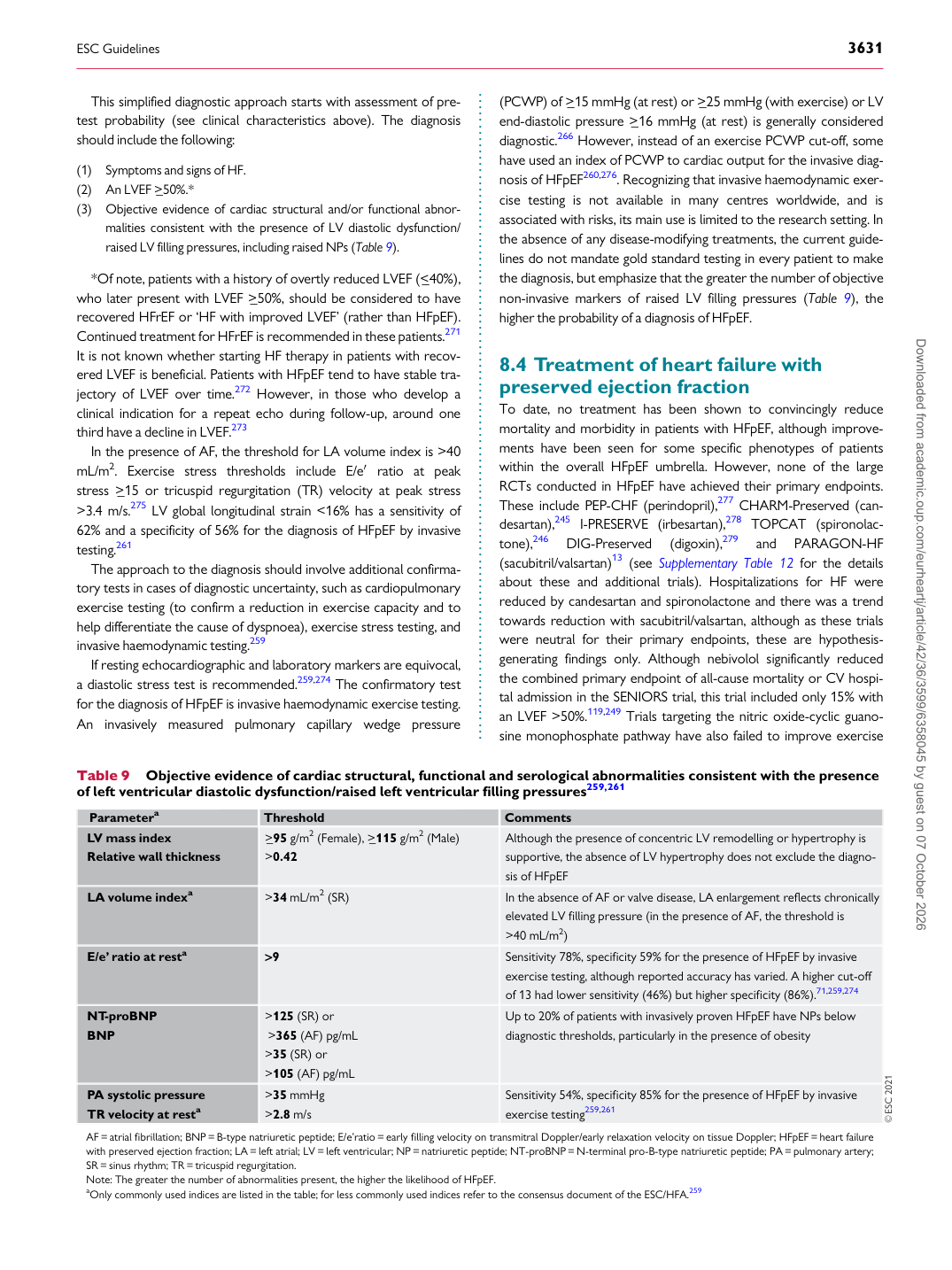
(1) Symptoms and signs of HF. (2) An LVEF >_50%.* (3) Objective evidence of cardiac structural and/or functional abnormalities consistent with the presence of LV diastolic dysfunction/ raised LV filling pressures, including raised NPs (Table 9).

*Of note, patients with a history of overtly reduced LVEF (<_40%), who later present with LVEF >_50%, should be considered to have recovered HFrEF or ‘HF with improved LVEF’ (rather than HFpEF). Continued treatment for HFrEF is recommended in these patients.271 It is not known whether starting HF therapy in patients with recovered LVEF is beneficial. Patients with HFpEF tend to have stable trajectory of LVEF over time.272 However, in those who develop a clinical indication for a repeat echo during follow-up, around one third have a decline in LVEF.273 In the presence of AF, the threshold for LA volume index is >40 mL/m2. Exercise stress thresholds include E/e0 ratio at peak stress >_15 or tricuspid regurgitation (TR) velocity at peak stress >3.4 m/s.275 LV global longitudinal strain <16% has a sensitivity of 62% and a specificity of 56% for the diagnosis of HFpEF by invasive testing.261 The approach to the diagnosis should involve additional confirmatory tests in cases of diagnostic uncertainty, such as cardiopulmonary exercise testing (to confirm a reduction in exercise capacity and to help differentiate the cause of dyspnoea), exercise stress testing, and invasive haemodynamic testing.259 If resting echocardiographic and laboratory markers are equivocal, a diastolic stress test is recommended.259,274 The confirmatory test for the diagnosis of HFpEF is invasive haemodynamic exercise testing. An invasively measured pulmonary capillary wedge pressure (PCWP) of >_15 mmHg (at rest) or >_25 mmHg (with exercise) or LV end-diastolic pressure >_16 mmHg (at rest) is generally considered diagnostic.266 However, instead of an exercise PCWP cut-off, some have used an index of PCWP to cardiac output for the invasive diagnosis of HFpEF260,276. Recognizing that invasive haemodynamic exercise testing is not available in many centres worldwide, and is associated with risks, its main use is limited to the research setting. In the absence of any disease-modifying treatments, the current guidelines do not mandate gold standard testing in every patient to make the diagnosis, but emphasize that the greater the number of objective non-invasive markers of raised LV filling pressures (Table 9), the higher the probability of a diagnosis of HFpEF.

8.4 Treatment of heart failure with

preserved ejection fraction To date, no treatment has been shown to convincingly reduce mortality and morbidity in patients with HFpEF, although improvements have been seen for some specific phenotypes of patients within the overall HFpEF umbrella. However, none of the large RCTs conducted in HFpEF have achieved their primary endpoints. These include PEP-CHF (perindopril),277 CHARM-Preserved (candesartan),245 I-PRESERVE (irbesartan),278 TOPCAT (spironolactone),246 DIG-Preserved (digoxin),279 and PARAGON-HF (sacubitril/valsartan)13 (see Supplementary Table 12 for the details about these and additional trials). Hospitalizations for HF were reduced by candesartan and spironolactone and there was a trend towards reduction with sacubitril/valsartan, although as these trials were neutral for their primary endpoints, these are hypothesisgenerating findings only. Although nebivolol significantly reduced the combined primary endpoint of all-cause mortality or CV hospital admission in the SENIORS trial, this trial included only 15% with an LVEF >50%.119,249 Trials targeting the nitric oxide-cyclic guanosine monophosphate pathway have also failed to improve exercise

Table 9 Objective evidence of cardiac structural, functional and serological abnormalities consistent with the presence of left ventricular diastolic dysfunction/raised left ventricular filling pressures259,261

Parametera Threshold Comments LV mass index Relative wall thickness >_95 g/m2 (Female), >_115 g/m2 (Male)

>0.42 Although the presence of concentric LV remodelling or hypertrophy is

supportive, the absence of LV hypertrophy does not exclude the diagnosis of HFpEF

LA volume indexa >34 mL/m2 (SR) In the absence of AF or valve disease, LA enlargement reflects chronically

elevated LV filling pressure (in the presence of AF, the threshold is >40 mL/m2)

E/e’ ratio at resta >9 Sensitivity 78%, specificity 59% for the presence of HFpEF by invasive

exercise testing, although reported accuracy has varied. A higher cut-off of 13 had lower sensitivity (46%) but higher specificity (86%).71,259,274

NT-proBNP BNP >125 (SR) or

>365 (AF) pg/mL >35 (SR) or >105 (AF) pg/mL Up to 20% of patients with invasively proven HFpEF have NPs below

diagnostic thresholds, particularly in the presence of obesity

PA systolic pressure TR velocity at resta >35 mmHg

>2.8 m/s Sensitivity 54%, specificity 85% for the presence of HFpEF by invasive

exercise testing259,261

AF = atrial fibrillation; BNP = B-type natriuretic peptide; E/e’ratio = early filling velocity on transmitral Doppler/early relaxation velocity on tissue Doppler; HFpEF = heart failure with preserved ejection fraction; LA = left atrial; LV = left ventricular; NP = natriuretic peptide; NT-proBNP = N-terminal pro-B-type natriuretic peptide; PA = pulmonary artery; SR = sinus rhythm; TR = tricuspid regurgitation. Note: The greater the number of abnormalities present, the higher the likelihood of HFpEF. aOnly commonly used indices are listed in the table; for less commonly used indices refer to the consensus document of the ESC/HFA.259 ESC 2021 Downloaded from academic.oup.com/eurheartj/article/42/36/3599/6358045 by guest on 07 October 2026