p.7 抽出テキスト
.................................. experts involved in the Task Force. The finalized document is approved by the CPG for publication in the European Heart Journal. The Guidelines were developed after careful consideration of the scientific and medical knowledge and the evidence available at the time of their dating.

The task of developing ESC Guidelines also includes the creation of educational tools and implementation programmes for the recommendations including condensed pocket guideline versions, summary slides, booklets with essential messages, summary cards for non-specialists and an electronic version for digital applications (smartphones, etc.). These versions are abridged and thus, for more detailed information, the user should always access to the full text version of the Guidelines, which is freely available via the ESC website and hosted on the EHJ website. The National Cardiac Societies of the ESC are encouraged to endorse, adopt, translate and implement all ESC Guidelines. Implementation programmes are needed because it has been shown that the outcome of disease may be favourably influenced by the thorough application of clinical recommendations.

Health professionals are encouraged to take the ESC Guidelines fully into account when exercising their clinical judgment, as well as in the determination and the implementation of preventive, diagnostic

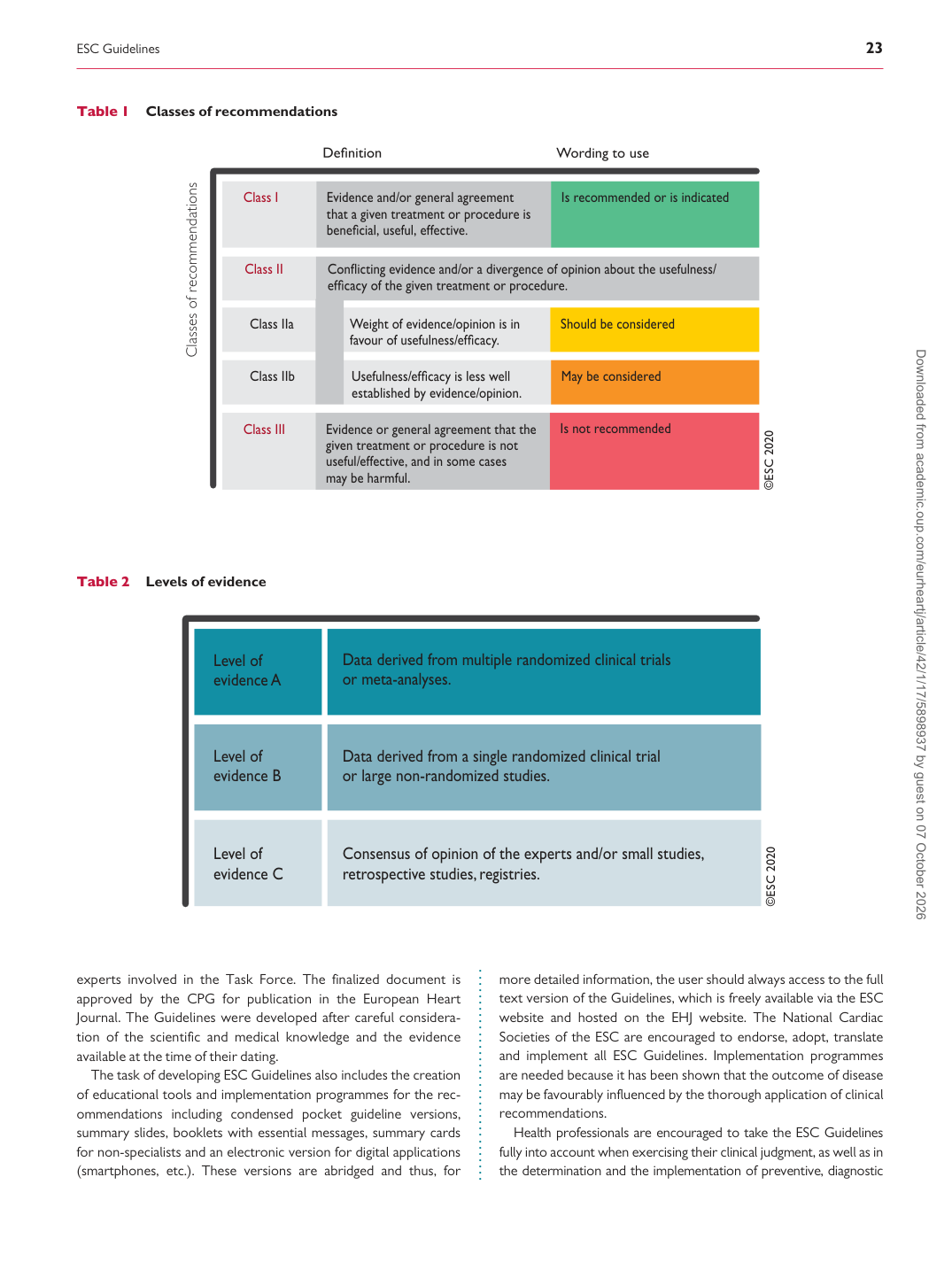
Table 1 Classes of recommendations

Classes of recommendations Class I Evidence and/or general agreement that a given treatment or procedure is Is recommended or is indicated

Wording to use

Class III Evidence or general agreement that the given treatment or procedure is not useful/effective, and in some cases may be harmful. Is not recommended

Class IIb

established by evidence/opinion. May be considered

Class IIa Weight of evidence/opinion is in Should be considered

Class II

©ESC 2020

Table 2 Levels of evidence

Level of evidence A Data derived from multiple randomized clinical trials or meta-analyses.

Level of evidence B Data derived from a single randomized clinical trial or large non-randomized studies.

Level of evidence C Consensus of opinion of the experts and/or small studies, retrospective studies, registries. ©ESC 2020 Downloaded from academic.oup.com/eurheartj/article/42/1/17/5898937 by guest on 07 October 2026