p.50 抽出テキスト
........................................................................................................................................................ Of note, exercise-induced isolated or repetitive PVCs with multiple morphologies, especially with beat-to-beat alternating morphologies (so-called ‘bi-directional’ pattern), may be the expression of catecholaminergic polymorphic VT, which can degenerate into VF.518,521

5.6.4.4 Practical management of cardiac patients with premature ventricular contractions or non-sustained ventricular tachycardia who want to engage in sports The most important task in individuals with PVCs or NSVT who want to engage in sports is to exclude underlying structural or familial arrhythmogenic conditions, since sports activity may trigger sustained VT. It has been suggested that the presence of >_2 PVCs on a baseline ECG (or even >_1 PVC in the case of high-endurance athletes) should prompt a more thorough evaluation.522Work-up includes a family history, assessment of the number, morphology, and complexity of PVCs by Holter and 12-lead ECG, inducibility by exertion (via exercise test or long-term ECG recording during sports activities), and tailored additional imaging.1 Further diagnostic evaluation with molecular genetic testing may be indicated in selected cases if the suspicion for familial disease is high. Finally, repeat evaluation may be needed after 6 months to 2 years. Recommendations for sports participation of athletes with PVC should be individualized based on evaluation for underlying cardiac conditions as described earlier, and often requires shared decision making. 5.6.5 Long QT syndrome The QT and corrected QTc intervals vary by sex and physical training. Congenital long QT syndrome (LQTS) should be distinguished from acquired forms, i.e. due to circumstances, which can be reversed and prevented. Once acquired LQTS is established, sports activity should be prohibited until the underlying cause is corrected.

A definitive diagnosis of congenital LQTS is often difficult.523 Congenital LQTS should be suspected on a routine ECG or 4 min into recovery after an exercise stress test,524 if the corrected QTc interval according to Bazett’s formula is >_470 ms or >_480 ms in asymptomatic male or female athletes, respectively.525 A QTc of >_500 ms is diagnostic.526 In the case of a borderline long QTc interval and a negative personal and familial history, subclinical arrhythmias should be excluded by exercise testing and long-term ECG recording. Since the risk of cardiac events during sports activities is largely gene-specific, genetic testing and cascade screening of family members should be performed following a clinical diagnosis of LQTS. Individuals with LQT1 are at highest risk during stressful exercise.527,528 Symptomatic athletes should not engage in competitive sports. Individuals with LQT1 should not engage in sports that involve diving into cold water since this is associated with increased risk of arrhythmias. General precautions include avoidance of QTprolonging drugs, dehydration, and electrolyte imbalance. Betablocker therapy is extremely effective in LQT1 and additional therapies are only needed to control more severe cases or specific genotypes.529 Survivors of SCA (certainly while taking beta-blocker therapy) should be referred for an ICD. Similarly, individuals who have experienced sudden syncope despite beta-blocker therapy should also be referred for an ICD or sympathetic cardiac denervation.530 ICD implantation does not constitute clearance for intensive or competitive sports. Continued sports participation with an ICD is possible, but specific recommendations apply (see section 5.5.6). American guidelines are more lenient with respect to participation in competitive sport (except for LQT1), provided that precautions include the presence of an automatic external defibrillator (AED) ‘as part of the athlete’s personal sports safety gear’.531 We consider such obligation to be impractical (e.g. winter sports, water sports), and it places an added responsibility on clubs or other bystanders, which cannot be justified by a medical recommendation for an individual athlete. Moreover, although LQTS-related cardiac arrest is uncommon, even during competitive sports,527 AED efficacy is not 100% in such cases.532 In asymptomatic LQTS mutation carriers without a prolonged QT interval, i.e. <470 ms in men and <480 ms in women (‘genotype positive/phenotype negative’), shared decision making is required, balancing the risk for arrhythmias with psychological well-being. A negative exercise stress test has no predictive value.

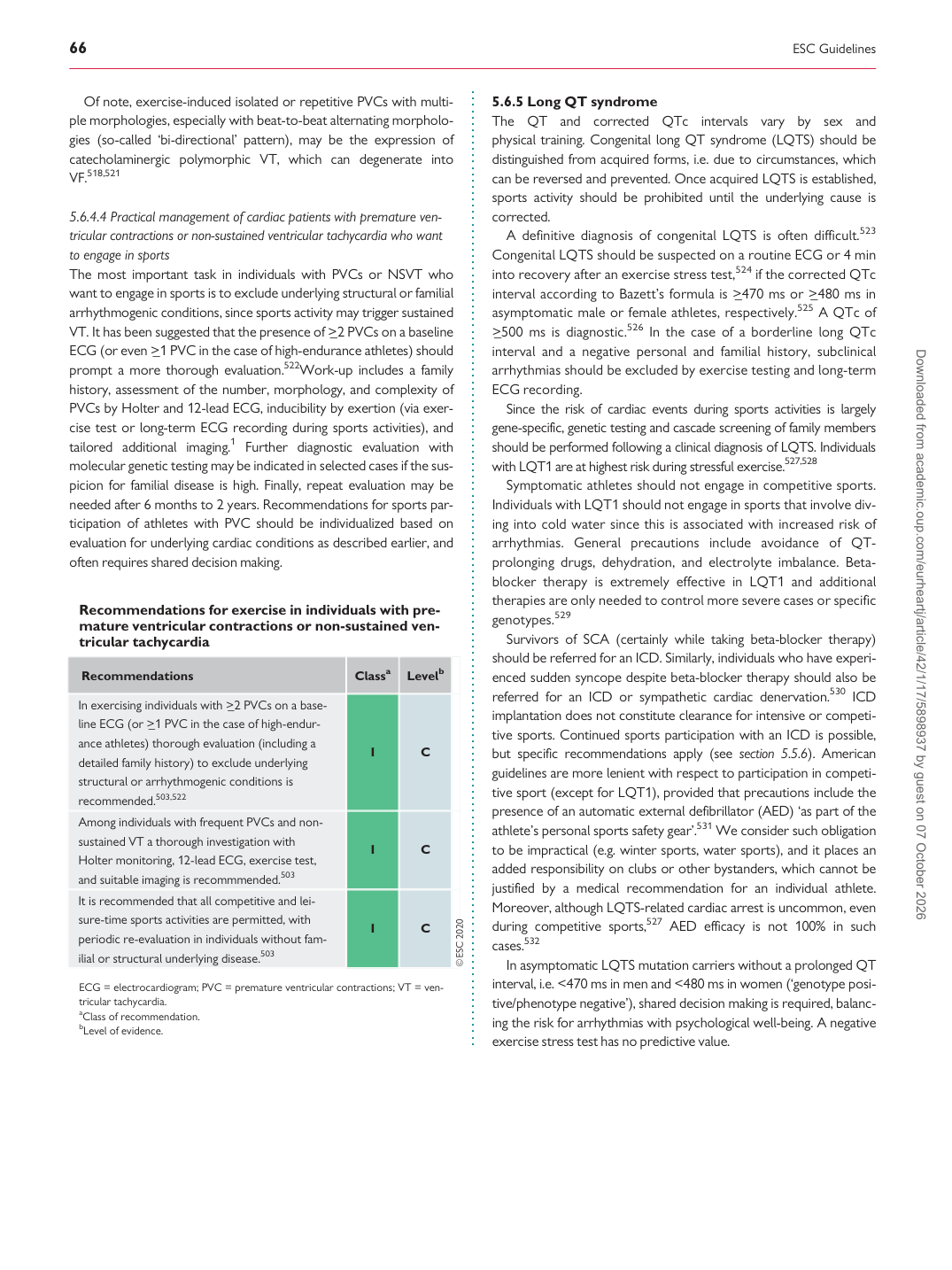
Recommendations for exercise in individuals with premature ventricular contractions or non-sustained ventricular tachycardia

Recommendations Classa Levelb

In exercising individuals with >_2 PVCs on a baseline ECG (or >_1 PVC in the case of high-endurance athletes) thorough evaluation (including a detailed family history) to exclude underlying structural or arrhythmogenic conditions is recommended.503,522 I C Among individuals with frequent PVCs and nonsustained VT a thorough investigation with Holter monitoring, 12-lead ECG, exercise test, and suitable imaging is recommmended.503 I C It is recommended that all competitive and leisure-time sports activities are permitted, with periodic re-evaluation in individuals without familial or structural underlying disease.503 I C

ECG = electrocardiogram; PVC = premature ventricular contractions; VT = ventricular tachycardia. aClass of recommendation. bLevel of evidence. Downloaded from academic.oup.com/eurheartj/article/42/1/17/5898937 by guest on 07 October 2026