p.35 抽出テキスト
................................. 5.3.5 Primary mitral regurgitation Most individuals with mitral valve disease have primary mitral regurgitation (MR) from myxomatous disease.326 MR is confirmed and quantified by echocardiography. General recommendations regarding exercise and sports are based on symptomatic status, severity of MR, LV function, systolic pulmonary artery pressure (sPAP), and the presence or absence of arrhythmias during exercise. Both athletic training and MR may be associated with an enlarged LV cavity; however, an enlarged LV that is disproportionate to the level of exercise may be suggestive of severe MR and an indication to refrain from competitive or leisure sports involving moderate- or high-intensity exercise. Asymptomatic individuals with mild or moderate MR may compete in all sports if they have good functional capacity, preserved LV function, sPAP < 50 mmHg and absence of complex arrhythmias during exercise. Individuals with symptomatic MR and reduced exercise capacity or individuals with MR with exercise-induced complex arrhythmias should not participate in competitive or leisure sport; however, low-intensity aerobic exercise should be encouraged to improve functional capacity and general well-being. Individuals on long-term anticoagulation therapy for AF should not engage in contact/collision sport.

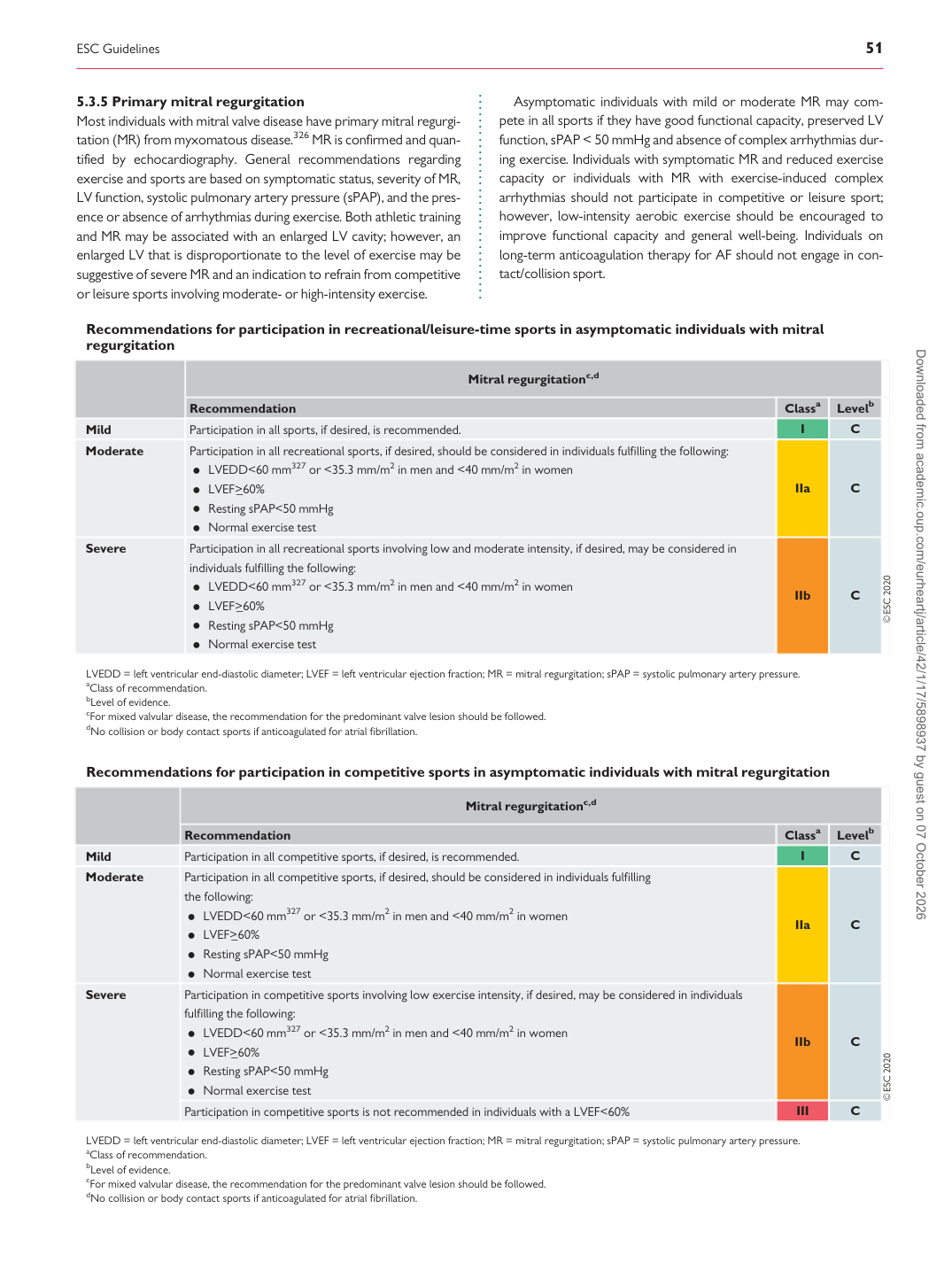
Recommendations for participation in recreational/leisure-time sports in asymptomatic individuals with mitral regurgitation

Mitral regurgitationc,d

Recommendation Classa Levelb

Mild Participation in all sports, if desired, is recommended. I C Moderate Participation in all recreational sports, if desired, should be considered in individuals fulfilling the following:

• LVEDD<60 mm327 or <35.3 mm/m2 in men and <40 mm/m2 in women • LVEF>_60% • Resting sPAP<50 mmHg • Normal exercise test IIa C

Severe Participation in all recreational sports involving low and moderate intensity, if desired, may be considered in

individuals fulfilling the following: • LVEDD<60 mm327 or <35.3 mm/m2 in men and <40 mm/m2 in women • LVEF>_60% • Resting sPAP<50 mmHg • Normal exercise test IIb C

LVEDD = left ventricular end-diastolic diameter; LVEF = left ventricular ejection fraction; MR = mitral regurgitation; sPAP = systolic pulmonary artery pressure. aClass of recommendation. bLevel of evidence. cFor mixed valvular disease, the recommendation for the predominant valve lesion should be followed. dNo collision or body contact sports if anticoagulated for atrial fibrillation.

Recommendations for participation in competitive sports in asymptomatic individuals with mitral regurgitation

Mitral regurgitationc,d

Recommendation Classa Levelb

Mild Participation in all competitive sports, if desired, is recommended. I C Moderate Participation in all competitive sports, if desired, should be considered in individuals fulfilling

the following: • LVEDD<60 mm327 or <35.3 mm/m2 in men and <40 mm/m2 in women • LVEF>_60% • Resting sPAP<50 mmHg • Normal exercise test IIa C

Severe Participation in competitive sports involving low exercise intensity, if desired, may be considered in individuals fulfilling the following:

• LVEDD<60 mm327 or <35.3 mm/m2 in men and <40 mm/m2 in women • LVEF>_60% • Resting sPAP<50 mmHg • Normal exercise test IIb C Participation in competitive sports is not recommended in individuals with a LVEF<60% III C

LVEDD = left ventricular end-diastolic diameter; LVEF = left ventricular ejection fraction; MR = mitral regurgitation; sPAP = systolic pulmonary artery pressure. aClass of recommendation. bLevel of evidence. cFor mixed valvular disease, the recommendation for the predominant valve lesion should be followed. dNo collision or body contact sports if anticoagulated for atrial fibrillation. Downloaded from academic.oup.com/eurheartj/article/42/1/17/5898937 by guest on 07 October 2026