p.33 抽出テキスト
.............................................................................................

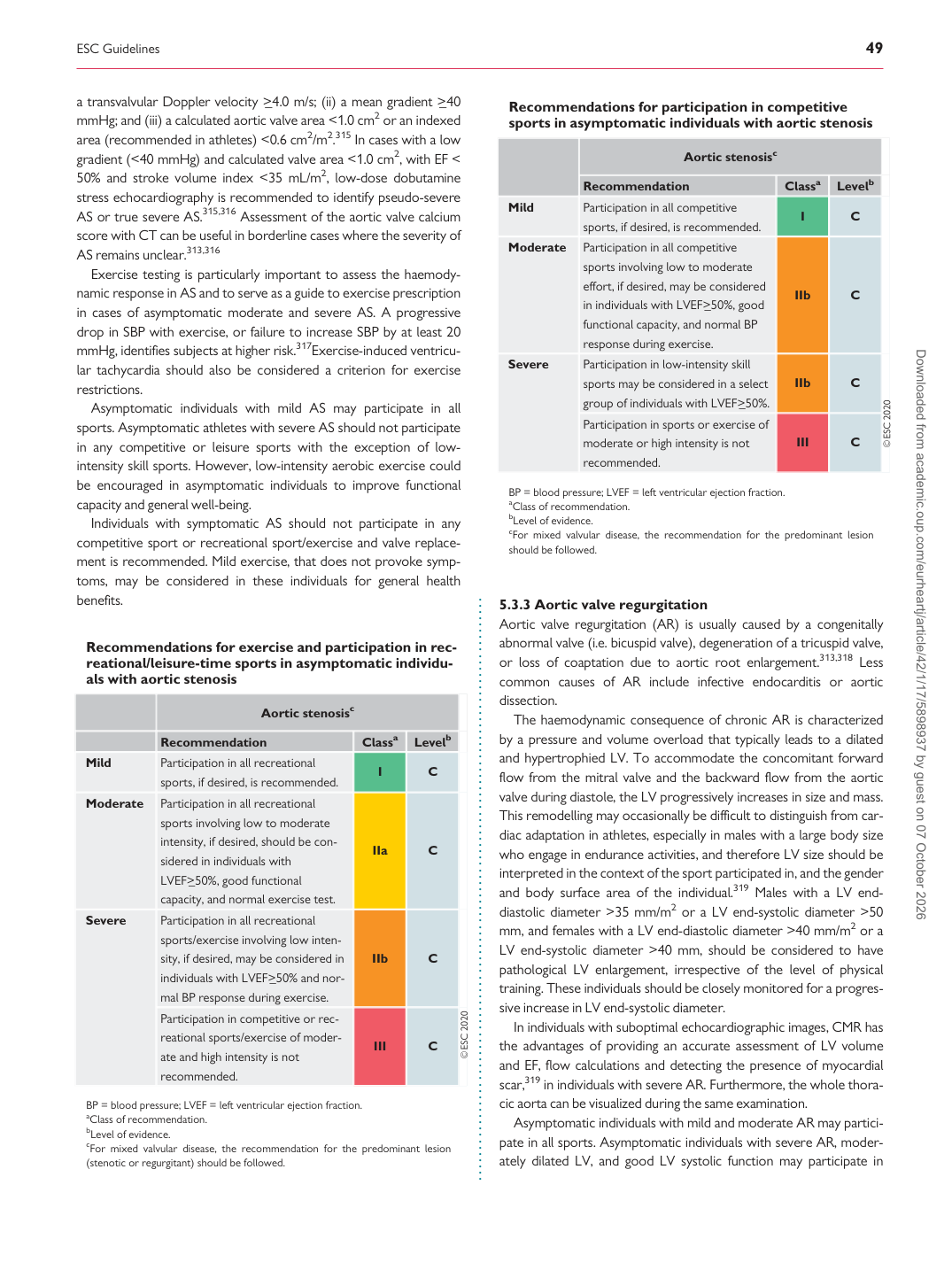
a transvalvular Doppler velocity >_4.0 m/s; (ii) a mean gradient >_40 mmHg; and (iii) a calculated aortic valve area <1.0 cm2 or an indexed area (recommended in athletes) <0.6 cm2/m2.315 In cases with a low gradient (<40 mmHg) and calculated valve area <1.0 cm2, with EF < 50% and stroke volume index <35 mL/m2, low-dose dobutamine stress echocardiography is recommended to identify pseudo-severe AS or true severe AS.315,316 Assessment of the aortic valve calcium score with CT can be useful in borderline cases where the severity of AS remains unclear.313,316 Exercise testing is particularly important to assess the haemodynamic response in AS and to serve as a guide to exercise prescription in cases of asymptomatic moderate and severe AS. A progressive drop in SBP with exercise, or failure to increase SBP by at least 20 mmHg, identifies subjects at higher risk.317Exercise-induced ventricular tachycardia should also be considered a criterion for exercise restrictions. Asymptomatic individuals with mild AS may participate in all sports. Asymptomatic athletes with severe AS should not participate in any competitive or leisure sports with the exception of lowintensity skill sports. However, low-intensity aerobic exercise could be encouraged in asymptomatic individuals to improve functional capacity and general well-being. Individuals with symptomatic AS should not participate in any competitive sport or recreational sport/exercise and valve replacement is recommended. Mild exercise, that does not provoke symptoms, may be considered in these individuals for general health benefits. 5.3.3 Aortic valve regurgitation Aortic valve regurgitation (AR) is usually caused by a congenitally abnormal valve (i.e. bicuspid valve), degeneration of a tricuspid valve, or loss of coaptation due to aortic root enlargement.313,318 Less common causes of AR include infective endocarditis or aortic dissection.

The haemodynamic consequence of chronic AR is characterized by a pressure and volume overload that typically leads to a dilated and hypertrophied LV. To accommodate the concomitant forward flow from the mitral valve and the backward flow from the aortic valve during diastole, the LV progressively increases in size and mass. This remodelling may occasionally be difficult to distinguish from cardiac adaptation in athletes, especially in males with a large body size who engage in endurance activities, and therefore LV size should be interpreted in the context of the sport participated in, and the gender and body surface area of the individual.319 Males with a LV enddiastolic diameter >35 mm/m2 or a LV end-systolic diameter >50 mm, and females with a LV end-diastolic diameter >40 mm/m2 or a LV end-systolic diameter >40 mm, should be considered to have pathological LV enlargement, irrespective of the level of physical training. These individuals should be closely monitored for a progressive increase in LV end-systolic diameter. In individuals with suboptimal echocardiographic images, CMR has the advantages of providing an accurate assessment of LV volume and EF, flow calculations and detecting the presence of myocardial scar,319 in individuals with severe AR. Furthermore, the whole thoracic aorta can be visualized during the same examination. Asymptomatic individuals with mild and moderate AR may participate in all sports. Asymptomatic individuals with severe AR, moderately dilated LV, and good LV systolic function may participate in

Recommendations for exercise and participation in recreational/leisure-time sports in asymptomatic individuals with aortic stenosis

Aortic stenosisc

Recommendation Classa Levelb

Mild Participation in all recreational

sports, if desired, is recommended. I C

Moderate Participation in all recreational sports involving low to moderate

intensity, if desired, should be considered in individuals with LVEF>_50%, good functional capacity, and normal exercise test. IIa C

Severe Participation in all recreational

sports/exercise involving low intensity, if desired, may be considered in individuals with LVEF>_50% and normal BP response during exercise. IIb C Participation in competitive or recreational sports/exercise of moderate and high intensity is not recommended. III C

BP = blood pressure; LVEF = left ventricular ejection fraction. aClass of recommendation. bLevel of evidence. cFor mixed valvular disease, the recommendation for the predominant lesion (stenotic or regurgitant) should be followed. Recommendations for participation in competitive sports in asymptomatic individuals with aortic stenosis

Aortic stenosisc

Recommendation Classa Levelb

Mild Participation in all competitive sports, if desired, is recommended. I C Moderate Participation in all competitive

sports involving low to moderate effort, if desired, may be considered in individuals with LVEF>_50%, good functional capacity, and normal BP response during exercise. IIb C

Severe Participation in low-intensity skill

sports may be considered in a select group of individuals with LVEF>_50%. IIb C Participation in sports or exercise of moderate or high intensity is not recommended. III C

BP = blood pressure; LVEF = left ventricular ejection fraction. aClass of recommendation. bLevel of evidence. cFor mixed valvular disease, the recommendation for the predominant lesion should be followed. Downloaded from academic.oup.com/eurheartj/article/42/1/17/5898937 by guest on 07 October 2026