p.27 抽出テキスト
............. in symptomatic individuals. Prior to successful correction, participation in sports, other than low-intensity skill sports, is discouraged regardless of symptoms. We are unable to provide exercise or sport recommendations for older patients (>40 years) with AOCA, due to the paucity of studies. However, recreational exercise of moderate intensity seems reasonable, but a cautious approach is advised to more vigorous exercise.

©ESC 2020

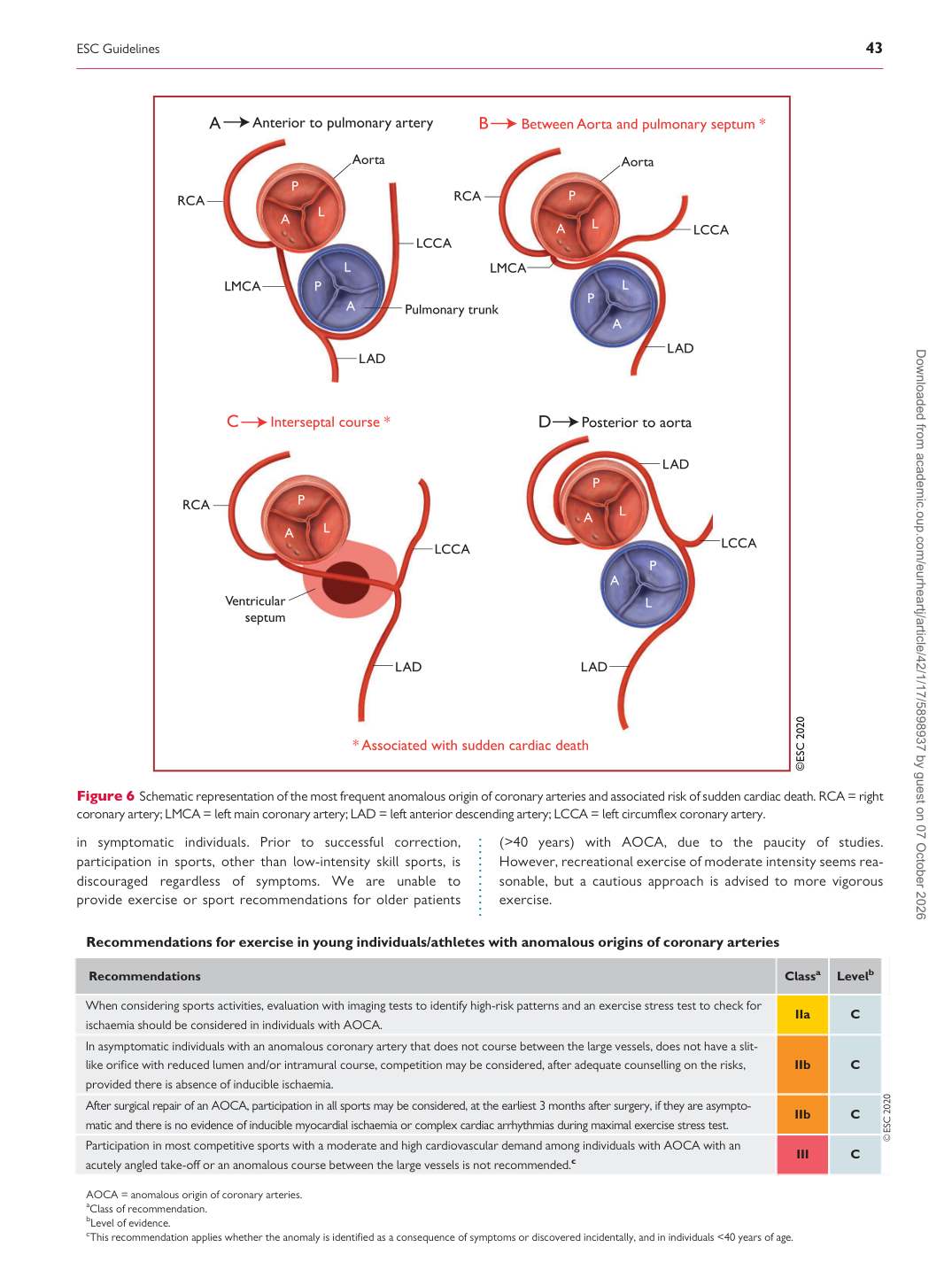
Figure 6 Schematic representation of the most frequent anomalous origin of coronary arteries and associated risk of sudden cardiac death. RCA = right coronary artery; LMCA = left main coronary artery; LAD = left anterior descending artery; LCCA = left circumflex coronary artery.

Recommendations for exercise in young individuals/athletes with anomalous origins of coronary arteries

Recommendations Classa Levelb

When considering sports activities, evaluation with imaging tests to identify high-risk patterns and an exercise stress test to check for ischaemia should be considered in individuals with AOCA. IIa C In asymptomatic individuals with an anomalous coronary artery that does not course between the large vessels, does not have a slitlike orifice with reduced lumen and/or intramural course, competition may be considered, after adequate counselling on the risks, provided there is absence of inducible ischaemia. IIb C After surgical repair of an AOCA, participation in all sports may be considered, at the earliest 3 months after surgery, if they are asymptomatic and there is no evidence of inducible myocardial ischaemia or complex cardiac arrhythmias during maximal exercise stress test. IIb C Participation in most competitive sports with a moderate and high cardiovascular demand among individuals with AOCA with an acutely angled take-off or an anomalous course between the large vessels is not recommended.c III C

AOCA = anomalous origin of coronary arteries. aClass of recommendation. bLevel of evidence. cThis recommendation applies whether the anomaly is identified as a consequence of symptoms or discovered incidentally, and in individuals <40 years of age. Downloaded from academic.oup.com/eurheartj/article/42/1/17/5898937 by guest on 07 October 2026