p.12 抽出テキスト
........................................................................................................................................................................

substantial increases in heart rate and energy expenditure. Examples of aerobic exercise include cycling, running, and swimming performed at low to moderate intensity.84 In contrast, anaerobic exercise refers to movement performed at high intensity unsustainable by oxygen delivery alone and requiring metabolism of stored energy to be processed largely by anaerobic glycolysis. A sustained isometric muscle action that is not working maximally but does not necessarily depend entirely upon oxygen during the muscle contraction is an example of anaerobic exercise. Another example of anaerobic exercise is intermittent high-intensity exercise.85

4.1.1.2 Exercise frequency Exercise frequency is usually expressed as the number of times an individual engages in exercise per week. Guidelines suggest that moderate exercise should be performed most days of the week, amounting to a minimum of 150 min/week.

4.1.1.3 Exercise intensity Of all the basic elements of exercise prescription, exercise intensity is generally considered to be the most critical for achieving aerobic fitness and to have the most favourable impact on risk factors.86,87 Absolute intensity refers to the rate of energy expenditure during exercise and is usually expressed in kcal/min or metabolic equivalents (METs).84,88 Relative exercise intensity refers to a fraction of an individual’s maximal power (load) that is maintained during exercise and is usually prescribed as a percentage of maximal aerobic capacity (VO2max) on the basis of a CPET.88 Training intensity can also be expressed as a percentage of maximal heart rate (HRmax) recorded during an exercise test89 or predicted on the basis of the equation [HRmax = 220 - age].90 The use of prediction equations for HRmax is not recommended, because there is a large standard deviation around the regression line between age and HRmax.91 Alternatively, exercise intensity can be expressed relative to a percentage of a person’s HR reserve (HRR), which uses a percentage of the difference between HRmax and resting HR and adds it to the resting HR (Karvonen formula).92 There are caveats to the use of HR for prescribing and evaluating exercise intensity in persons using beta-blockers.93 Ideally, the HR derived for training should only be used if functional capacity was determined (an exercise test was performed) while taking the medication. Intensity is also commonly monitored using the rate of perceived exertion scale (e.g. 12- 14 on the Borg 6- 20 scale) or ‘talk test’, e.g. ‘to be able to talk while exercising’.91,94

General zones for various exercise intensities are shown in Table 4.

4.1.1.4 Training volume Exercise intensity is inversely related to exercise time. Their product (in kcal or kJ) defines the volume of each training unit, which in turn multiplied by frequency provides an estimate of the energy expenditure of the training bout or session. The frequency of training sessions and the duration of the training period provide total energy expenditure of a training programme. Meeting the minimal activity guidelines equates to approximately 1000 kcal/ week or about 10 MET/h/week (the product of MET level and duration in hours per week). Training volume should increase weekly either by 2.5% in intensity95 or 2 mins’ duration,95 although the rate of progression should be individualized according to the biological adaptation of the individual. Training adaptation is also influenced by age, genetics,96 fitness, and environmental factors, such as hydration, heat, cold, and altitude.97

4.1.1.5 Type of training

Aerobic training. Aerobic exercise training can either be continuous or interval based. There is a plethora of evidence and many guidelines on continuous aerobic exercise, but there is also strong evidence emerging about the benefits of interval-type training. The interval design involves the completion of short bouts of exercise at high intensities, interspersed with recovery periods. When compared with continuous training, this approach provides a greater challenge to the cardiopulmonary, peripheral, and metabolic systems and results in a more efficient training effect.98 Interval training has been reported to be motivating, since the traditional continuous training can often be tedious. Interval training should be employed only in stable cardiac patients because it places a higher stress on the CV system.99 Since intermittent training exposes subjects to near maximal effort, rest intervals of appropriate duration, preferably active ones, are recommended.100 The exercise to rest ratio varies.101 There are a number of different approaches used, which should be individualized according to fitness and comorbidities.

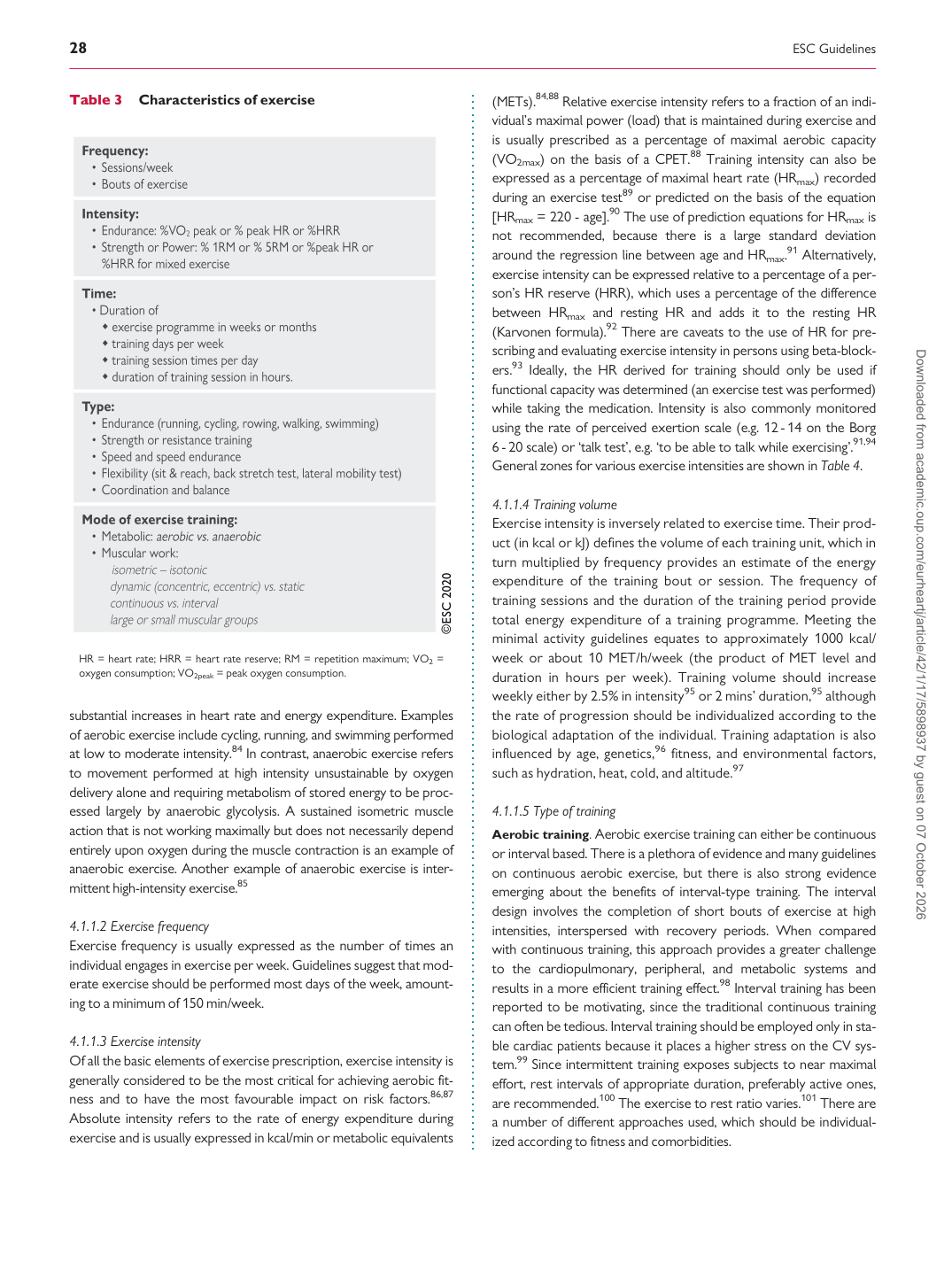
Table 3 Characteristics of exercise

©ESC 2020

HR = heart rate; HRR = heart rate reserve; RM = repetition maximum; VO2 = oxygen consumption; VO2peak = peak oxygen consumption. Downloaded from academic.oup.com/eurheartj/article/42/1/17/5898937 by guest on 07 October 2026