p.11 抽出テキスト
................................................................................................. CAD based on the ESC Systematic Coronary Risk Evaluation (SCORE) system (see chapters 4 and 5).6,81

Exercise testing may also be useful to evaluate the blood pressure (BP) response to exercise, the occurrence of exercise-induced arrhythmias, and to assess symptoms or physical performance and its relation to exercise training.81 In adult and elderly individuals, especially those naı ̈ve to moderate to vigorous PA, exercise testing or cardiopulmonary exercise testing (CPET) is a useful means to assess overall CV health and performance, allowing individualized recommendations regarding sports and exercise type and intensity, as will be discussed in subsequent sections.82

4 Physical activity, leisure

exercise, and competitive sports participation

4.1 General introduction

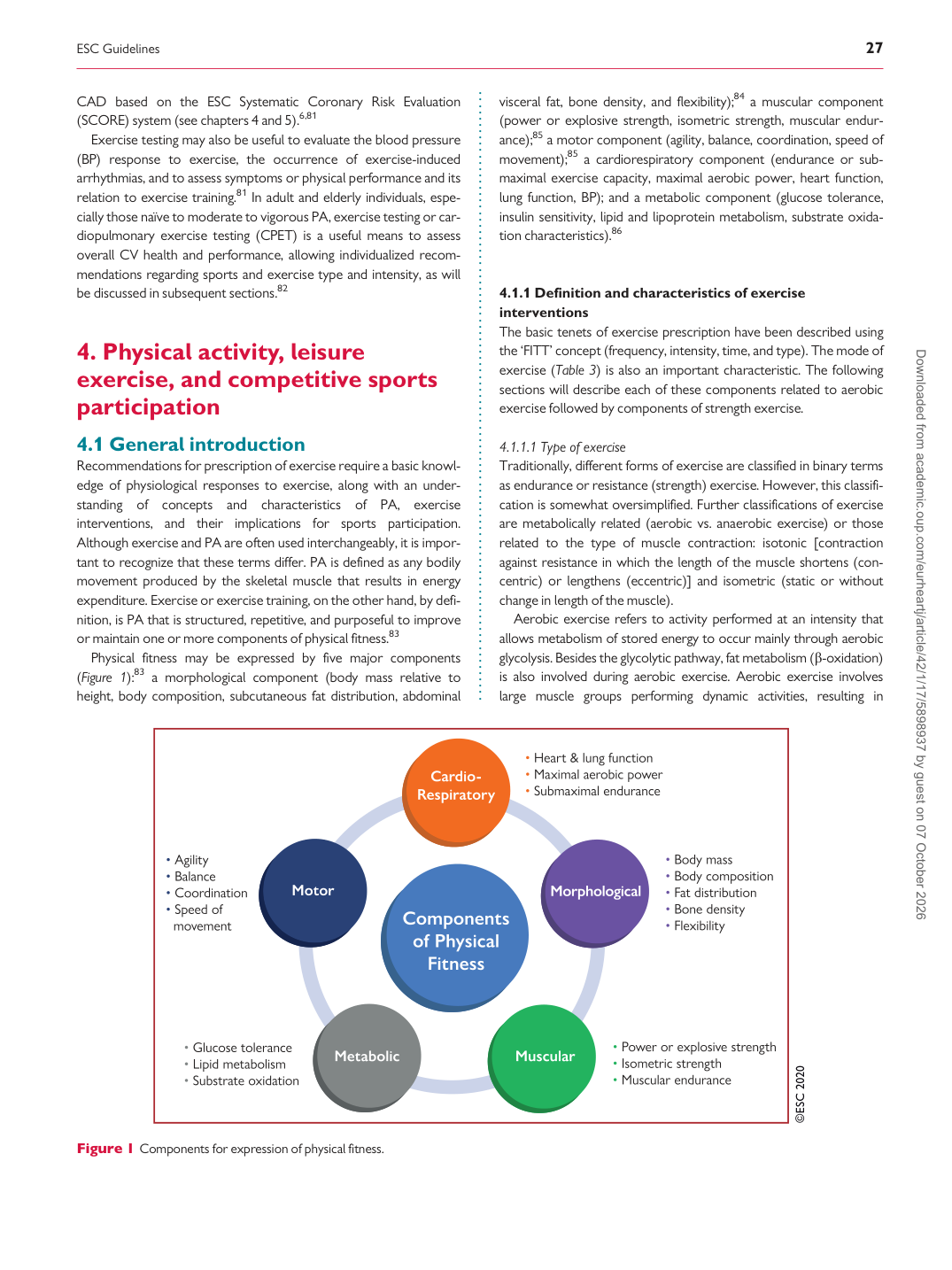
Recommendations for prescription of exercise require a basic knowledge of physiological responses to exercise, along with an understanding of concepts and characteristics of PA, exercise interventions, and their implications for sports participation. Although exercise and PA are often used interchangeably, it is important to recognize that these terms differ. PA is defined as any bodily movement produced by the skeletal muscle that results in energy expenditure. Exercise or exercise training, on the other hand, by definition, is PA that is structured, repetitive, and purposeful to improve or maintain one or more components of physical fitness.83 Physical fitness may be expressed by five major components (Figure 1):83 a morphological component (body mass relative to height, body composition, subcutaneous fat distribution, abdominal visceral fat, bone density, and flexibility);84 a muscular component (power or explosive strength, isometric strength, muscular endurance);85 a motor component (agility, balance, coordination, speed of movement);85 a cardiorespiratory component (endurance or submaximal exercise capacity, maximal aerobic power, heart function, lung function, BP); and a metabolic component (glucose tolerance, insulin sensitivity, lipid and lipoprotein metabolism, substrate oxidation characteristics).86

4.1.1 Definition and characteristics of exercise interventions The basic tenets of exercise prescription have been described using the ‘FITT’ concept (frequency, intensity, time, and type). The mode of exercise (Table 3) is also an important characteristic. The following sections will describe each of these components related to aerobic exercise followed by components of strength exercise.

4.1.1.1 Type of exercise Traditionally, different forms of exercise are classified in binary terms as endurance or resistance (strength) exercise. However, this classification is somewhat oversimplified. Further classifications of exercise are metabolically related (aerobic vs. anaerobic exercise) or those related to the type of muscle contraction: isotonic [contraction against resistance in which the length of the muscle shortens (concentric) or lengthens (eccentric)] and isometric (static or without change in length of the muscle). Aerobic exercise refers to activity performed at an intensity that allows metabolism of stored energy to occur mainly through aerobic glycolysis. Besides the glycolytic pathway, fat metabolism (b-oxidation) is also involved during aerobic exercise. Aerobic exercise involves large muscle groups performing dynamic activities, resulting in

©ESC 2020

Figure 1 Components for expression of physical fitness. Downloaded from academic.oup.com/eurheartj/article/42/1/17/5898937 by guest on 07 October 2026