p.71 抽出テキスト
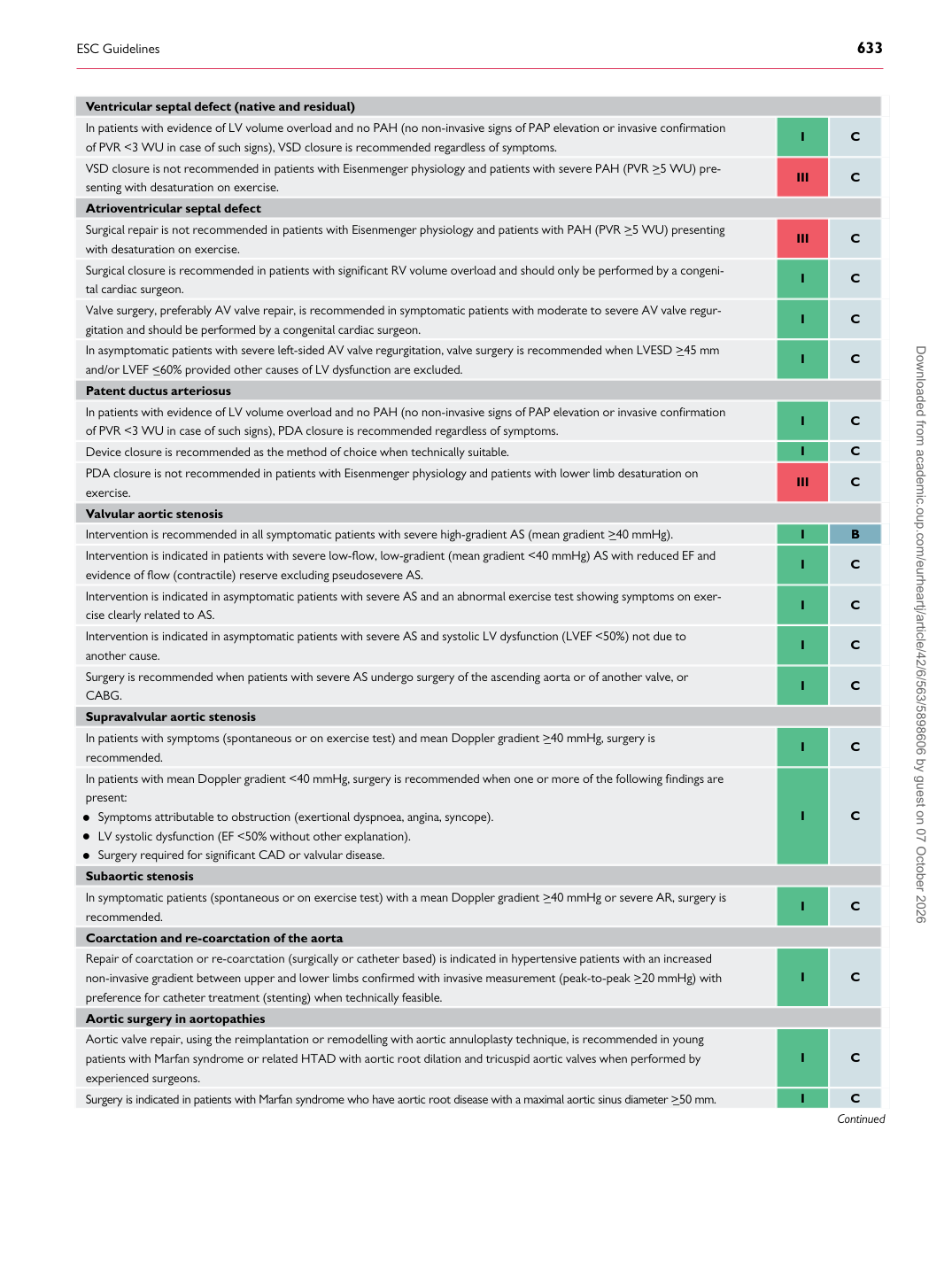
Ventricular septal defect (native and residual) In patients with evidence of LV volume overload and no PAH (no non-invasive signs of PAP elevation or invasive confirmation of PVR <3 WU in case of such signs), VSD closure is recommended regardless of symptoms. I C VSD closure is not recommended in patients with Eisenmenger physiology and patients with severe PAH (PVR >_5 WU) presenting with desaturation on exercise. III C Atrioventricular septal defect Surgical repair is not recommended in patients with Eisenmenger physiology and patients with PAH (PVR >_5 WU) presenting with desaturation on exercise. III C Surgical closure is recommended in patients with significant RV volume overload and should only be performed by a congenital cardiac surgeon. I C Valve surgery, preferably AV valve repair, is recommended in symptomatic patients with moderate to severe AV valve regurgitation and should be performed by a congenital cardiac surgeon. I C In asymptomatic patients with severe left-sided AV valve regurgitation, valve surgery is recommended when LVESD >_45 mm and/or LVEF <_60% provided other causes of LV dysfunction are excluded. I C Patent ductus arteriosus In patients with evidence of LV volume overload and no PAH (no non-invasive signs of PAP elevation or invasive confirmation of PVR <3 WU in case of such signs), PDA closure is recommended regardless of symptoms. I C Device closure is recommended as the method of choice when technically suitable. I C PDA closure is not recommended in patients with Eisenmenger physiology and patients with lower limb desaturation on exercise. III C Valvular aortic stenosis Intervention is recommended in all symptomatic patients with severe high-gradient AS (mean gradient >_40 mmHg). I B Intervention is indicated in patients with severe low-flow, low-gradient (mean gradient <40 mmHg) AS with reduced EF and evidence of flow (contractile) reserve excluding pseudosevere AS. I C Intervention is indicated in asymptomatic patients with severe AS and an abnormal exercise test showing symptoms on exercise clearly related to AS. I C Intervention is indicated in asymptomatic patients with severe AS and systolic LV dysfunction (LVEF <50%) not due to another cause. I C Surgery is recommended when patients with severe AS undergo surgery of the ascending aorta or of another valve, or CABG. I C Supravalvular aortic stenosis In patients with symptoms (spontaneous or on exercise test) and mean Doppler gradient >_40 mmHg, surgery is recommended. I C In patients with mean Doppler gradient <40 mmHg, surgery is recommended when one or more of the following findings are present: • Symptoms attributable to obstruction (exertional dyspnoea, angina, syncope). • LV systolic dysfunction (EF <50% without other explanation). • Surgery required for significant CAD or valvular disease. I C Subaortic stenosis In symptomatic patients (spontaneous or on exercise test) with a mean Doppler gradient >_40 mmHg or severe AR, surgery is recommended. I C Coarctation and re-coarctation of the aorta Repair of coarctation or re-coarctation (surgically or catheter based) is indicated in hypertensive patients with an increased non-invasive gradient between upper and lower limbs confirmed with invasive measurement (peak-to-peak >_20 mmHg) with preference for catheter treatment (stenting) when technically feasible. I C Aortic surgery in aortopathies Aortic valve repair, using the reimplantation or remodelling with aortic annuloplasty technique, is recommended in young patients with Marfan syndrome or related HTAD with aortic root dilation and tricuspid aortic valves when performed by experienced surgeons. I C Surgery is indicated in patients with Marfan syndrome who have aortic root disease with a maximal aortic sinus diameter >_50 mm. I C

Continued Downloaded from academic.oup.com/eurheartj/article/42/6/563/5898606 by guest on 07 October 2026