p.38 抽出テキスト
............................................................................................................................................................................. stenosis in young patients is not necessarily associated with significant calcification. • Cardiac catheterization is only required if non-invasive evaluation yields uncertain results, for evaluation of coronary arteries, or when percutaneous balloon angioplasty is considered.

4.5.1.4 Medical therapy Symptomatic patients require urgent surgery. Medical treatment for AS-related heart failure is reserved for non-operable patients. Neither statin treatment, nor any other medical treatment, has so far been shown to retard progression of AS.

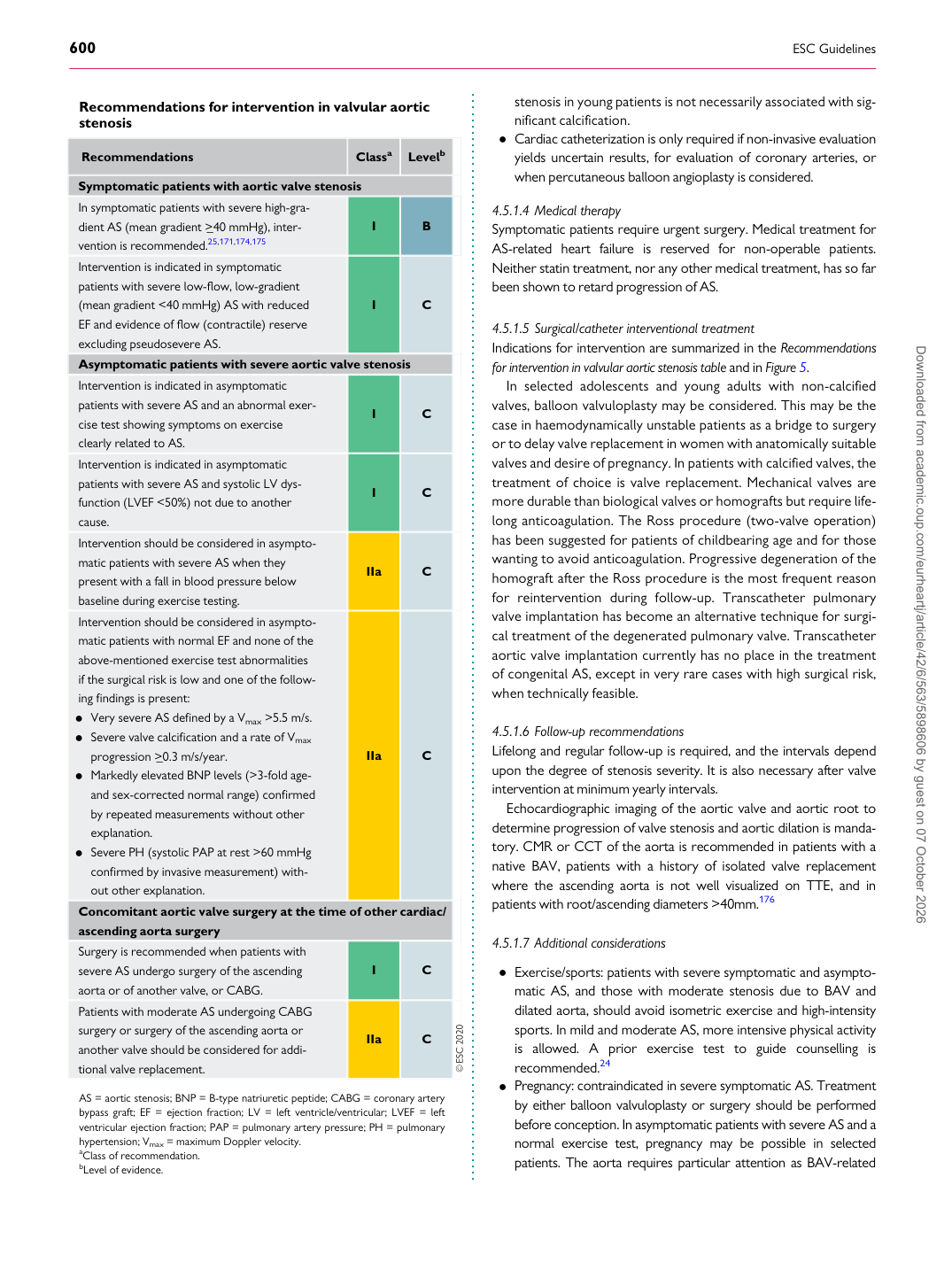
4.5.1.5 Surgical/catheter interventional treatment Indications for intervention are summarized in the Recommendations for intervention in valvular aortic stenosis table and in Figure 5. In selected adolescents and young adults with non-calcified valves, balloon valvuloplasty may be considered. This may be the case in haemodynamically unstable patients as a bridge to surgery or to delay valve replacement in women with anatomically suitable valves and desire of pregnancy. In patients with calcified valves, the treatment of choice is valve replacement. Mechanical valves are more durable than biological valves or homografts but require lifelong anticoagulation. The Ross procedure (two-valve operation) has been suggested for patients of childbearing age and for those wanting to avoid anticoagulation. Progressive degeneration of the homograft after the Ross procedure is the most frequent reason for reintervention during follow-up. Transcatheter pulmonary valve implantation has become an alternative technique for surgical treatment of the degenerated pulmonary valve. Transcatheter aortic valve implantation currently has no place in the treatment of congenital AS, except in very rare cases with high surgical risk, when technically feasible.

4.5.1.6 Follow-up recommendations Lifelong and regular follow-up is required, and the intervals depend upon the degree of stenosis severity. It is also necessary after valve intervention at minimum yearly intervals. Echocardiographic imaging of the aortic valve and aortic root to determine progression of valve stenosis and aortic dilation is mandatory. CMR or CCT of the aorta is recommended in patients with a native BAV, patients with a history of isolated valve replacement where the ascending aorta is not well visualized on TTE, and in patients with root/ascending diameters >40mm.176

4.5.1.7 Additional considerations

• Exercise/sports: patients with severe symptomatic and asymptomatic AS, and those with moderate stenosis due to BAV and dilated aorta, should avoid isometric exercise and high-intensity sports. In mild and moderate AS, more intensive physical activity is allowed. A prior exercise test to guide counselling is recommended.24 • Pregnancy: contraindicated in severe symptomatic AS. Treatment by either balloon valvuloplasty or surgery should be performed before conception. In asymptomatic patients with severe AS and a normal exercise test, pregnancy may be possible in selected patients. The aorta requires particular attention as BAV-related

Recommendations for intervention in valvular aortic stenosis

Recommendations Classa Levelb

Symptomatic patients with aortic valve stenosis In symptomatic patients with severe high-gradient AS (mean gradient >_40 mmHg), intervention is recommended.25,171,174,175 I B Intervention is indicated in symptomatic patients with severe low-flow, low-gradient (mean gradient <40 mmHg) AS with reduced EF and evidence of flow (contractile) reserve excluding pseudosevere AS. I C Asymptomatic patients with severe aortic valve stenosis Intervention is indicated in asymptomatic patients with severe AS and an abnormal exercise test showing symptoms on exercise clearly related to AS. I C Intervention is indicated in asymptomatic patients with severe AS and systolic LV dysfunction (LVEF <50%) not due to another cause. I C Intervention should be considered in asymptomatic patients with severe AS when they present with a fall in blood pressure below baseline during exercise testing. IIa C Intervention should be considered in asymptomatic patients with normal EF and none of the above-mentioned exercise test abnormalities if the surgical risk is low and one of the following findings is present: • Very severe AS defined by a Vmax >5.5 m/s. • Severe valve calcification and a rate of Vmax progression >_0.3 m/s/year. • Markedly elevated BNP levels (>3-fold age-

and sex-corrected normal range) confirmed by repeated measurements without other

explanation. • Severe PH (systolic PAP at rest >60 mmHg confirmed by invasive measurement) with-

out other explanation. IIa C Concomitant aortic valve surgery at the time of other cardiac/ ascending aorta surgery Surgery is recommended when patients with severe AS undergo surgery of the ascending aorta or of another valve, or CABG. I C Patients with moderate AS undergoing CABG surgery or surgery of the ascending aorta or another valve should be considered for additional valve replacement. IIa C

AS = aortic stenosis; BNP = B-type natriuretic peptide; CABG = coronary artery bypass graft; EF = ejection fraction; LV = left ventricle/ventricular; LVEF = left ventricular ejection fraction; PAP = pulmonary artery pressure; PH = pulmonary hypertension; Vmax = maximum Doppler velocity. aClass of recommendation. bLevel of evidence. Downloaded from academic.oup.com/eurheartj/article/42/6/563/5898606 by guest on 07 October 2026