p.21 抽出テキスト
............................................................................................................ population study reported a PAH prevalence of 3.2% in CHD patients, accounting for 100 per million in the general adult population.47

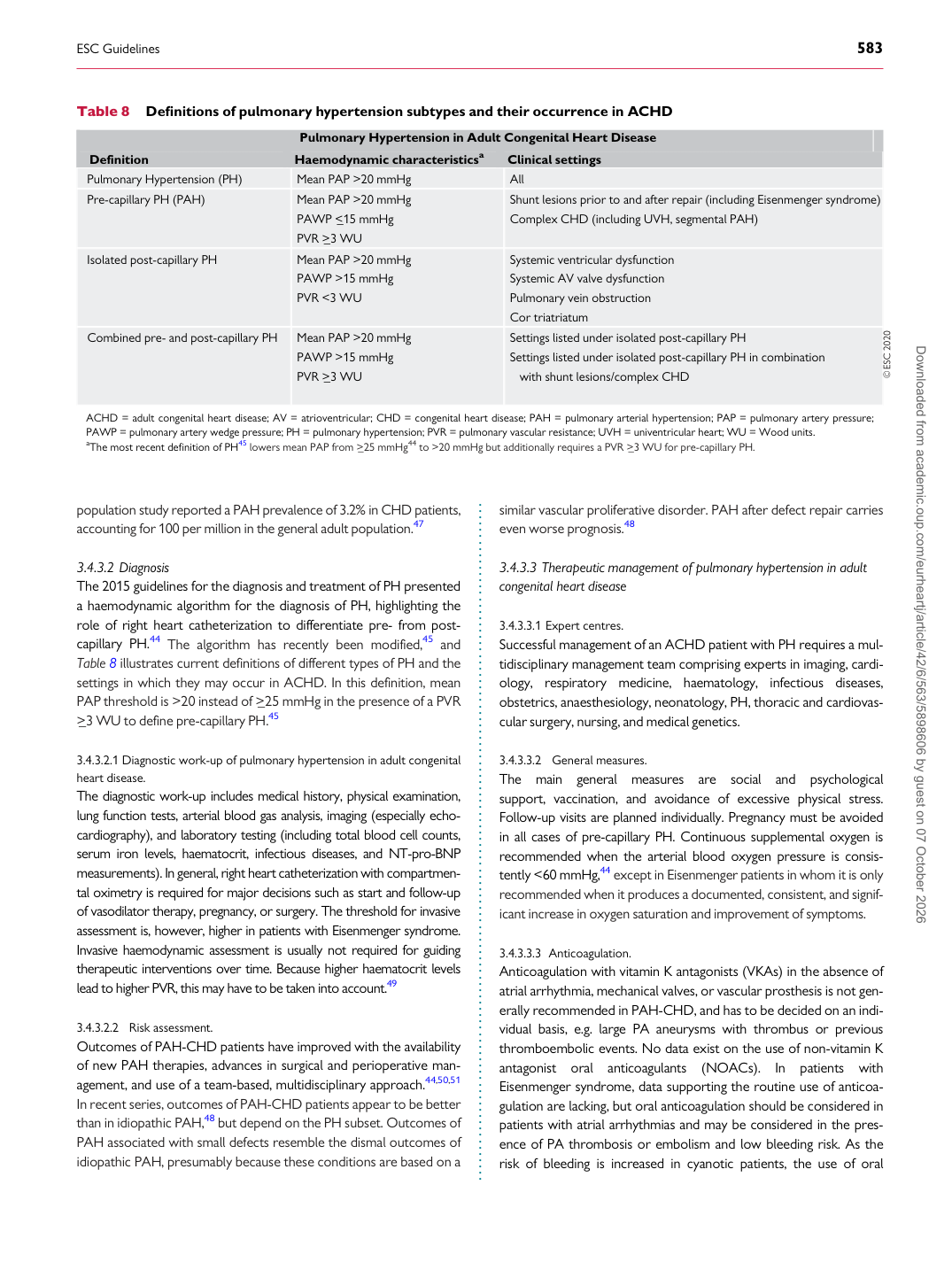
3.4.3.2 Diagnosis The 2015 guidelines for the diagnosis and treatment of PH presented a haemodynamic algorithm for the diagnosis of PH, highlighting the role of right heart catheterization to differentiate pre- from postcapillary PH.44 The algorithm has recently been modified,45 and Table 8 illustrates current definitions of different types of PH and the settings in which they may occur in ACHD. In this definition, mean PAP threshold is >20 instead of >_25 mmHg in the presence of a PVR >_3 WU to define pre-capillary PH.45

3.4.3.2.1 Diagnostic work-up of pulmonary hypertension in adult congenital heart disease. The diagnostic work-up includes medical history, physical examination, lung function tests, arterial blood gas analysis, imaging (especially echocardiography), and laboratory testing (including total blood cell counts, serum iron levels, haematocrit, infectious diseases, and NT-pro-BNP measurements). In general, right heart catheterization with compartmental oximetry is required for major decisions such as start and follow-up of vasodilator therapy, pregnancy, or surgery. The threshold for invasive assessment is, however, higher in patients with Eisenmenger syndrome. Invasive haemodynamic assessment is usually not required for guiding therapeutic interventions over time. Because higher haematocrit levels lead to higher PVR, this may have to be taken into account.49

3.4.3.2.2 Risk assessment. Outcomes of PAH-CHD patients have improved with the availability of new PAH therapies, advances in surgical and perioperative management, and use of a team-based, multidisciplinary approach.44,50,51 In recent series, outcomes of PAH-CHD patients appear to be better than in idiopathic PAH,48 but depend on the PH subset. Outcomes of PAH associated with small defects resemble the dismal outcomes of idiopathic PAH, presumably because these conditions are based on a similar vascular proliferative disorder. PAH after defect repair carries even worse prognosis.48

3.4.3.3 Therapeutic management of pulmonary hypertension in adult congenital heart disease

3.4.3.3.1 Expert centres. Successful management of an ACHD patient with PH requires a multidisciplinary management team comprising experts in imaging, cardiology, respiratory medicine, haematology, infectious diseases, obstetrics, anaesthesiology, neonatology, PH, thoracic and cardiovascular surgery, nursing, and medical genetics.

3.4.3.3.2 General measures. The main general measures are social and psychological support, vaccination, and avoidance of excessive physical stress. Follow-up visits are planned individually. Pregnancy must be avoided in all cases of pre-capillary PH. Continuous supplemental oxygen is recommended when the arterial blood oxygen pressure is consistently <60 mmHg,44 except in Eisenmenger patients in whom it is only recommended when it produces a documented, consistent, and significant increase in oxygen saturation and improvement of symptoms.

3.4.3.3.3 Anticoagulation. Anticoagulation with vitamin K antagonists (VKAs) in the absence of atrial arrhythmia, mechanical valves, or vascular prosthesis is not generally recommended in PAH-CHD, and has to be decided on an individual basis, e.g. large PA aneurysms with thrombus or previous thromboembolic events. No data exist on the use of non-vitamin K antagonist oral anticoagulants (NOACs). In patients with Eisenmenger syndrome, data supporting the routine use of anticoagulation are lacking, but oral anticoagulation should be considered in patients with atrial arrhythmias and may be considered in the presence of PA thrombosis or embolism and low bleeding risk. As the risk of bleeding is increased in cyanotic patients, the use of oral

....................................................................................................................................................................................................................

Table 8 Definitions of pulmonary hypertension subtypes and their occurrence in ACHD

Pulmonary Hypertension in Adult Congenital Heart Disease

Definition Haemodynamic characteristicsa Clinical settings Pulmonary Hypertension (PH) Mean PAP >20 mmHg All Pre-capillary PH (PAH) Mean PAP >20 mmHg

PAWP <_15 mmHg PVR >_3 WU Shunt lesions prior to and after repair (including Eisenmenger syndrome)

Complex CHD (including UVH, segmental PAH)

Isolated post-capillary PH Mean PAP >20 mmHg

PAWP >15 mmHg PVR <3 WU Systemic ventricular dysfunction

Systemic AV valve dysfunction Pulmonary vein obstruction Cor triatriatum

Combined pre- and post-capillary PH Mean PAP >20 mmHg

PAWP >15 mmHg PVR >_3 WU Settings listed under isolated post-capillary PH

Settings listed under isolated post-capillary PH in combination

with shunt lesions/complex CHD

ACHD = adult congenital heart disease; AV = atrioventricular; CHD = congenital heart disease; PAH = pulmonary arterial hypertension; PAP = pulmonary artery pressure; PAWP = pulmonary artery wedge pressure; PH = pulmonary hypertension; PVR = pulmonary vascular resistance; UVH = univentricular heart; WU = Wood units. aThe most recent definition of PH45 lowers mean PAP from >_25 mmHg44 to >20 mmHg but additionally requires a PVR >_3 WU for pre-capillary PH. Downloaded from academic.oup.com/eurheartj/article/42/6/563/5898606 by guest on 07 October 2026