p.8 抽出テキスト
.......................................................... 2.3.2 New recommendations in 2019 2.3.3 New revised concepts • Drug therapy for inappropriate sinus tachycardia and focal atrial tachycardia. • Therapeutic options for acute conversion and anticoagulation of atrial flutter. • Therapy of atrioventricular nodal re-entrant tachycardia. • Therapy of antidromic atrioventricular re-entrant tachycardia and pre-excited atrial fibrillation. • Management of patients with asymptomatic pre-excitation. • Diagnosis and therapy of tachycardiomyopathy.

3 Definitions and classification

The term ‘SVT’ literally indicates tachycardia [atrial rates >100 beats per minute (b.p.m.) at rest], the mechanism of which involves tissue from the His bundle or above.2,3 Traditionally, SVT has been used to describe all kinds of tachycardias apart from ventricular tachycardias (VTs) and AF. It has therefore included tachycardias such as atrioventricular (AV) re-entry due to accessory connections, which is not, in

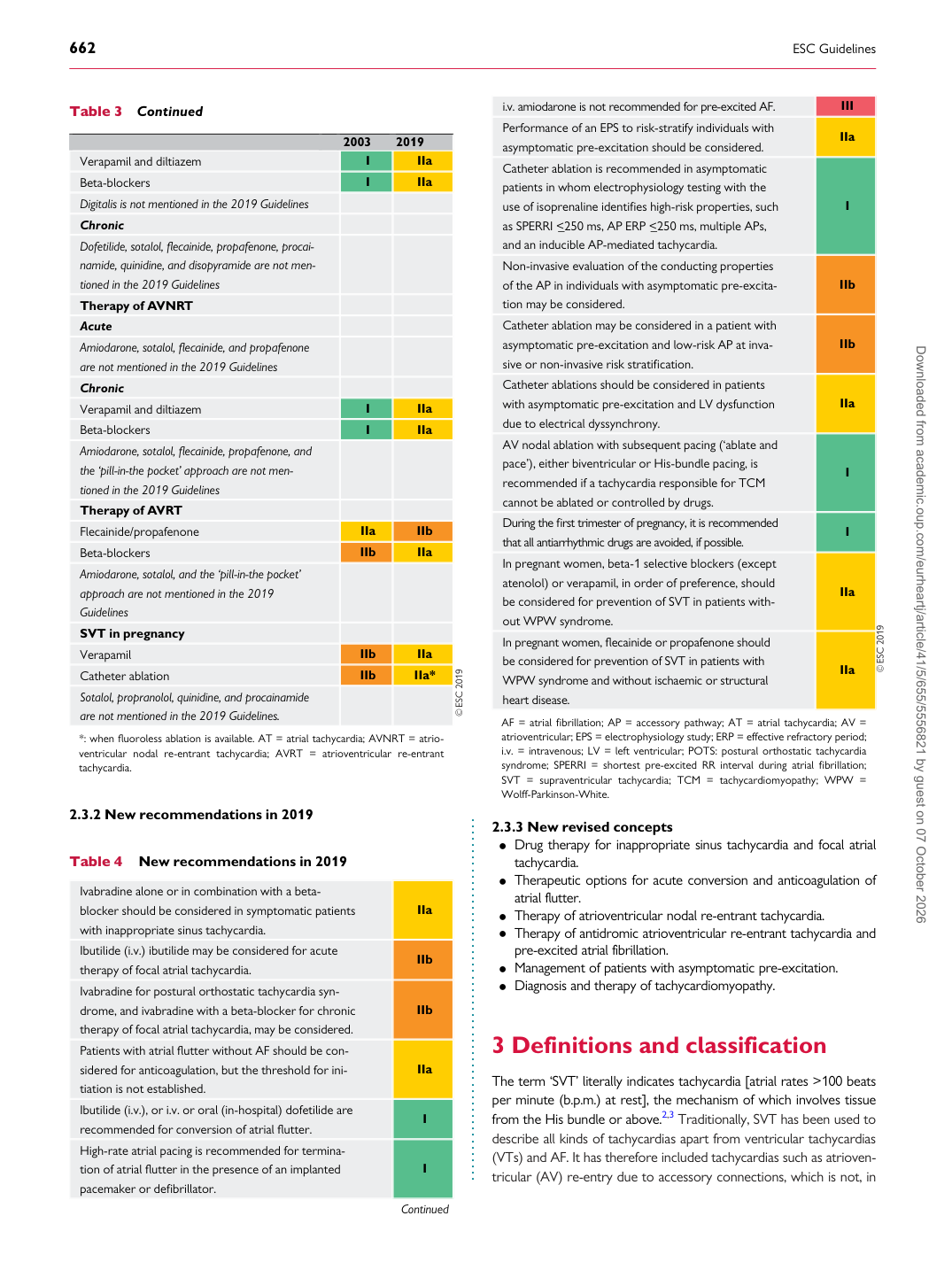
Table 3 Continued

2003 2019

Verapamil and diltiazem I IIa Beta-blockers I IIa Digitalis is not mentioned in the 2019 Guidelines Chronic Dofetilide, sotalol, flecainide, propafenone, procainamide, quinidine, and disopyramide are not mentioned in the 2019 Guidelines Therapy of AVNRT Acute Amiodarone, sotalol, flecainide, and propafenone are not mentioned in the 2019 Guidelines Chronic Verapamil and diltiazem I IIa Beta-blockers I IIa Amiodarone, sotalol, flecainide, propafenone, and the ‘pill-in-the pocket’ approach are not mentioned in the 2019 Guidelines Therapy of AVRT Flecainide/propafenone IIa IIb Beta-blockers IIb IIa Amiodarone, sotalol, and the ‘pill-in-the pocket’ approach are not mentioned in the 2019 Guidelines SVT in pregnancy Verapamil IIb IIa Catheter ablation IIb IIa* Sotalol, propranolol, quinidine, and procainamide are not mentioned in the 2019 Guidelines. *: when fluoroless ablation is available. AT = atrial tachycardia; AVNRT = atrioventricular nodal re-entrant tachycardia; AVRT = atrioventricular re-entrant tachycardia.

Table 4 New recommendations in 2019

Ivabradine alone or in combination with a betablocker should be considered in symptomatic patients with inappropriate sinus tachycardia. IIa Ibutilide (i.v.) ibutilide may be considered for acute therapy of focal atrial tachycardia. IIb Ivabradine for postural orthostatic tachycardia syndrome, and ivabradine with a beta-blocker for chronic therapy of focal atrial tachycardia, may be considered. IIb Patients with atrial flutter without AF should be considered for anticoagulation, but the threshold for initiation is not established. IIa Ibutilide (i.v.), or i.v. or oral (in-hospital) dofetilide are recommended for conversion of atrial flutter. I High-rate atrial pacing is recommended for termination of atrial flutter in the presence of an implanted pacemaker or defibrillator. I

Continued i.v. amiodarone is not recommended for pre-excited AF. III

Performance of an EPS to risk-stratify individuals with asymptomatic pre-excitation should be considered. IIa Catheter ablation is recommended in asymptomatic patients in whom electrophysiology testing with the use of isoprenaline identifies high-risk properties, such as SPERRI <_250 ms, AP ERP <_250 ms, multiple APs, and an inducible AP-mediated tachycardia. I Non-invasive evaluation of the conducting properties of the AP in individuals with asymptomatic pre-excitation may be considered. IIb Catheter ablation may be considered in a patient with asymptomatic pre-excitation and low-risk AP at invasive or non-invasive risk stratification. IIb Catheter ablations should be considered in patients with asymptomatic pre-excitation and LV dysfunction due to electrical dyssynchrony. IIa AV nodal ablation with subsequent pacing (‘ablate and pace’), either biventricular or His-bundle pacing, is recommended if a tachycardia responsible for TCM cannot be ablated or controlled by drugs. I During the first trimester of pregnancy, it is recommended that all antiarrhythmic drugs are avoided, if possible. I In pregnant women, beta-1 selective blockers (except atenolol) or verapamil, in order of preference, should be considered for prevention of SVT in patients without WPW syndrome. IIa In pregnant women, flecainide or propafenone should be considered for prevention of SVT in patients with WPW syndrome and without ischaemic or structural heart disease. IIa AF = atrial fibrillation; AP = accessory pathway; AT = atrial tachycardia; AV = atrioventricular; EPS = electrophysiology study; ERP = effective refractory period; i.v. = intravenous; LV = left ventricular; POTS: postural orthostatic tachycardia syndrome; SPERRI = shortest pre-excited RR interval during atrial fibrillation; SVT = supraventricular tachycardia; TCM = tachycardiomyopathy; WPW = Wolff-Parkinson-White. Downloaded from academic.oup.com/eurheartj/article/41/5/655/5556821 by guest on 07 October 2026