p.7 抽出テキスト
........................ with that patient or the patient’s caregiver where appropriate and/or necessary. It is also the health professional’s responsibility to verify the rules and regulations applicable in each country to drugs and devices at the time of prescription.

2 Introduction

Supraventricular arrhythmias are common and patients are often symptomatic, requiring management with drugs and electrophysiological procedures. The ESC published management Guidelines for supraventricular tachycardias (SVTs) in 20031; corresponding US guidelines have also been published, the most recent being in 2015.2 There is a need to provide expert recommendations for professionals participating in the care of patients presenting with SVT. In addition, several associated conditions where SVTs may coexist need to be explained in more detail. To address this topic, a Task Force was convened by the ESC, with the remit to comprehensively review the published evidence and to publish Guidelines on the management of patients with SVT, with up-to-date consensus recommendations for clinical practice. This document summarizes current developments in the field, with a focus on advances since the last ESC Guidelines were published, and provides general recommendations for the management of adults with SVT based on the principles of evidence-based medicine.

2.1 Evidence review

Members of the Task Force were asked to perform a detailed literature review, weigh the strength of evidence for or against a particular treatment or procedure, and include estimates of expected health outcomes where data exist. Patient-specific modifiers, comorbidities, and issues of patient preference that might influence the choice of particular tests or therapies were considered, as were frequency of follow-up and cost-effectiveness. In controversial areas, or with regard to issues without evidence other than usual clinical practice, consensus was achieved by agreement of the expert panel after thorough deliberation. The document was peer-reviewed by official external reviewers. The strengths of the recommendations and levels of evidence of particular management options were weighed and graded according to predefined scales, as outlined above in Tables 1 and 2, respectively. Overall, these Guidelines include evidence and expert opinions from several countries. The pharmacological and nonpharmacological antiarrhythmic approaches discussed may therefore include drugs that do not have the approval of governmental regulatory agencies in all countries.

2.2 Relationships with industry and other

conflicts of interest It is ESC policy to sponsor position papers and Guidelines without commercial support, and all members volunteered their time. Thus, all members of the writing group, as well as the reviewers, have disclosed any potential conflicts of interest in detail. The details of these declarations will be posted on the ESC website upon publication of these Guidelines. 2.3 What is new in the 2019 Guidelines?

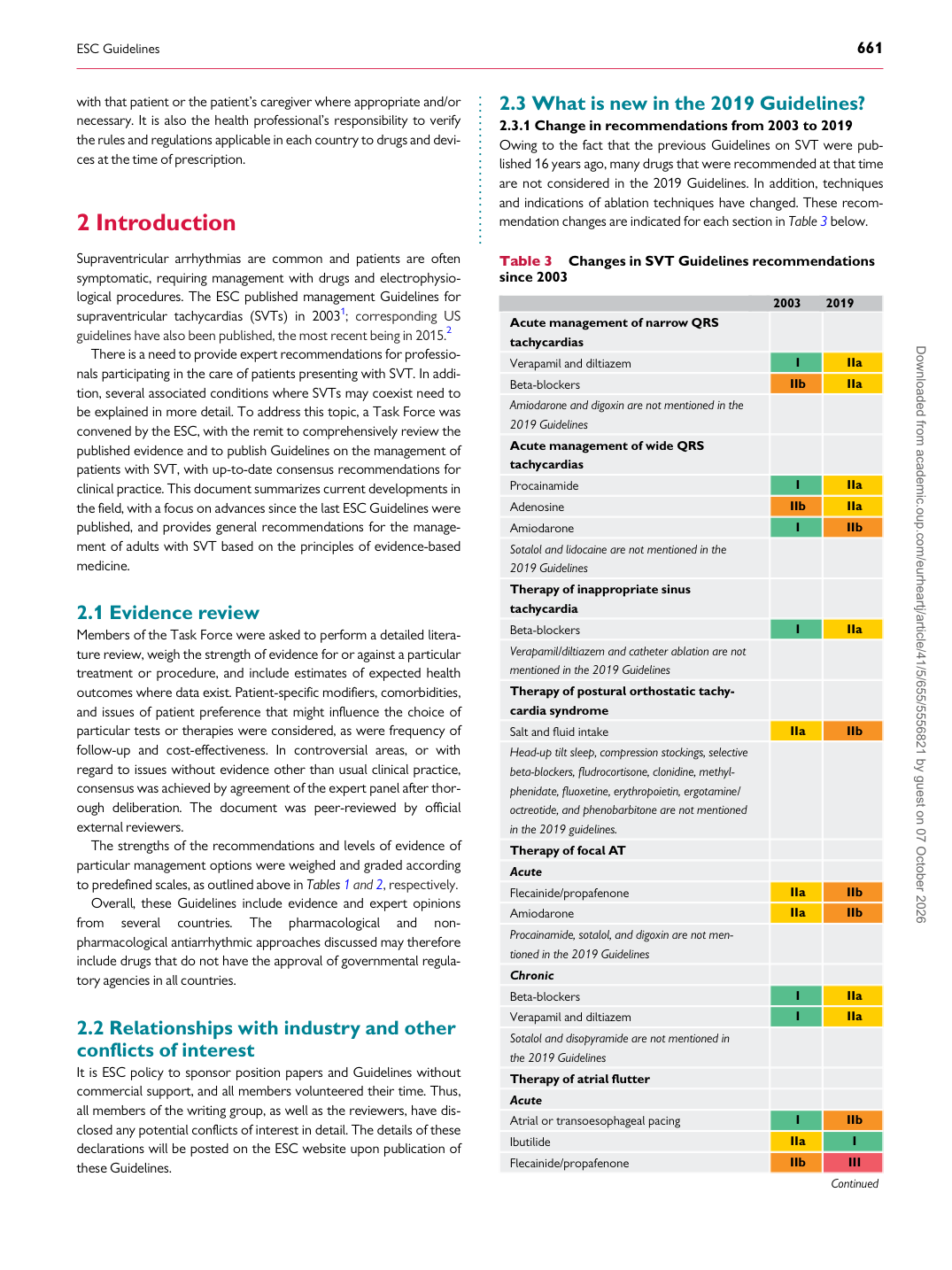
2.3.1 Change in recommendations from 2003 to 2019 Owing to the fact that the previous Guidelines on SVT were published 16 years ago, many drugs that were recommended at that time are not considered in the 2019 Guidelines. In addition, techniques and indications of ablation techniques have changed. These recommendation changes are indicated for each section in Table 3 below.

Table 3 Changes in SVT Guidelines recommendations since 2003

2003 2019

Acute management of narrow QRS tachycardias Verapamil and diltiazem I IIa Beta-blockers IIb IIa Amiodarone and digoxin are not mentioned in the 2019 Guidelines Acute management of wide QRS tachycardias Procainamide I IIa Adenosine IIb IIa Amiodarone I IIb Sotalol and lidocaine are not mentioned in the 2019 Guidelines Therapy of inappropriate sinus tachycardia Beta-blockers I IIa Verapamil/diltiazem and catheter ablation are not mentioned in the 2019 Guidelines Therapy of postural orthostatic tachycardia syndrome Salt and fluid intake IIa IIb Head-up tilt sleep, compression stockings, selective beta-blockers, fludrocortisone, clonidine, methylphenidate, fluoxetine, erythropoietin, ergotamine/ octreotide, and phenobarbitone are not mentioned in the 2019 guidelines. Therapy of focal AT Acute Flecainide/propafenone IIa IIb Amiodarone IIa IIb Procainamide, sotalol, and digoxin are not mentioned in the 2019 Guidelines Chronic Beta-blockers I IIa Verapamil and diltiazem I IIa Sotalol and disopyramide are not mentioned in the 2019 Guidelines Therapy of atrial flutter Acute Atrial or transoesophageal pacing I IIb Ibutilide IIa I Flecainide/propafenone IIb III

Continued Downloaded from academic.oup.com/eurheartj/article/41/5/655/5556821 by guest on 07 October 2026