p.12 抽出テキスト
©ESC 2019

AF Focal AT or flutter with variable AV conduction

Multifocal AT

Narrow QRS tachycardia

(QRS≤120 ms)

Yes

Yes

Yes

Yes No

No

No

No

Atrial flutter Focal AT AVNRT (rare)

Short (RP<PR)

RP>90 ms Short (RP<PR)

RP≤90 ms Long (RP≥PR)

AVRT Atypical AVNRT

Focal AT

Typical AVNRT

Focal AT JET AVRT (rare) Focal AT

AVRT Atypical AVNRT

High septal VT JET AVNRT (rare) Nodoventricular/fascicular-nodal

re-entry (rare)

Visible P waves?

Atrial rate greater than ventricular rate?

Ventricular rate greater than atrial rate

Consider RP Interval

Regular tachycardia

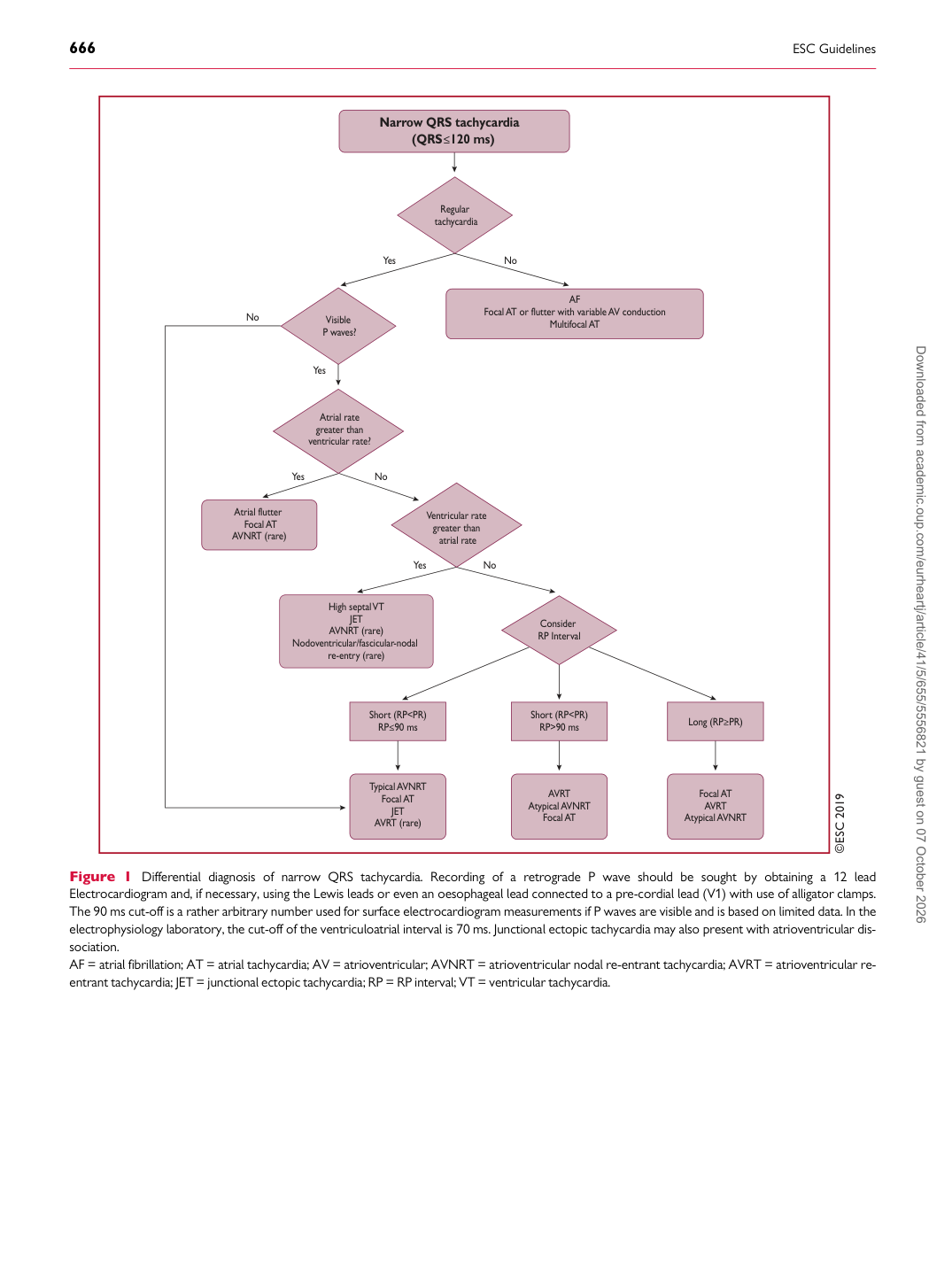
Figure 1 Differential diagnosis of narrow QRS tachycardia. Recording of a retrograde P wave should be sought by obtaining a 12 lead Electrocardiogram and, if necessary, using the Lewis leads or even an oesophageal lead connected to a pre-cordial lead (V1) with use of alligator clamps. The 90 ms cut-off is a rather arbitrary number used for surface electrocardiogram measurements if P waves are visible and is based on limited data. In the electrophysiology laboratory, the cut-off of the ventriculoatrial interval is 70 ms. Junctional ectopic tachycardia may also present with atrioventricular dissociation. AF = atrial fibrillation; AT = atrial tachycardia; AV = atrioventricular; AVNRT = atrioventricular nodal re-entrant tachycardia; AVRT = atrioventricular reentrant tachycardia; JET = junctional ectopic tachycardia; RP = RP interval; VT = ventricular tachycardia. Downloaded from academic.oup.com/eurheartj/article/41/5/655/5556821 by guest on 07 October 2026