p.58 抽出テキスト
16 ‘What to do’ and ‘what not to do’ messages from the Guidelines

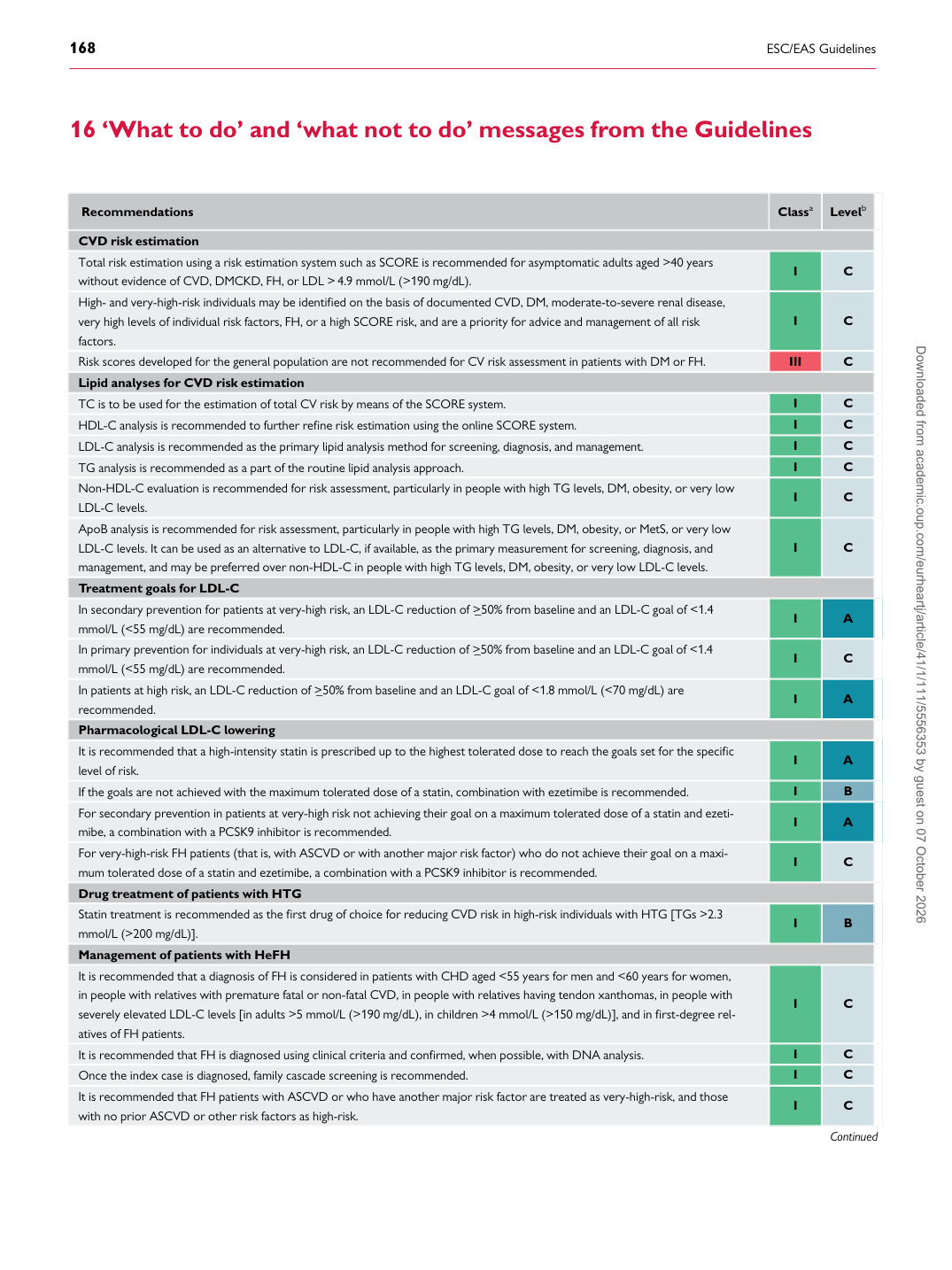
Recommendations Classa Levelb

CVD risk estimation Total risk estimation using a risk estimation system such as SCORE is recommended for asymptomatic adults aged >40 years without evidence of CVD, DMCKD, FH, or LDL > 4.9 mmol/L (>190 mg/dL). I C High- and very-high-risk individuals may be identified on the basis of documented CVD, DM, moderate-to-severe renal disease, very high levels of individual risk factors, FH, or a high SCORE risk, and are a priority for advice and management of all risk factors. I C Risk scores developed for the general population are not recommended for CV risk assessment in patients with DM or FH. III C Lipid analyses for CVD risk estimation TC is to be used for the estimation of total CV risk by means of the SCORE system. I C HDL-C analysis is recommended to further refine risk estimation using the online SCORE system. I C LDL-C analysis is recommended as the primary lipid analysis method for screening, diagnosis, and management. I C TG analysis is recommended as a part of the routine lipid analysis approach. I C Non-HDL-C evaluation is recommended for risk assessment, particularly in people with high TG levels, DM, obesity, or very low LDL-C levels. I C ApoB analysis is recommended for risk assessment, particularly in people with high TG levels, DM, obesity, or MetS, or very low LDL-C levels. It can be used as an alternative to LDL-C, if available, as the primary measurement for screening, diagnosis, and management, and may be preferred over non-HDL-C in people with high TG levels, DM, obesity, or very low LDL-C levels. I C Treatment goals for LDL-C In secondary prevention for patients at very-high risk, an LDL-C reduction of >_50% from baseline and an LDL-C goal of <1.4 mmol/L (<55 mg/dL) are recommended. I A In primary prevention for individuals at very-high risk, an LDL-C reduction of >_50% from baseline and an LDL-C goal of <1.4 mmol/L (<55 mg/dL) are recommended. I C In patients at high risk, an LDL-C reduction of >_50% from baseline and an LDL-C goal of <1.8 mmol/L (<70 mg/dL) are recommended. I A Pharmacological LDL-C lowering It is recommended that a high-intensity statin is prescribed up to the highest tolerated dose to reach the goals set for the specific level of risk. I A If the goals are not achieved with the maximum tolerated dose of a statin, combination with ezetimibe is recommended. I B For secondary prevention in patients at very-high risk not achieving their goal on a maximum tolerated dose of a statin and ezetimibe, a combination with a PCSK9 inhibitor is recommended. I A For very-high-risk FH patients (that is, with ASCVD or with another major risk factor) who do not achieve their goal on a maximum tolerated dose of a statin and ezetimibe, a combination with a PCSK9 inhibitor is recommended. I C Drug treatment of patients with HTG Statin treatment is recommended as the first drug of choice for reducing CVD risk in high-risk individuals with HTG [TGs >2.3 mmol/L (>200 mg/dL)]. I B Management of patients with HeFH It is recommended that a diagnosis of FH is considered in patients with CHD aged <55 years for men and <60 years for women, in people with relatives with premature fatal or non-fatal CVD, in people with relatives having tendon xanthomas, in people with severely elevated LDL-C levels [in adults >5 mmol/L (>190 mg/dL), in children >4 mmol/L (>150 mg/dL)], and in first-degree relatives of FH patients. I C It is recommended that FH is diagnosed using clinical criteria and confirmed, when possible, with DNA analysis. I C Once the index case is diagnosed, family cascade screening is recommended. I C It is recommended that FH patients with ASCVD or who have another major risk factor are treated as very-high-risk, and those with no prior ASCVD or other risk factors as high-risk. I C

Continued Downloaded from academic.oup.com/eurheartj/article/41/1/111/5556353 by guest on 07 October 2026