p.55 抽出テキスト
Box 8 lists the key messages regarding the cost-effectiveness of CVD prevention by lipid modification, and Box 9 highlights gaps in the evidence. ©ESC 2019

1,600

1,400

1,200

1,000

800 600

400 200

0 1 1.5 2 ≥5%, <10%

≥10%, <20%

≥20%, <30%

≥30%

LDL cholesterol reduction (mmol/L)

with statin treatment 5 year risk of major vascular event

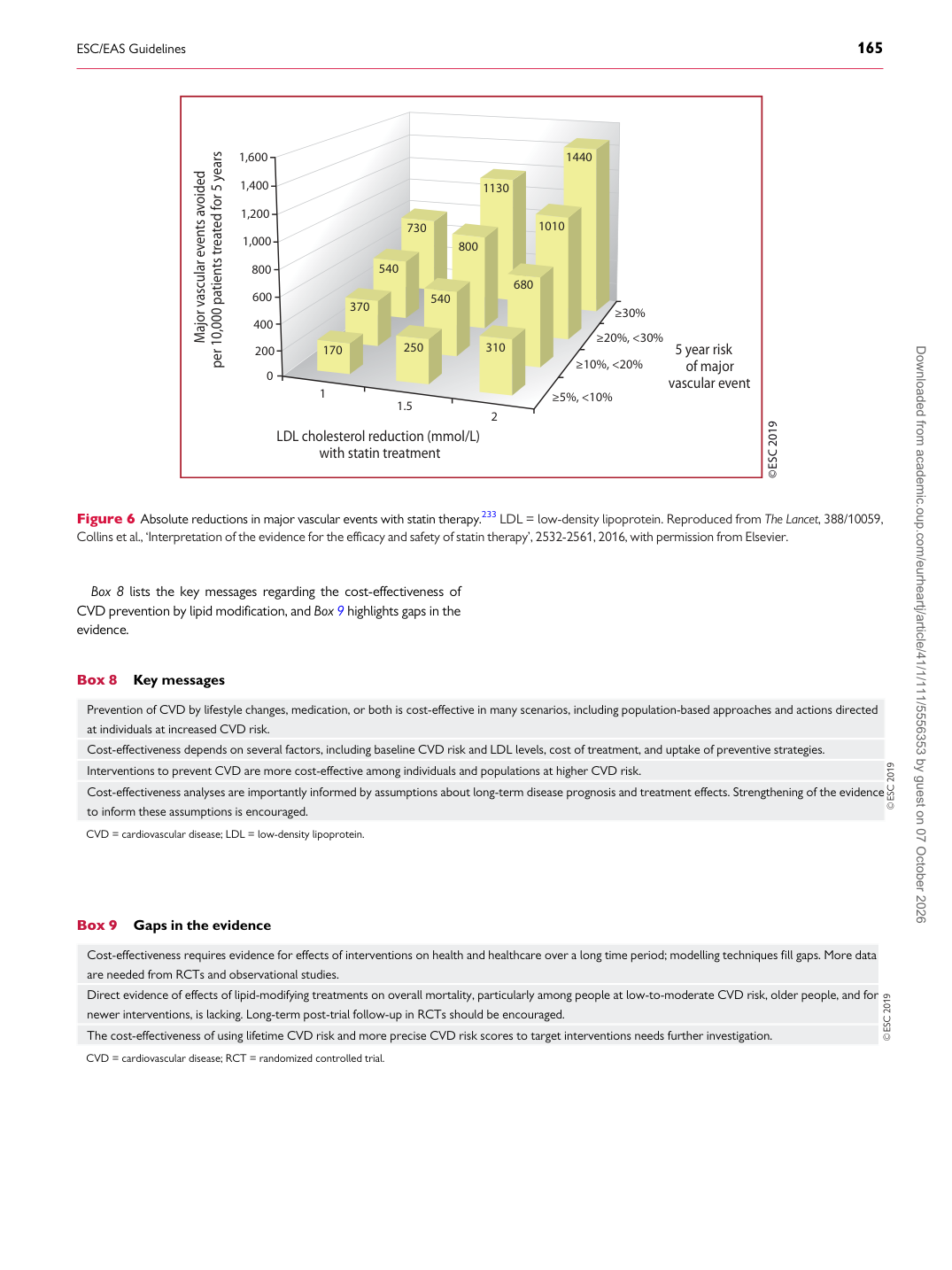
Major vascular events avoided per 10,000 patients treated for 5 years 730 1130 1440

540 800

1010 370 540 680

170 250 310

Figure 6 Absolute reductions in major vascular events with statin therapy.233 LDL = low-density lipoprotein. Reproduced from The Lancet, 388/10059, Collins et al., ‘Interpretation of the evidence for the efficacy and safety of statin therapy’, 2532-2561, 2016, with permission from Elsevier.

Box 8 Key messages

Prevention of CVD by lifestyle changes, medication, or both is cost-effective in many scenarios, including population-based approaches and actions directed at individuals at increased CVD risk. Cost-effectiveness depends on several factors, including baseline CVD risk and LDL levels, cost of treatment, and uptake of preventive strategies. Interventions to prevent CVD are more cost-effective among individuals and populations at higher CVD risk. Cost-effectiveness analyses are importantly informed by assumptions about long-term disease prognosis and treatment effects. Strengthening of the evidence to inform these assumptions is encouraged. CVD = cardiovascular disease; LDL = low-density lipoprotein.

Box 9 Gaps in the evidence

Cost-effectiveness requires evidence for effects of interventions on health and healthcare over a long time period; modelling techniques fill gaps. More data are needed from RCTs and observational studies. Direct evidence of effects of lipid-modifying treatments on overall mortality, particularly among people at low-to-moderate CVD risk, older people, and for newer interventions, is lacking. Long-term post-trial follow-up in RCTs should be encouraged. The cost-effectiveness of using lifetime CVD risk and more precise CVD risk scores to target interventions needs further investigation. CVD = cardiovascular disease; RCT = randomized controlled trial. Downloaded from academic.oup.com/eurheartj/article/41/1/111/5556353 by guest on 07 October 2026