p.8 抽出テキスト
........................................................................................ A variety of terms are used that generally do not match the definitions in this document closely enough to be used as synonyms of the defined terms. For example, a ‘faint’ approximately conforms to syncope but emphasizes vasovagal syncope (VVS) over other forms. A glossary of uncertain terms is shown in section 1 of the Web Practical Instructions.

3.2 Classification and pathophysiology of

syncope and transient loss of consciousness 3.2.1 Syncope Table 3 provides a classification of the principal causes of syncope, emphasizing groups of disorders with common pathophysiology, presentation, and risk. Clinical features, epidemiology, prognosis, impact on quality of life, and economic issues are shown in section 2 of the Web Practical Instructions. The pathophysiological classification centres on a fall in systemic blood pressure (BP) with a decrease in global cerebral blood flow as the defining characteristic of syncope. Figure 3 shows low BP and global cerebral hypoperfusion as the central final common pathway of syncope. A sudden cessation of cerebral blood flow for as short as 6–8 s can cause complete LOC. A systolic BP of 50–60 mmHg at heart level, i.e. 30–45 mmHg at brain level in the upright position, will cause LOC.8,9 Systemic BP is the product of cardiac output and total peripheral resistance; a fall in either can cause syncope. However, in syncope, both mechanisms often act together to a varying degree. There are three primary causes of a low total peripheral resistance. The first is decreased reflex activity causing vasodilatation through withdrawal of sympathetic vasoconstriction: this is the ‘vasodepressive type’ of reflex syncope, seen in the outer ring in Figure 3. The second is a functional impairment, and the third a structural impairment of the autonomic nervous system, with druginduced, primary, and secondary autonomic failure in the outer ring. In autonomic failure, there is insufficient sympathetic vasoconstriction in response to the upright position.

There are four primary causes of low cardiac output. The first is a reflex bradycardia, known as cardioinhibitory reflex syncope. The second concerns cardiovascular causes: arrhythmia, structural disease including pulmonary embolism, and pulmonary hypertension. The third is inadequate venous return due to volume depletion or venous pooling. Finally, chronotropic and inotropic incompetence through autonomic failure may impair cardiac output. Note that these primary mechanisms may interact in different ways: firstly, venous pooling and inadequate venous return is also a factor that can trigger an inappropriate reflex in orthostatic reflex syncope; secondly, a low total peripheral resistance may cause venous pooling of blood below the diaphragm, in turn decreasing venous return and consequently cardiac output. The three main groups of syncope, i.e. reflex, cardiovascular, and secondary to orthostatic hypotension (OH), are shown outside the rings in Figure 3. Both reflex syncope and OH span the two main pathophysiological mechanisms.

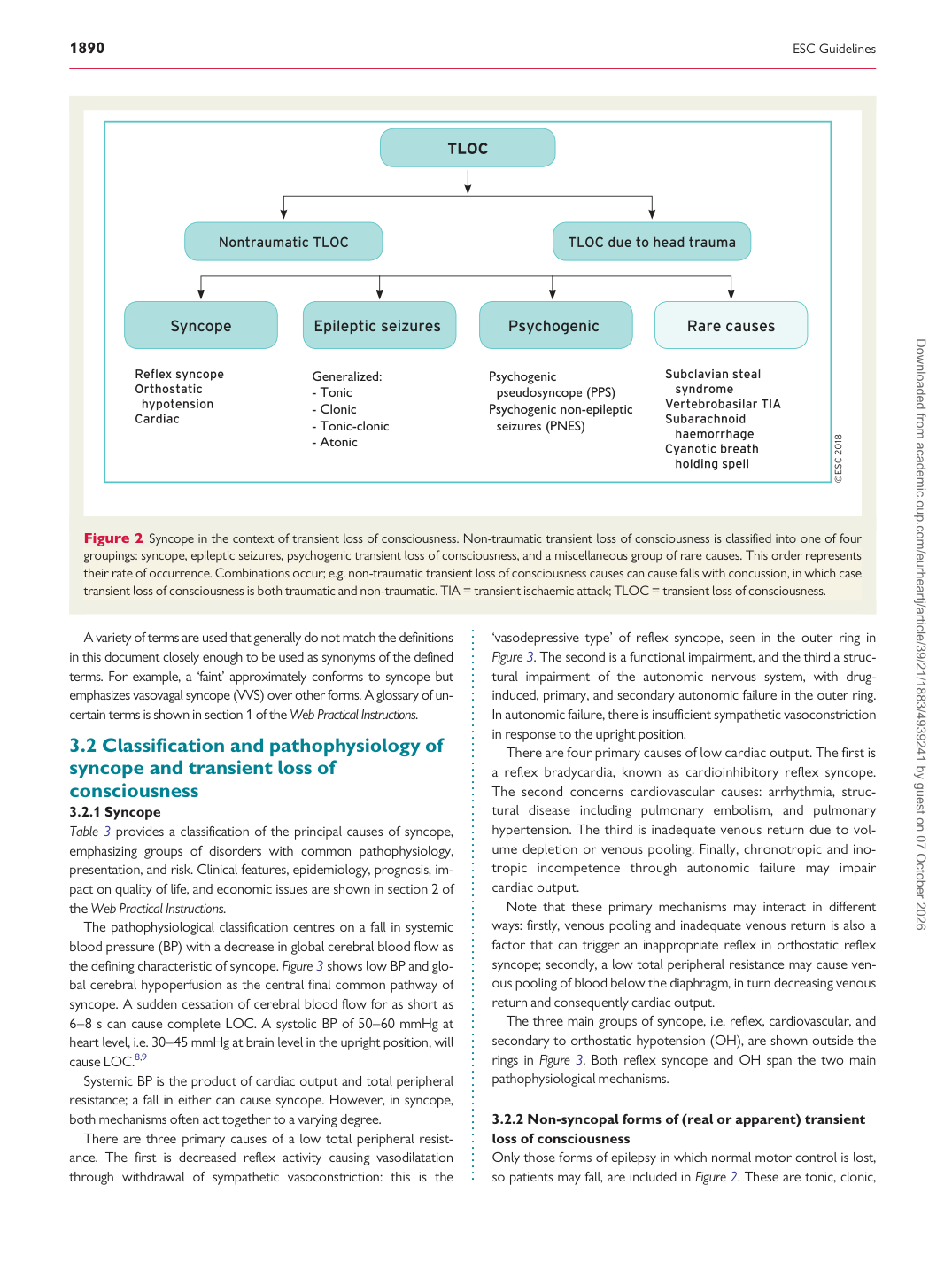
3.2.2 Non-syncopal forms of (real or apparent) transient loss of consciousness Only those forms of epilepsy in which normal motor control is lost, so patients may fall, are included in Figure 2. These are tonic, clonic,

Generalized: - Tonic - Clonic - Tonic-clonic - Atonic Psychogenic pseudosyncope (PPS) Psychogenic non-epileptic seizures (PNES)

Figure 2 Syncope in the context of transient loss of consciousness. Non-traumatic transient loss of consciousness is classified into one of four groupings: syncope, epileptic seizures, psychogenic transient loss of consciousness, and a miscellaneous group of rare causes. This order represents their rate of occurrence. Combinations occur; e.g. non-traumatic transient loss of consciousness causes can cause falls with concussion, in which case transient loss of consciousness is both traumatic and non-traumatic. TIA = transient ischaemic attack; TLOC = transient loss of consciousness. Downloaded from academic.oup.com/eurheartj/article/39/21/1883/4939241 by guest on 07 October 2026