p.7 抽出テキスト
.................................................................... management of patients with TLOC from their arrival in the emergency department (ED), and give practical instructions on how to set up outpatient syncope clinics (syncope units) aimed at reducing hospitalization, under- and misdiagnoses, and costs.

2.1 What is new in the 2018 version?

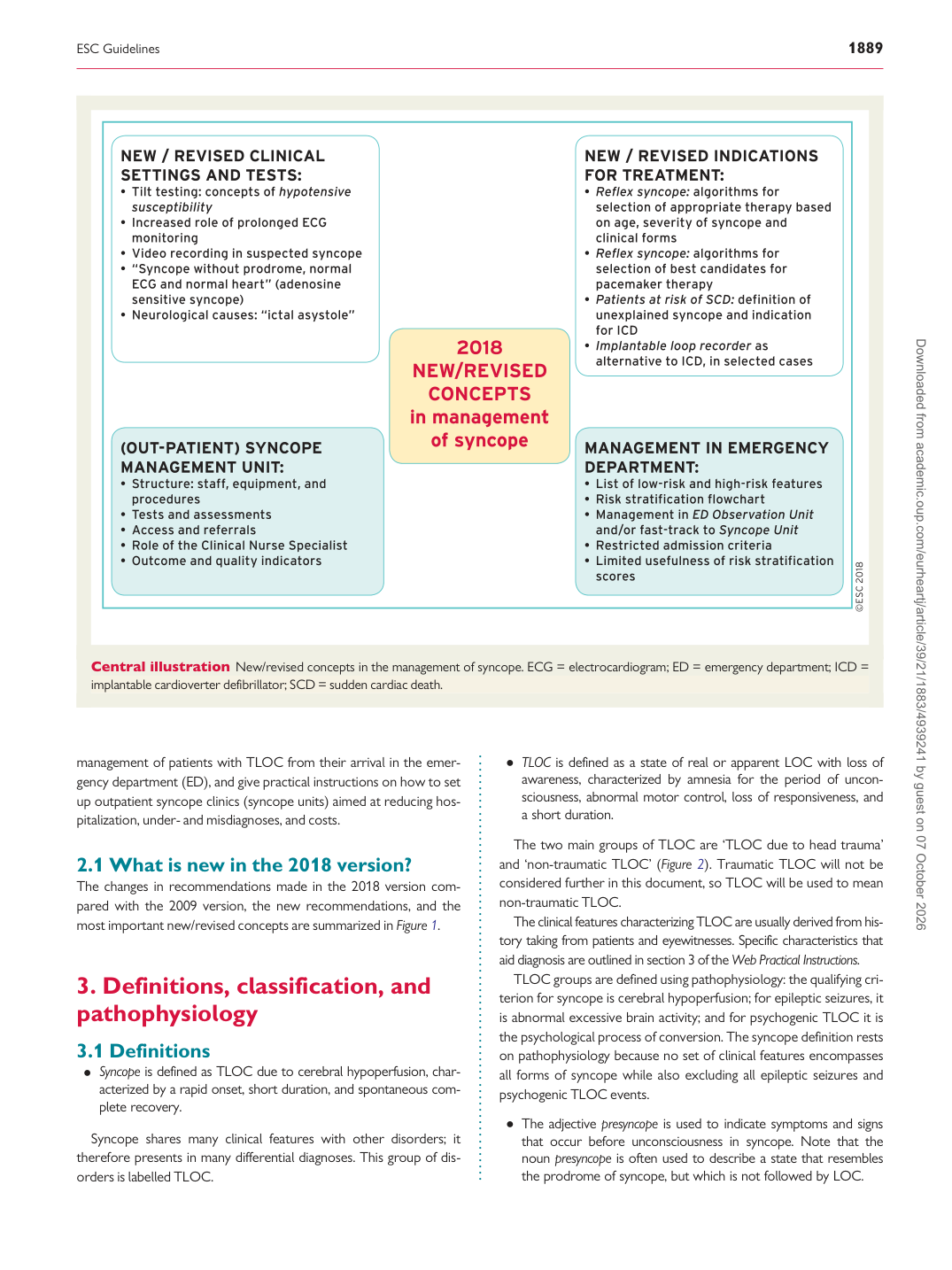
The changes in recommendations made in the 2018 version compared with the 2009 version, the new recommendations, and the most important new/revised concepts are summarized in Figure 1.

3 Definitions, classification, and

pathophysiology

3.1 Definitions

• Syncope is defined as TLOC due to cerebral hypoperfusion, characterized by a rapid onset, short duration, and spontaneous complete recovery. Syncope shares many clinical features with other disorders; it therefore presents in many differential diagnoses. This group of disorders is labelled TLOC. • TLOC is defined as a state of real or apparent LOC with loss of awareness, characterized by amnesia for the period of unconsciousness, abnormal motor control, loss of responsiveness, and a short duration.

The two main groups of TLOC are ‘TLOC due to head trauma’ and ‘non-traumatic TLOC’ (Figure 2). Traumatic TLOC will not be considered further in this document, so TLOC will be used to mean non-traumatic TLOC. The clinical features characterizing TLOC are usually derived from history taking from patients and eyewitnesses. Specific characteristics that aid diagnosis are outlined in section 3 of the Web Practical Instructions. TLOC groups are defined using pathophysiology: the qualifying criterion for syncope is cerebral hypoperfusion; for epileptic seizures, it is abnormal excessive brain activity; and for psychogenic TLOC it is the psychological process of conversion. The syncope definition rests on pathophysiology because no set of clinical features encompasses all forms of syncope while also excluding all epileptic seizures and psychogenic TLOC events. • The adjective presyncope is used to indicate symptoms and signs that occur before unconsciousness in syncope. Note that the noun presyncope is often used to describe a state that resembles the prodrome of syncope, but which is not followed by LOC.

Central illustration New/revised concepts in the management of syncope. ECG = electrocardiogram; ED = emergency department; ICD = implantable cardioverter defibrillator; SCD = sudden cardiac death. Downloaded from academic.oup.com/eurheartj/article/39/21/1883/4939241 by guest on 07 October 2026