p.57 抽出テキスト
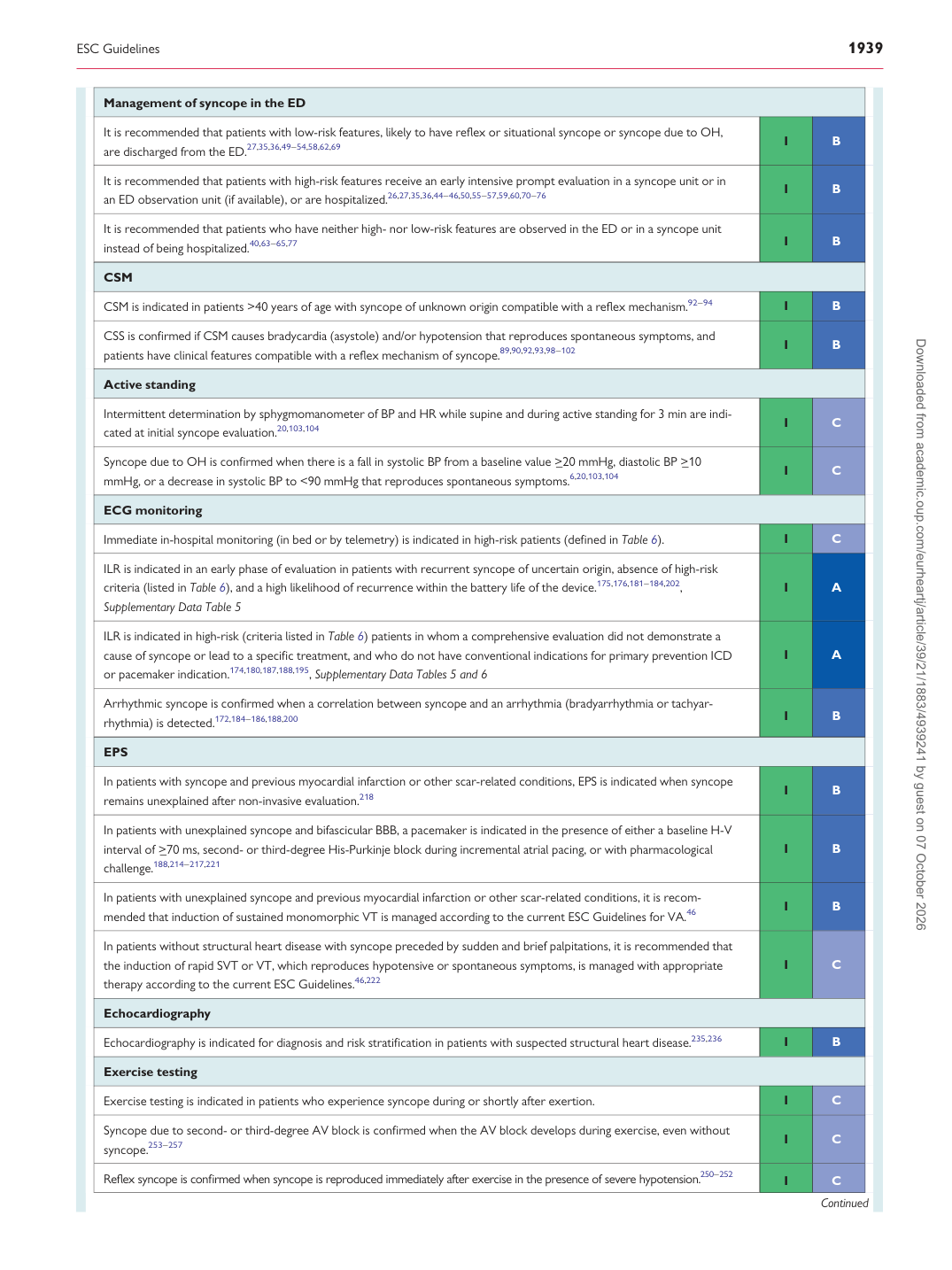
Management of syncope in the ED

It is recommended that patients with low-risk features, likely to have reflex or situational syncope or syncope due to OH, are discharged from the ED.27,35,36,49–54,58,62,69 I B

It is recommended that patients with high-risk features receive an early intensive prompt evaluation in a syncope unit or in an ED observation unit (if available), or are hospitalized.26,27,35,36,44–46,50,55–57,59,60,70–76 I B

It is recommended that patients who have neither high- nor low-risk features are observed in the ED or in a syncope unit instead of being hospitalized.40,63–65,77 I B

CSM CSM is indicated in patients >40 years of age with syncope of unknown origin compatible with a reflex mechanism.92–94 I B

CSS is confirmed if CSM causes bradycardia (asystole) and/or hypotension that reproduces spontaneous symptoms, and patients have clinical features compatible with a reflex mechanism of syncope.89,90,92,93,98–102 I B

Active standing

Intermittent determination by sphygmomanometer of BP and HR while supine and during active standing for 3 min are indicated at initial syncope evaluation.20,103,104 I C

Syncope due to OH is confirmed when there is a fall in systolic BP from a baseline value >_20 mmHg, diastolic BP >_10 mmHg, or a decrease in systolic BP to <90 mmHg that reproduces spontaneous symptoms.6,20,103,104 I C

ECG monitoring

Immediate in-hospital monitoring (in bed or by telemetry) is indicated in high-risk patients (defined in Table 6). I C

ILR is indicated in an early phase of evaluation in patients with recurrent syncope of uncertain origin, absence of high-risk criteria (listed in Table 6), and a high likelihood of recurrence within the battery life of the device.175,176,181–184,202, Supplementary Data Table 5 I A

ILR is indicated in high-risk (criteria listed in Table 6) patients in whom a comprehensive evaluation did not demonstrate a cause of syncope or lead to a specific treatment, and who do not have conventional indications for primary prevention ICD or pacemaker indication.174,180,187,188,195, Supplementary Data Tables 5 and 6 I A

Arrhythmic syncope is confirmed when a correlation between syncope and an arrhythmia (bradyarrhythmia or tachyarrhythmia) is detected.172,184–186,188,200 I B

EPS

In patients with syncope and previous myocardial infarction or other scar-related conditions, EPS is indicated when syncope remains unexplained after non-invasive evaluation.218 I B

In patients with unexplained syncope and bifascicular BBB, a pacemaker is indicated in the presence of either a baseline H-V interval of >_70 ms, second- or third-degree His-Purkinje block during incremental atrial pacing, or with pharmacological challenge.188,214–217,221 I B

In patients with unexplained syncope and previous myocardial infarction or other scar-related conditions, it is recommended that induction of sustained monomorphic VT is managed according to the current ESC Guidelines for VA.46 I B

In patients without structural heart disease with syncope preceded by sudden and brief palpitations, it is recommended that the induction of rapid SVT or VT, which reproduces hypotensive or spontaneous symptoms, is managed with appropriate therapy according to the current ESC Guidelines.46,222 I C

Echocardiography Echocardiography is indicated for diagnosis and risk stratification in patients with suspected structural heart disease.235,236 I B

Exercise testing

Exercise testing is indicated in patients who experience syncope during or shortly after exertion. I C

Syncope due to second- or third-degree AV block is confirmed when the AV block develops during exercise, even without syncope.253–257 I C Reflex syncope is confirmed when syncope is reproduced immediately after exercise in the presence of severe hypotension.250–252 I C

Continued Downloaded from academic.oup.com/eurheartj/article/39/21/1883/4939241 by guest on 07 October 2026