p.56 抽出テキスト
..................................................................................... Therefore, there is a need for:

2) Large clinical studies that test the superiority of management in a dedicated syncope facility vs. conventional management

Diagnosis: the need for new diagnostic tests and devices BP recording is crucial for the majority of clinical TLOC situations and will yield important information for the treatment of syncope. Unfortunately, current long-term BP (or surrogate) recording systems are not optimal for diagnostic use in the syncope evaluation setting.

Therefore, there is a need for:

3) Development and validation of new diagnostic multiparametric devices that can record heart rhythm and BP (and possibly other physiological parameters such as cerebral saturation or EEG) at the time of a syncopal event.

Treatment: lack of evidence of efficacy of most available therapies Only a few small RCTs have been conducted on treatment of syncope. In addition, syncopal recurrences are unpredictable and often decrease spontaneously after medical assessment, even in the absence of a specific therapy. The consequence of the spontaneous decrease is that any therapy for syncope prevention appears to be more effective than it actually is, making the results of observational data on therapy questionable in the absence of a control group. No therapy can be effective for all patients. Any therapy should be assessed in homogeneous subgroups. Therefore, there is strong urgent need for RCTs on the efficacy of:

4) Pharmacological therapies targeted to specific subgroups of reflex syncope. 5) Pacemaker therapy targeted to specific subgroups of cardioinhibitory reflex syncope. 6) Pharmacological therapies of OH-mediated syncope. 7) ICD therapy targeted to specific subgroups of patients with unexplained syncope at risk of SCD.

Treatment: the need for new therapies There is a need to move towards personalized medicine. Improving our knowledge of the biochemical mechanisms underlying specific forms of reflex syncope will allow the development of new therapies in such specific settings. For example, a low adenosine phenotype and a low norepinephrine phenotype have been recently identified.

Therefore, there is a need for:

8) Randomized clinical trials on the efficacy of theophylline (and other xantine antagonists) for low adenosine syncope and norepinephrine transport inhibitors for low epinephrine syncope.

Syncope is a transient phenomenon. The ideal therapy should be one that is administered only when needed.

Therefore, there is a need for:

9) Randomized clinical trials of on-demand administration of specific therapy based on specific sensors similar to adrenalin injectors in asthma or nasal spray for paroxysmal SVT.

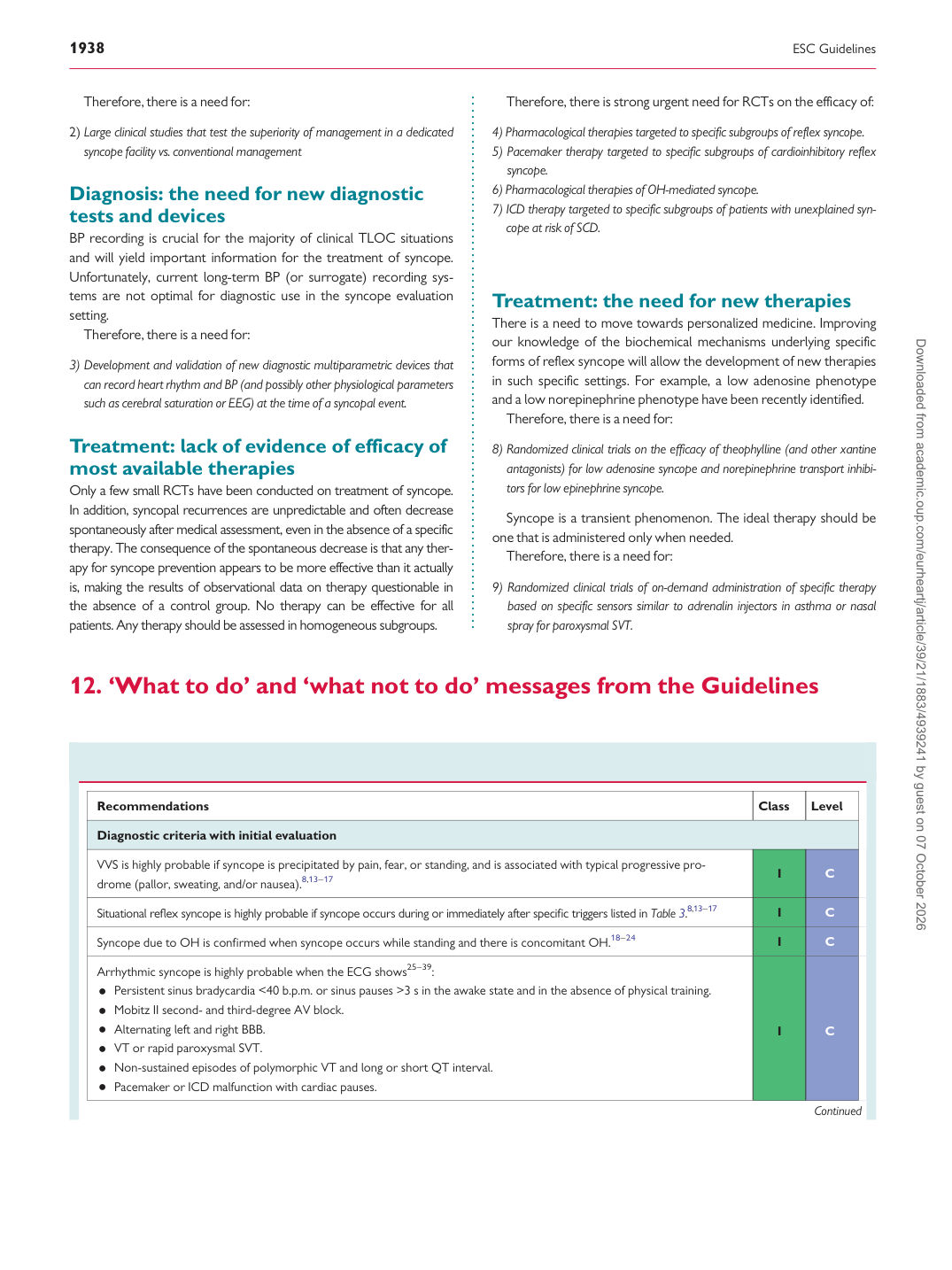
Recommendations Class Level

Diagnostic criteria with initial evaluation

VVS is highly probable if syncope is precipitated by pain, fear, or standing, and is associated with typical progressive prodrome (pallor, sweating, and/or nausea).8,13–17 I C Situational reflex syncope is highly probable if syncope occurs during or immediately after specific triggers listed in Table 3.8,13–17 I C Syncope due to OH is confirmed when syncope occurs while standing and there is concomitant OH.18–24 I C Arrhythmic syncope is highly probable when the ECG shows25–39: • Persistent sinus bradycardia <40 b.p.m. or sinus pauses >3 s in the awake state and in the absence of physical training. • Mobitz II second- and third-degree AV block. • Alternating left and right BBB. • VT or rapid paroxysmal SVT. • Non-sustained episodes of polymorphic VT and long or short QT interval. • Pacemaker or ICD malfunction with cardiac pauses. I C

Continued

12 ‘What to do’ and ‘what not to do’ messages from the Guidelines Downloaded from academic.oup.com/eurheartj/article/39/21/1883/4939241 by guest on 07 October 2026