p.52 抽出テキスト
....................................... 9.1.2 Definition of syncope specialist The syncope specialist is defined as one who has responsibility for the comprehensive management of the patient from risk stratification to diagnosis, therapy, and follow-up, through a standardized protocol. A syncope specialist is a physician who has sufficient knowledge of historical clues and physical findings to recognize all major forms of TLOC, including mimics, as well as syndromes of orthostatic intolerance.

9.1.3 Goal of a syncope unit Although the benefit of a syncope unit or a syncope specialist in the different healthcare systems has not been exposed to rigorous scientific or economic scrutiny, the consensus is that a dedicated service (a syncope unit) affords better management of TLOC, from risk stratification to diagnosis, therapy, and follow-up, and better education and training of stakeholders. Further research is likely to have an important impact on our confidence in the estimate of effect.

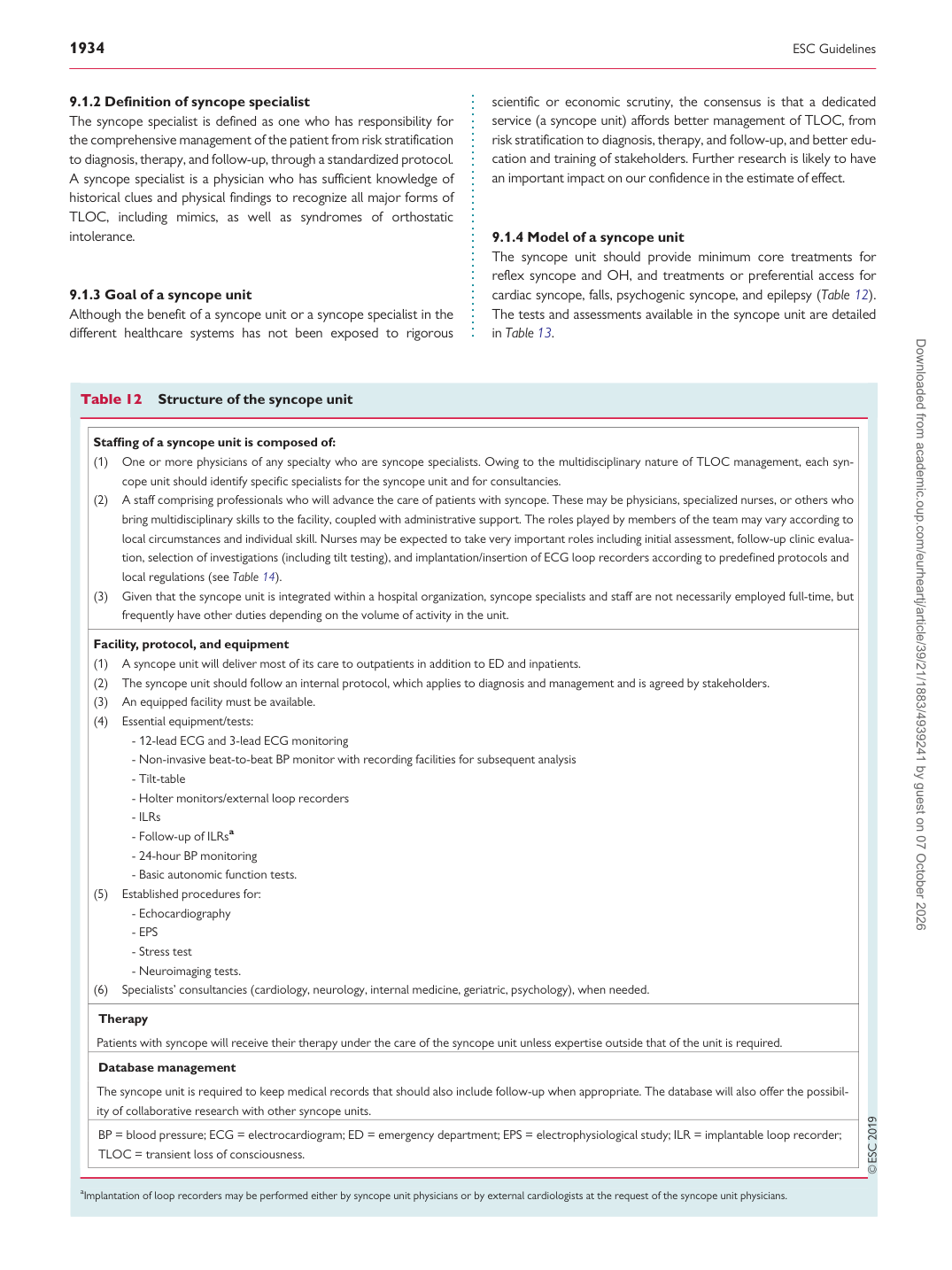
9.1.4 Model of a syncope unit The syncope unit should provide minimum core treatments for reflex syncope and OH, and treatments or preferential access for cardiac syncope, falls, psychogenic syncope, and epilepsy (Table 12). The tests and assessments available in the syncope unit are detailed in Table 13.

Table 12 Structure of the syncope unit

Staffing of a syncope unit is composed of: (1) One or more physicians of any specialty who are syncope specialists. Owing to the multidisciplinary nature of TLOC management, each syn-

cope unit should identify specific specialists for the syncope unit and for consultancies. (2) A staff comprising professionals who will advance the care of patients with syncope. These may be physicians, specialized nurses, or others who bring multidisciplinary skills to the facility, coupled with administrative support. The roles played by members of the team may vary according to

local circumstances and individual skill. Nurses may be expected to take very important roles including initial assessment, follow-up clinic evaluation, selection of investigations (including tilt testing), and implantation/insertion of ECG loop recorders according to predefined protocols and local regulations (see Table 14). (3) Given that the syncope unit is integrated within a hospital organization, syncope specialists and staff are not necessarily employed full-time, but

frequently have other duties depending on the volume of activity in the unit.

Facility, protocol, and equipment (1) A syncope unit will deliver most of its care to outpatients in addition to ED and inpatients. (2) The syncope unit should follow an internal protocol, which applies to diagnosis and management and is agreed by stakeholders. (3) An equipped facility must be available. (4) Essential equipment/tests:

- 12-lead ECG and 3-lead ECG monitoring - Non-invasive beat-to-beat BP monitor with recording facilities for subsequent analysis - Tilt-table - Holter monitors/external loop recorders - ILRs - Follow-up of ILRsa - 24-hour BP monitoring - Basic autonomic function tests. (5) Established procedures for:

- Echocardiography - EPS - Stress test - Neuroimaging tests. (6) Specialists’ consultancies (cardiology, neurology, internal medicine, geriatric, psychology), when needed.

Therapy Patients with syncope will receive their therapy under the care of the syncope unit unless expertise outside that of the unit is required. Database management The syncope unit is required to keep medical records that should also include follow-up when appropriate. The database will also offer the possibility of collaborative research with other syncope units. BP = blood pressure; ECG = electrocardiogram; ED = emergency department; EPS = electrophysiological study; ILR = implantable loop recorder; TLOC = transient loss of consciousness.

aImplantation of loop recorders may be performed either by syncope unit physicians or by external cardiologists at the request of the syncope unit physicians. Downloaded from academic.oup.com/eurheartj/article/39/21/1883/4939241 by guest on 07 October 2026