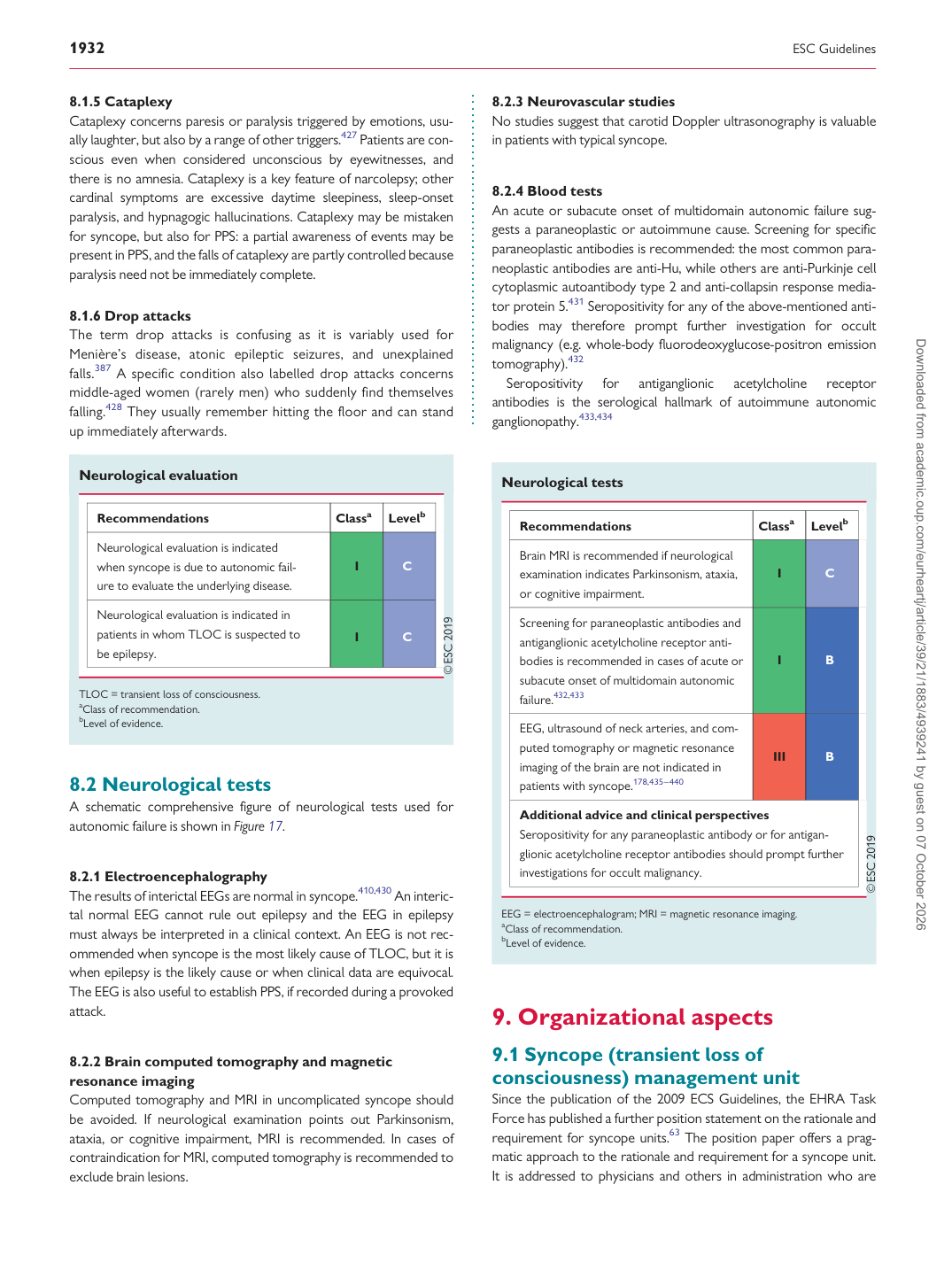
p.50 抽出テキスト
..................................................... 8.1.5 Cataplexy Cataplexy concerns paresis or paralysis triggered by emotions, usually laughter, but also by a range of other triggers.427 Patients are conscious even when considered unconscious by eyewitnesses, and there is no amnesia. Cataplexy is a key feature of narcolepsy; other cardinal symptoms are excessive daytime sleepiness, sleep-onset paralysis, and hypnagogic hallucinations. Cataplexy may be mistaken for syncope, but also for PPS: a partial awareness of events may be present in PPS, and the falls of cataplexy are partly controlled because paralysis need not be immediately complete.

8.1.6 Drop attacks The term drop attacks is confusing as it is variably used for Menie`re’s disease, atonic epileptic seizures, and unexplained falls.387 A specific condition also labelled drop attacks concerns middle-aged women (rarely men) who suddenly find themselves falling.428 They usually remember hitting the floor and can stand up immediately afterwards.

8.2 Neurological tests

A schematic comprehensive figure of neurological tests used for autonomic failure is shown in Figure 17.

8.2.1 Electroencephalography The results of interictal EEGs are normal in syncope.410,430 An interictal normal EEG cannot rule out epilepsy and the EEG in epilepsy must always be interpreted in a clinical context. An EEG is not recommended when syncope is the most likely cause of TLOC, but it is when epilepsy is the likely cause or when clinical data are equivocal. The EEG is also useful to establish PPS, if recorded during a provoked attack.

8.2.2 Brain computed tomography and magnetic resonance imaging Computed tomography and MRI in uncomplicated syncope should be avoided. If neurological examination points out Parkinsonism, ataxia, or cognitive impairment, MRI is recommended. In cases of contraindication for MRI, computed tomography is recommended to exclude brain lesions. 8.2.3 Neurovascular studies No studies suggest that carotid Doppler ultrasonography is valuable in patients with typical syncope.

8.2.4 Blood tests An acute or subacute onset of multidomain autonomic failure suggests a paraneoplastic or autoimmune cause. Screening for specific paraneoplastic antibodies is recommended: the most common paraneoplastic antibodies are anti-Hu, while others are anti-Purkinje cell cytoplasmic autoantibody type 2 and anti-collapsin response mediator protein 5.431 Seropositivity for any of the above-mentioned antibodies may therefore prompt further investigation for occult malignancy (e.g. whole-body fluorodeoxyglucose-positron emission tomography).432 Seropositivity for antiganglionic acetylcholine receptor antibodies is the serological hallmark of autoimmune autonomic ganglionopathy.433,434

9 Organizational aspects

9.1 Syncope (transient loss of

consciousness) management unit Since the publication of the 2009 ECS Guidelines, the EHRA Task Force has published a further position statement on the rationale and requirement for syncope units.63 The position paper offers a pragmatic approach to the rationale and requirement for a syncope unit. It is addressed to physicians and others in administration who are

Neurological evaluation

Recommendations Classa Levelb

Neurological evaluation is indicated when syncope is due to autonomic failure to evaluate the underlying disease. I C

Neurological evaluation is indicated in patients in whom TLOC is suspected to be epilepsy. I C

TLOC = transient loss of consciousness. aClass of recommendation. bLevel of evidence. Neurological tests

Recommendations Classa Levelb

Brain MRI is recommended if neurological examination indicates Parkinsonism, ataxia, or cognitive impairment. I C

Screening for paraneoplastic antibodies and antiganglionic acetylcholine receptor antibodies is recommended in cases of acute or subacute onset of multidomain autonomic failure.432,433 I B

EEG, ultrasound of neck arteries, and computed tomography or magnetic resonance imaging of the brain are not indicated in patients with syncope.178,435–440 III B

Additional advice and clinical perspectives Seropositivity for any paraneoplastic antibody or for antiganglionic acetylcholine receptor antibodies should prompt further investigations for occult malignancy.

EEG = electroencephalogram; MRI = magnetic resonance imaging. aClass of recommendation. bLevel of evidence. Downloaded from academic.oup.com/eurheartj/article/39/21/1883/4939241 by guest on 07 October 2026