p.5 抽出テキスト
...................................................... These versions are abridged and thus, if needed, one should always refer to the full-text version, which is freely available via the ESC website and hosted on the EHJ website. The National Societies of the ESC are encouraged to endorse, translate and implement all ESC Guidelines. Implementation programmes are needed because it has been shown that the outcome of disease may be favourably influenced by the thorough application of clinical recommendations.

Surveys and registries are needed to verify that real-life daily practice is in keeping with what is recommended in the guidelines, thus completing the loop between clinical research, writing of guidelines, disseminating them and implementing them into clinical practice. Health professionals are encouraged to take the ESC Guidelines fully into account when exercising their clinical judgment, as well as in the determination and the implementation of preventive, diagnostic, or therapeutic medical strategies. However, the ESC Guidelines do not override in any way whatsoever the individual responsibility of health professionals to make appropriate and accurate decisions in consideration of each patient’s health condition and in consultation with that patient or the patient’s caregiver where appropriate and/or necessary. It is also the health professional’s responsibility to verify the rules and regulations applicable to drugs and devices at the time of prescription.

2 Introduction

The first ESC Guidelines for the management of syncope were published in 2001, with subsequent versions in 2004 and 2009. In March 2015, the ESC CPG considered that there were enough new data to justify the production of new Guidelines. The most important aspect characterizing this document is the composition of the Task Force, which is truly multidisciplinary. Cardiologists form a minority of the panel; experts in emergency medicine, internal medicine and physiology, neurology and autonomic diseases, geriatric medicine, and nursing cover all aspects of management of the various forms of syncope and transient loss of consciousness (TLOC).

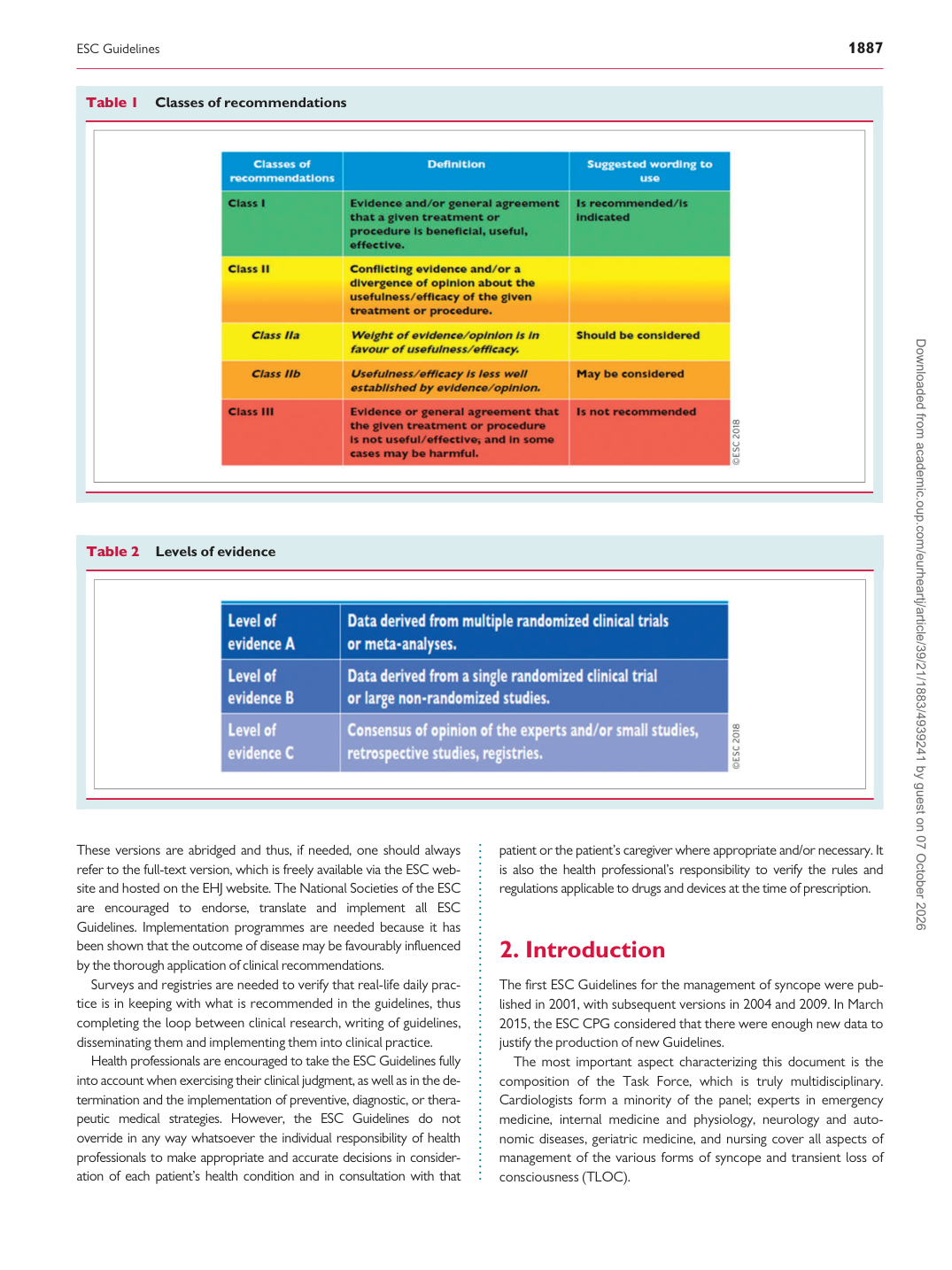
Table 1 Classes of recommendations

Table 2 Levels of evidence Downloaded from academic.oup.com/eurheartj/article/39/21/1883/4939241 by guest on 07 October 2026