p.48 抽出テキスト
............................................................................................................................................................................. tested. Secondary features: subtle signs incompatible with LOC such as eyelid flicker, eyeball movements, swallowing, intact muscle tone, normal movements absent in true unconsciousness, and resistance to eye opening. • BP: normal or elevated during TLOC. • EEG: normal waking eye-closed EEG pattern, i.e. usually with alpha activity, during TLOC.

The gold standard for PPS is documenting an attack with a home video recorder or with a tilt testing during which BP, HR, and EEG are normal.116,204,404 The gold standard for PNES is documenting an attack with video-EEG monitoring.204,404

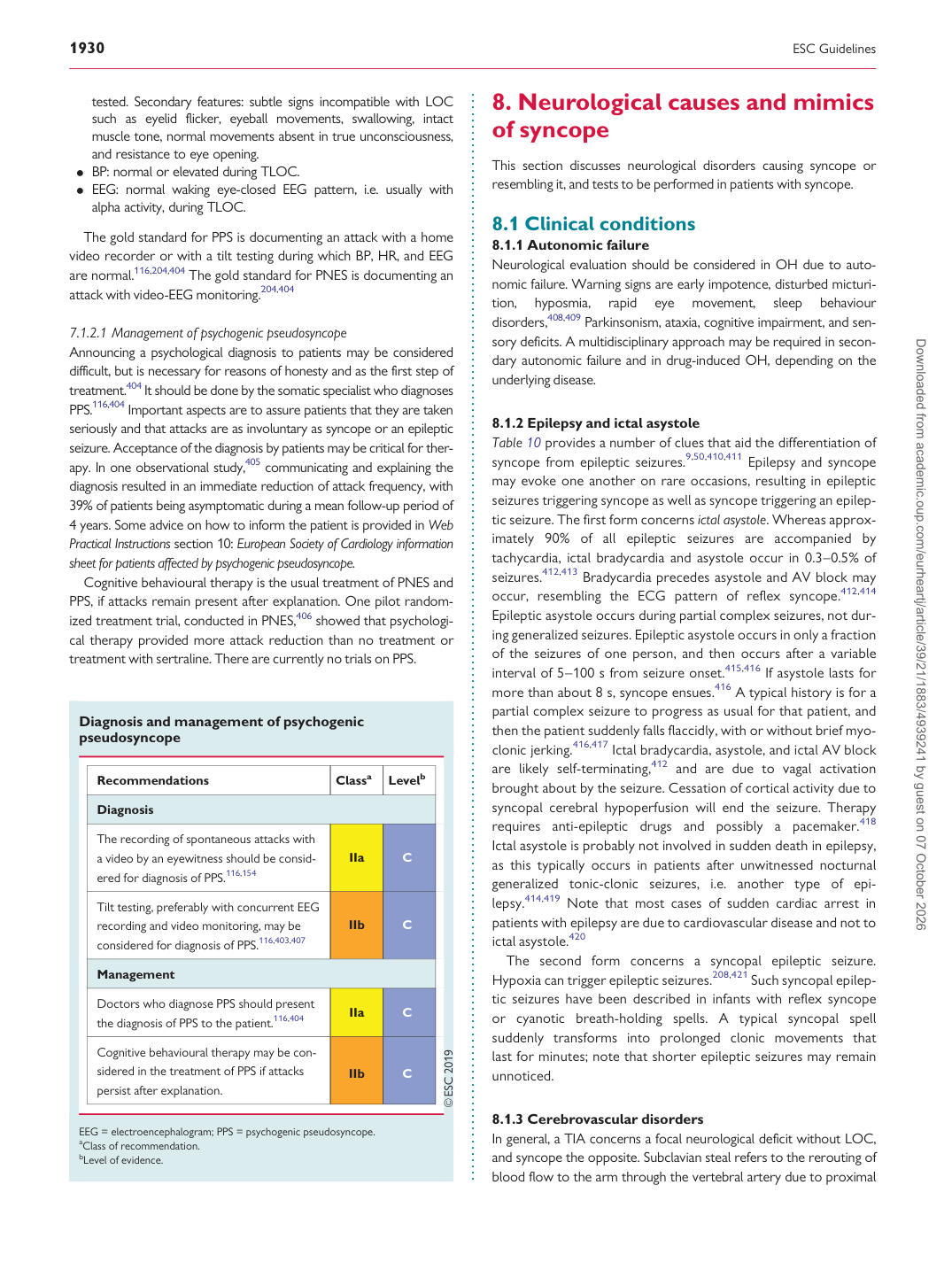
7.1.2.1 Management of psychogenic pseudosyncope Announcing a psychological diagnosis to patients may be considered difficult, but is necessary for reasons of honesty and as the first step of treatment.404 It should be done by the somatic specialist who diagnoses PPS.116,404 Important aspects are to assure patients that they are taken seriously and that attacks are as involuntary as syncope or an epileptic seizure. Acceptance of the diagnosis by patients may be critical for therapy. In one observational study,405 communicating and explaining the diagnosis resulted in an immediate reduction of attack frequency, with 39% of patients being asymptomatic during a mean follow-up period of 4 years. Some advice on how to inform the patient is provided in Web Practical Instructions section 10: European Society of Cardiology information sheet for patients affected by psychogenic pseudosyncope. Cognitive behavioural therapy is the usual treatment of PNES and PPS, if attacks remain present after explanation. One pilot randomized treatment trial, conducted in PNES,406 showed that psychological therapy provided more attack reduction than no treatment or treatment with sertraline. There are currently no trials on PPS. 8 Neurological causes and mimics

of syncope

This section discusses neurological disorders causing syncope or resembling it, and tests to be performed in patients with syncope.

8.1 Clinical conditions

8.1.1 Autonomic failure Neurological evaluation should be considered in OH due to autonomic failure. Warning signs are early impotence, disturbed micturition, hyposmia, rapid eye movement, sleep behaviour disorders,408,409 Parkinsonism, ataxia, cognitive impairment, and sensory deficits. A multidisciplinary approach may be required in secondary autonomic failure and in drug-induced OH, depending on the underlying disease.

8.1.2 Epilepsy and ictal asystole Table 10 provides a number of clues that aid the differentiation of syncope from epileptic seizures.9,50,410,411 Epilepsy and syncope may evoke one another on rare occasions, resulting in epileptic seizures triggering syncope as well as syncope triggering an epileptic seizure. The first form concerns ictal asystole. Whereas approximately 90% of all epileptic seizures are accompanied by tachycardia, ictal bradycardia and asystole occur in 0.3–0.5% of seizures.412,413 Bradycardia precedes asystole and AV block may occur, resembling the ECG pattern of reflex syncope.412,414 Epileptic asystole occurs during partial complex seizures, not during generalized seizures. Epileptic asystole occurs in only a fraction of the seizures of one person, and then occurs after a variable interval of 5–100 s from seizure onset.415,416 If asystole lasts for more than about 8 s, syncope ensues.416 A typical history is for a partial complex seizure to progress as usual for that patient, and then the patient suddenly falls flaccidly, with or without brief myoclonic jerking.416,417 Ictal bradycardia, asystole, and ictal AV block are likely self-terminating,412 and are due to vagal activation brought about by the seizure. Cessation of cortical activity due to syncopal cerebral hypoperfusion will end the seizure. Therapy requires anti-epileptic drugs and possibly a pacemaker.418 Ictal asystole is probably not involved in sudden death in epilepsy, as this typically occurs in patients after unwitnessed nocturnal generalized tonic-clonic seizures, i.e. another type of epilepsy.414,419 Note that most cases of sudden cardiac arrest in patients with epilepsy are due to cardiovascular disease and not to ictal asystole.420 The second form concerns a syncopal epileptic seizure. Hypoxia can trigger epileptic seizures.208,421 Such syncopal epileptic seizures have been described in infants with reflex syncope or cyanotic breath-holding spells. A typical syncopal spell suddenly transforms into prolonged clonic movements that last for minutes; note that shorter epileptic seizures may remain unnoticed.

8.1.3 Cerebrovascular disorders In general, a TIA concerns a focal neurological deficit without LOC, and syncope the opposite. Subclavian steal refers to the rerouting of blood flow to the arm through the vertebral artery due to proximal

Diagnosis and management of psychogenic pseudosyncope

Recommendations Classa Levelb

Diagnosis

The recording of spontaneous attacks with a video by an eyewitness should be considered for diagnosis of PPS.116,154 IIa C

Tilt testing, preferably with concurrent EEG recording and video monitoring, may be considered for diagnosis of PPS.116,403,407 IIb C

Management

Doctors who diagnose PPS should present the diagnosis of PPS to the patient.116,404 IIa C

Cognitive behavioural therapy may be considered in the treatment of PPS if attacks persist after explanation. IIb C

EEG = electroencephalogram; PPS = psychogenic pseudosyncope. aClass of recommendation. bLevel of evidence. Downloaded from academic.oup.com/eurheartj/article/39/21/1883/4939241 by guest on 07 October 2026