p.46 抽出テキスト
........................................................ cardiovascular diagnoses such as aortic stenosis or atrial fibrillation377

may not necessarily be the attributable cause of events.378–380 The prescription of polypharmacy, cardiovascular medications, and psychotropic (neuroleptics and antidepressants) and dopaminergic drugs also increases the risk of syncope and falls.381–385 Conversely, the discontinuation or reduction of hypotensive therapy reduces such risk.260 Negative dromotropic and chronotropic medications should be carefully evaluated in older patients presenting with syncope or falls. Focal neurological events can occasionally occur due to hypotension and syncope, even in patients without significant carotid artery stenosis (so called ‘hypotensive TIA’). Although these neurological events occur in only 6% of patients with recurrent syncope, their misdiagnosis is particularly important because they may lead to a lowering of BP with antihypertensive medications (e.g. if focal neurology is mistakenly attributed to vascular pathology rather than hypotension), and to a further increase of the risk of syncope and neurologic events.386

Despite the lack of large controlled trials and an overall modest quality of studies, there is strong consensus that reduction or discontinuation of hypotensive drugs and psychotropic drugs clearly outweighs the undesirable effects (e.g. complications) of high BP. Further research is likely to have an important impact on our confidence in the estimate of effect.

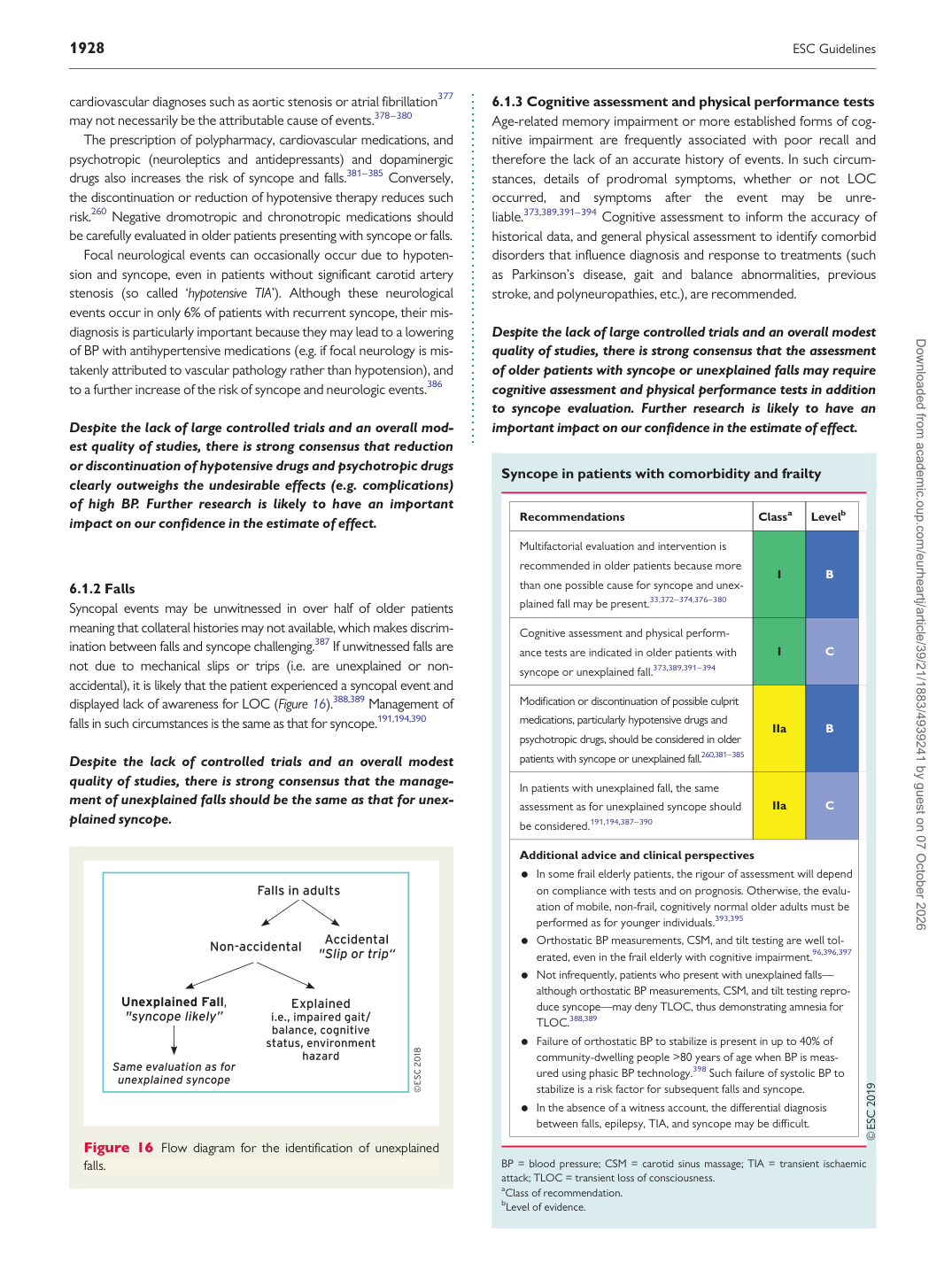
6.1.2 Falls Syncopal events may be unwitnessed in over half of older patients meaning that collateral histories may not available, which makes discrimination between falls and syncope challenging.387 If unwitnessed falls are not due to mechanical slips or trips (i.e. are unexplained or nonaccidental), it is likely that the patient experienced a syncopal event and displayed lack of awareness for LOC (Figure 16).388,389 Management of falls in such circumstances is the same as that for syncope.191,194,390

Despite the lack of controlled trials and an overall modest quality of studies, there is strong consensus that the management of unexplained falls should be the same as that for unexplained syncope. 6.1.3 Cognitive assessment and physical performance tests Age-related memory impairment or more established forms of cognitive impairment are frequently associated with poor recall and therefore the lack of an accurate history of events. In such circumstances, details of prodromal symptoms, whether or not LOC occurred, and symptoms after the event may be unreliable.373,389,391–394 Cognitive assessment to inform the accuracy of historical data, and general physical assessment to identify comorbid disorders that influence diagnosis and response to treatments (such as Parkinson’s disease, gait and balance abnormalities, previous stroke, and polyneuropathies, etc.), are recommended.

Despite the lack of large controlled trials and an overall modest quality of studies, there is strong consensus that the assessment of older patients with syncope or unexplained falls may require cognitive assessment and physical performance tests in addition to syncope evaluation. Further research is likely to have an important impact on our confidence in the estimate of effect.

Figure 16 Flow diagram for the identification of unexplained falls. Syncope in patients with comorbidity and frailty

Recommendations Classa Levelb

Multifactorial evaluation and intervention is recommended in older patients because more than one possible cause for syncope and unexplained fall may be present.33,372–374,376–380 I B

Cognitive assessment and physical performance tests are indicated in older patients with syncope or unexplained fall.373,389,391–394 I C

Modification or discontinuation of possible culprit medications, particularly hypotensive drugs and psychotropic drugs, should be considered in older patients with syncope or unexplained fall.260,381–385 IIa B

In patients with unexplained fall, the same assessment as for unexplained syncope should be considered.191,194,387–390 IIa C

Additional advice and clinical perspectives • In some frail elderly patients, the rigour of assessment will depend on compliance with tests and on prognosis. Otherwise, the evaluation of mobile, non-frail, cognitively normal older adults must be performed as for younger individuals.393,395 • Orthostatic BP measurements, CSM, and tilt testing are well tolerated, even in the frail elderly with cognitive impairment.96,396,397 • Not infrequently, patients who present with unexplained falls— although orthostatic BP measurements, CSM, and tilt testing reproduce syncope—may deny TLOC, thus demonstrating amnesia for TLOC.388,389 • Failure of orthostatic BP to stabilize is present in up to 40% of community-dwelling people >80 years of age when BP is measured using phasic BP technology.398 Such failure of systolic BP to stabilize is a risk factor for subsequent falls and syncope. • In the absence of a witness account, the differential diagnosis between falls, epilepsy, TIA, and syncope may be difficult.

BP = blood pressure; CSM = carotid sinus massage; TIA = transient ischaemic attack; TLOC = transient loss of consciousness. aClass of recommendation. bLevel of evidence. Downloaded from academic.oup.com/eurheartj/article/39/21/1883/4939241 by guest on 07 October 2026