p.45 抽出テキスト
.................... (sustained VT or VF, appropriate ICD therapy, or sudden death) in patients with Brugada syndrome was 7.7% per year in those with a history of sudden cardiac arrest, 1.9% per year with syncope, and 0.5% per year in asymptomatic patients.353 However, in a second study, the rate of appropriate ICD shocks was similar in asymptomatic patients and in those with syncope, a difference possibly explained by patient selection and a high rate of non-arrhythmic syncope.355

On balance, this Task Force believes that it is reasonable to consider an ICD in the case of unexplained syncope. New studies356,365 published after the 2015 ESC Guidelines for VA and the prevention of SCD46 showed that non-arrhythmic syncope is frequent in Brugada syndrome and appears to be more benign; thus, ICD should be avoided in patients with non-arrhythmic syncope that is established according to the definition reported in this section. ILR is increasingly used in doubtful cases to exclude a VA as the cause of syncope.365,366 The final decision to implant an ICD in patients with Brugada syndrome and unexplained syncope should also take into account other risk factors for arrhythmic events, including spontaneous type 1 Brugada ECG pattern, family history of sudden death, VF inducibility with one or two ventricular premature beats during EPS, fractionated QRS, early repolarization in the peripheral leads, increased Tpeak–Tend interval, and long PR interval.220,367–371 A drug-induced type 1 ECG pattern has a lower risk of sudden death than a spontaneous type 1 response.

5.6.5.3 Other forms Due to a lack of studies examining unexplained syncope in other forms of inheritable arrhythmic diseases such as catecholaminergic polymorphic VT, early repolarization syndrome, and short QT syndrome, this Task Force is unable to give specific recommendations for the investigation and treatment of unexplained syncope. For further information refer to the 2015 ESC Guidelines for VA and the prevention of SCD.46

6 Special issues

6.1 Syncope in patients with comorbidity

and frailty The approach to the assessment and management of an older patient with syncope is similar to that of other age groups; however, there are a number of additional features pertinent to age-related comorbidity and frailty that warrant special attention.372–374

6.1.1 Comorbidity and polypharmacy Comorbidity influences the diagnosis of syncope and management decisions.33,375 Older patients frequently have abnormal findings on more than one investigation and may have more than one possible cause of syncope.372,374,376 Conversely, coincidental findings of

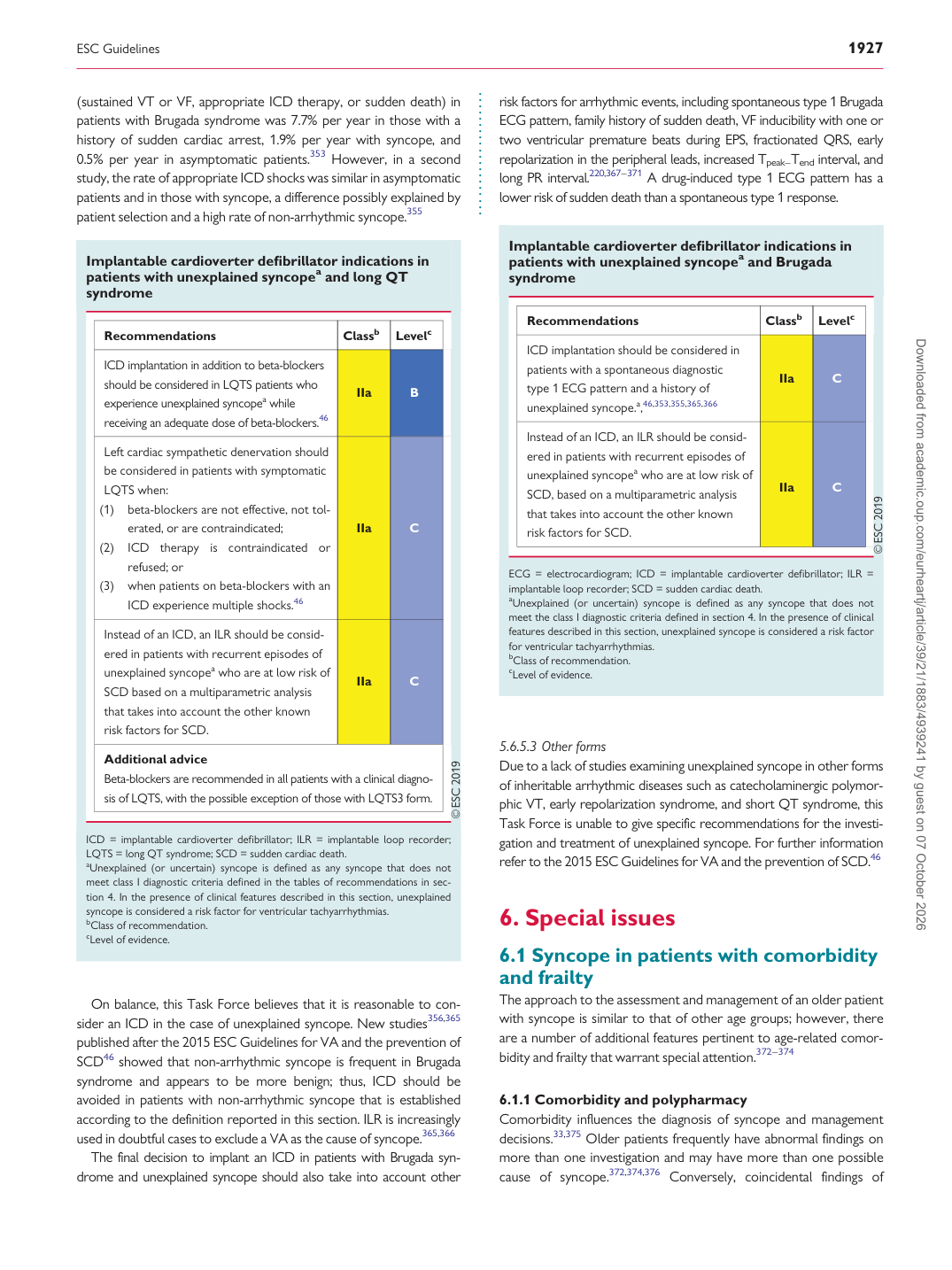
Implantable cardioverter defibrillator indications in patients with unexplained syncopea and long QT syndrome

Recommendations Classb Levelc

ICD implantation in addition to beta-blockers should be considered in LQTS patients who experience unexplained syncopea while receiving an adequate dose of beta-blockers.46 IIa B

Left cardiac sympathetic denervation should be considered in patients with symptomatic LQTS when: (1) beta-blockers are not effective, not tol-

erated, or are contraindicated; (2) ICD therapy is contraindicated or refused; or (3) when patients on beta-blockers with an

ICD experience multiple shocks.46 IIa C

Instead of an ICD, an ILR should be considered in patients with recurrent episodes of unexplained syncopea who are at low risk of SCD based on a multiparametric analysis that takes into account the other known risk factors for SCD. IIa C

Additional advice Beta-blockers are recommended in all patients with a clinical diagnosis of LQTS, with the possible exception of those with LQTS3 form.

ICD = implantable cardioverter defibrillator; ILR = implantable loop recorder; LQTS = long QT syndrome; SCD = sudden cardiac death. aUnexplained (or uncertain) syncope is defined as any syncope that does not meet class I diagnostic criteria defined in the tables of recommendations in section 4. In the presence of clinical features described in this section, unexplained syncope is considered a risk factor for ventricular tachyarrhythmias. bClass of recommendation. cLevel of evidence. Implantable cardioverter defibrillator indications in patients with unexplained syncopea and Brugada syndrome

Recommendations Classb Levelc

ICD implantation should be considered in patients with a spontaneous diagnostic type 1 ECG pattern and a history of unexplained syncope.a,46,353,355,365,366 IIa C

Instead of an ICD, an ILR should be considered in patients with recurrent episodes of unexplained syncopea who are at low risk of SCD, based on a multiparametric analysis that takes into account the other known risk factors for SCD. IIa C

ECG = electrocardiogram; ICD = implantable cardioverter defibrillator; ILR = implantable loop recorder; SCD = sudden cardiac death. aUnexplained (or uncertain) syncope is defined as any syncope that does not meet the class I diagnostic criteria defined in section 4. In the presence of clinical features described in this section, unexplained syncope is considered a risk factor for ventricular tachyarrhythmias. bClass of recommendation. cLevel of evidence. Downloaded from academic.oup.com/eurheartj/article/39/21/1883/4939241 by guest on 07 October 2026