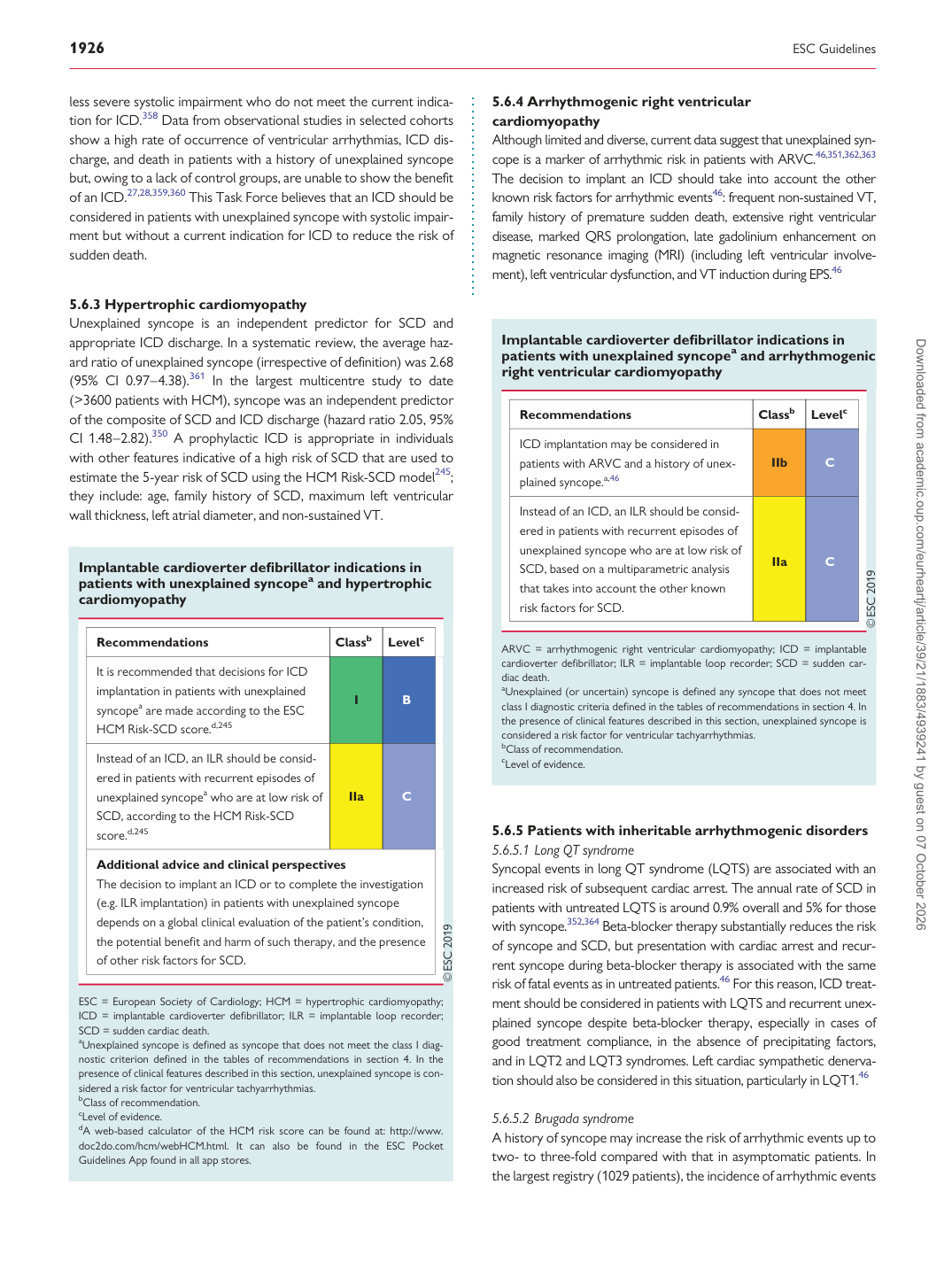
p.44 抽出テキスト
................................ less severe systolic impairment who do not meet the current indication for ICD.358 Data from observational studies in selected cohorts show a high rate of occurrence of ventricular arrhythmias, ICD discharge, and death in patients with a history of unexplained syncope but, owing to a lack of control groups, are unable to show the benefit of an ICD.27,28,359,360 This Task Force believes that an ICD should be considered in patients with unexplained syncope with systolic impairment but without a current indication for ICD to reduce the risk of sudden death. 5.6.3 Hypertrophic cardiomyopathy Unexplained syncope is an independent predictor for SCD and appropriate ICD discharge. In a systematic review, the average hazard ratio of unexplained syncope (irrespective of definition) was 2.68 (95% CI 0.97–4.38).361 In the largest multicentre study to date (>3600 patients with HCM), syncope was an independent predictor of the composite of SCD and ICD discharge (hazard ratio 2.05, 95% CI 1.48–2.82).350 A prophylactic ICD is appropriate in individuals with other features indicative of a high risk of SCD that are used to estimate the 5-year risk of SCD using the HCM Risk-SCD model245; they include: age, family history of SCD, maximum left ventricular wall thickness, left atrial diameter, and non-sustained VT. 5.6.4 Arrhythmogenic right ventricular cardiomyopathy Although limited and diverse, current data suggest that unexplained syncope is a marker of arrhythmic risk in patients with ARVC.46,351,362,363

The decision to implant an ICD should take into account the other known risk factors for arrhythmic events46: frequent non-sustained VT, family history of premature sudden death, extensive right ventricular disease, marked QRS prolongation, late gadolinium enhancement on magnetic resonance imaging (MRI) (including left ventricular involvement), left ventricular dysfunction, and VT induction during EPS.46

5.6.5 Patients with inheritable arrhythmogenic disorders 5.6.5.1 Long QT syndrome Syncopal events in long QT syndrome (LQTS) are associated with an increased risk of subsequent cardiac arrest. The annual rate of SCD in patients with untreated LQTS is around 0.9% overall and 5% for those with syncope.352,364 Beta-blocker therapy substantially reduces the risk of syncope and SCD, but presentation with cardiac arrest and recurrent syncope during beta-blocker therapy is associated with the same risk of fatal events as in untreated patients.46 For this reason, ICD treatment should be considered in patients with LQTS and recurrent unexplained syncope despite beta-blocker therapy, especially in cases of good treatment compliance, in the absence of precipitating factors, and in LQT2 and LQT3 syndromes. Left cardiac sympathetic denervation should also be considered in this situation, particularly in LQT1.46

5.6.5.2 Brugada syndrome A history of syncope may increase the risk of arrhythmic events up to two- to three-fold compared with that in asymptomatic patients. In the largest registry (1029 patients), the incidence of arrhythmic events

Implantable cardioverter defibrillator indications in patients with unexplained syncopea and hypertrophic cardiomyopathy

Recommendations Classb Levelc

It is recommended that decisions for ICD implantation in patients with unexplained syncopea are made according to the ESC HCM Risk-SCD score.d,245 I B

Instead of an ICD, an ILR should be considered in patients with recurrent episodes of unexplained syncopea who are at low risk of SCD, according to the HCM Risk-SCD score.d,245 IIa C

Additional advice and clinical perspectives The decision to implant an ICD or to complete the investigation (e.g. ILR implantation) in patients with unexplained syncope depends on a global clinical evaluation of the patient’s condition, the potential benefit and harm of such therapy, and the presence of other risk factors for SCD.

ESC = European Society of Cardiology; HCM = hypertrophic cardiomyopathy; ICD = implantable cardioverter defibrillator; ILR = implantable loop recorder; SCD = sudden cardiac death. aUnexplained syncope is defined as syncope that does not meet the class I diagnostic criterion defined in the tables of recommendations in section 4. In the presence of clinical features described in this section, unexplained syncope is considered a risk factor for ventricular tachyarrhythmias. bClass of recommendation. cLevel of evidence. dA web-based calculator of the HCM risk score can be found at: http://www. doc2do.com/hcm/webHCM.html. It can also be found in the ESC Pocket Guidelines App found in all app stores. Implantable cardioverter defibrillator indications in patients with unexplained syncopea and arrhythmogenic right ventricular cardiomyopathy

Recommendations Classb Levelc

ICD implantation may be considered in patients with ARVC and a history of unexplained syncope.a,46 IIb C

Instead of an ICD, an ILR should be considered in patients with recurrent episodes of unexplained syncope who are at low risk of SCD, based on a multiparametric analysis that takes into account the other known risk factors for SCD. IIa C

ARVC = arrhythmogenic right ventricular cardiomyopathy; ICD = implantable cardioverter defibrillator; ILR = implantable loop recorder; SCD = sudden cardiac death. aUnexplained (or uncertain) syncope is defined any syncope that does not meet class I diagnostic criteria defined in the tables of recommendations in section 4. In the presence of clinical features described in this section, unexplained syncope is considered a risk factor for ventricular tachyarrhythmias. bClass of recommendation. cLevel of evidence. Downloaded from academic.oup.com/eurheartj/article/39/21/1883/4939241 by guest on 07 October 2026