p.43 抽出テキスト
......................................... 5.5 Treatment of syncope secondary to structural cardiac, cardiopulmonary, and great vessel disease Cardiac syncope is diagnosed when syncope presents in patients with severe aortic stenosis, acute myocardial infarction/ischaemia, HCM, cardiac masses (atrial myxoma, ball thrombus, etc.), pericardial disease/tamponade, congenital anomalies of the coronary arteries, prosthetic valve dysfunction, pulmonary embolus, acute aortic dissection, and pulmonary hypertension (see section 4.1.1). Structural cardiac or cardiopulmonary disease can be present in some patients with syncope, and its incidence increases in older patients. The mere presence of heart disease does not imply that syncope is related to the underlying cardiac disorder. Some of these patients have typical reflex syncope; in others, such as those with inferior myocardial infarction or aortic stenosis, the underlying cardiac disease may play a role in triggering or potentiating a reflex mechanism, and—finally—the underlying cardiac disease may be the substrate for conduction disturbances, supraventricular arrhythmia, or VA that causes syncope.

Even in the absence of specific trials, there is strong consensus that with syncope secondary to structural cardiac disease, the goal of treatment is not only to prevent syncopal recurrence, but to treat the underlying disease and decrease the risk of death.

5.6 Treatment of unexplained syncope in

patients at high risk of sudden cardiac death The underlying clinical situation is that of a patient being evaluated for ICD implantation because they are affected by syncope(s) supposedly due to transient self-terminating ventricular tachyarrhythmias (fast VT or VF), which have not yet been documented because of their short duration.349 Syncope due to documented VT/VF is outside the scope of this section; please refer to section 5.4.2. General guidance may be sought in the 2015 ESC Guidelines for VA and the prevention of SCD.46

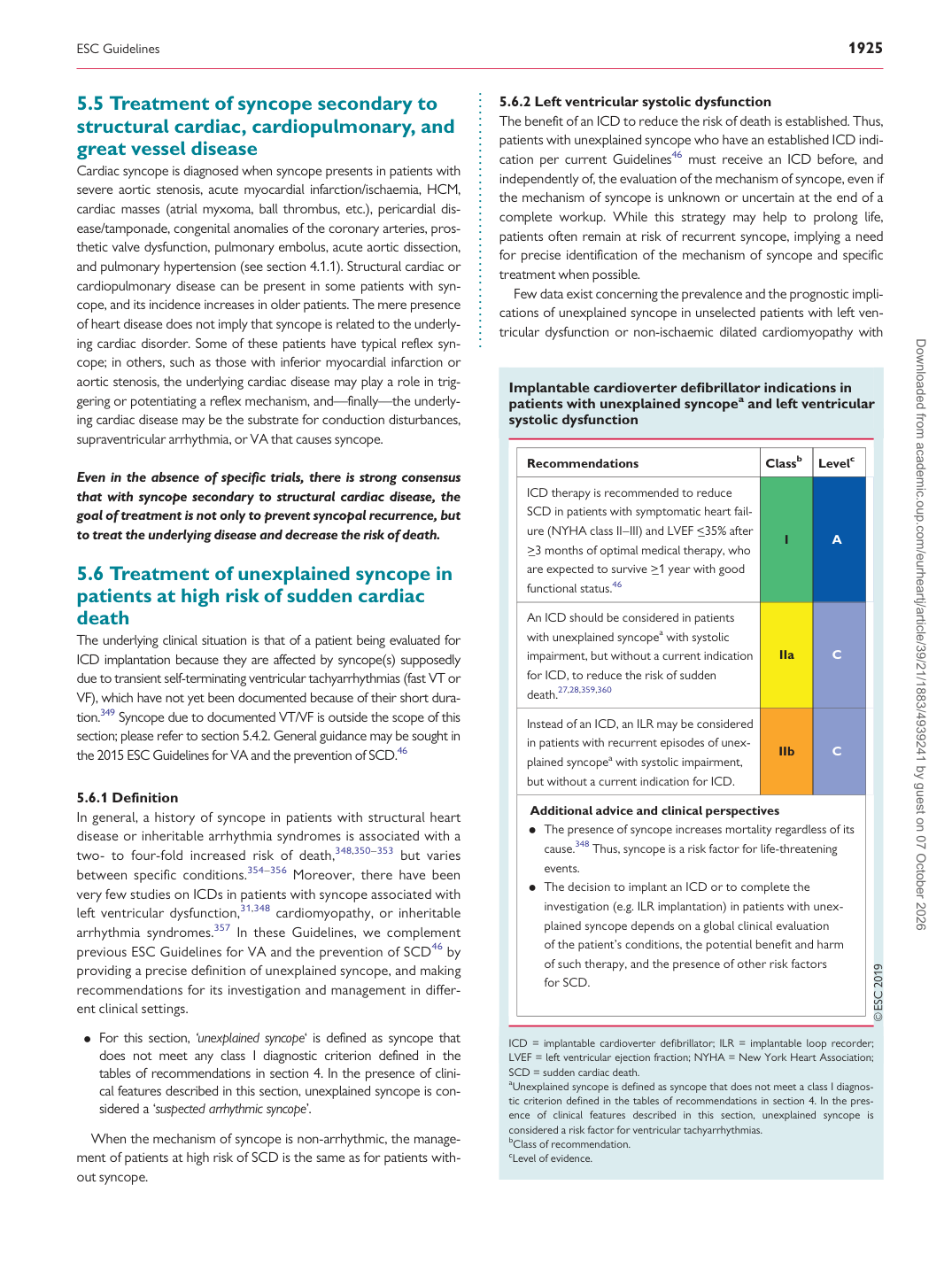
5.6.1 Definition In general, a history of syncope in patients with structural heart disease or inheritable arrhythmia syndromes is associated with a two- to four-fold increased risk of death,348,350–353 but varies between specific conditions.354–356 Moreover, there have been very few studies on ICDs in patients with syncope associated with left ventricular dysfunction,31,348 cardiomyopathy, or inheritable arrhythmia syndromes.357 In these Guidelines, we complement previous ESC Guidelines for VA and the prevention of SCD46 by providing a precise definition of unexplained syncope, and making recommendations for its investigation and management in different clinical settings. • For this section, ‘unexplained syncope‘ is defined as syncope that does not meet any class I diagnostic criterion defined in the tables of recommendations in section 4. In the presence of clinical features described in this section, unexplained syncope is considered a ‘suspected arrhythmic syncope’. When the mechanism of syncope is non-arrhythmic, the management of patients at high risk of SCD is the same as for patients without syncope. 5.6.2 Left ventricular systolic dysfunction The benefit of an ICD to reduce the risk of death is established. Thus, patients with unexplained syncope who have an established ICD indication per current Guidelines46 must receive an ICD before, and independently of, the evaluation of the mechanism of syncope, even if the mechanism of syncope is unknown or uncertain at the end of a complete workup. While this strategy may help to prolong life, patients often remain at risk of recurrent syncope, implying a need for precise identification of the mechanism of syncope and specific treatment when possible.

Few data exist concerning the prevalence and the prognostic implications of unexplained syncope in unselected patients with left ventricular dysfunction or non-ischaemic dilated cardiomyopathy with

Implantable cardioverter defibrillator indications in patients with unexplained syncopea and left ventricular systolic dysfunction

Recommendations Classb Levelc

ICD therapy is recommended to reduce SCD in patients with symptomatic heart failure (NYHA class II–III) and LVEF <_35% after >_3 months of optimal medical therapy, who are expected to survive >_1 year with good functional status.46 I A

An ICD should be considered in patients with unexplained syncopea with systolic impairment, but without a current indication for ICD, to reduce the risk of sudden death.27,28,359,360 IIa C

Instead of an ICD, an ILR may be considered in patients with recurrent episodes of unexplained syncopea with systolic impairment, but without a current indication for ICD. IIb C Additional advice and clinical perspectives • The presence of syncope increases mortality regardless of its cause.348 Thus, syncope is a risk factor for life-threatening

events. • The decision to implant an ICD or to complete the investigation (e.g. ILR implantation) in patients with unex-

plained syncope depends on a global clinical evaluation of the patient’s conditions, the potential benefit and harm of such therapy, and the presence of other risk factors for SCD.

ICD = implantable cardioverter defibrillator; ILR = implantable loop recorder; LVEF = left ventricular ejection fraction; NYHA = New York Heart Association; SCD = sudden cardiac death. aUnexplained syncope is defined as syncope that does not meet a class I diagnostic criterion defined in the tables of recommendations in section 4. In the presence of clinical features described in this section, unexplained syncope is considered a risk factor for ventricular tachyarrhythmias. bClass of recommendation. cLevel of evidence. Downloaded from academic.oup.com/eurheartj/article/39/21/1883/4939241 by guest on 07 October 2026