p.42 抽出テキスト
..................... with VT can be found in the 2015 ESC Guidelines for VA and the prevention of SCD.46

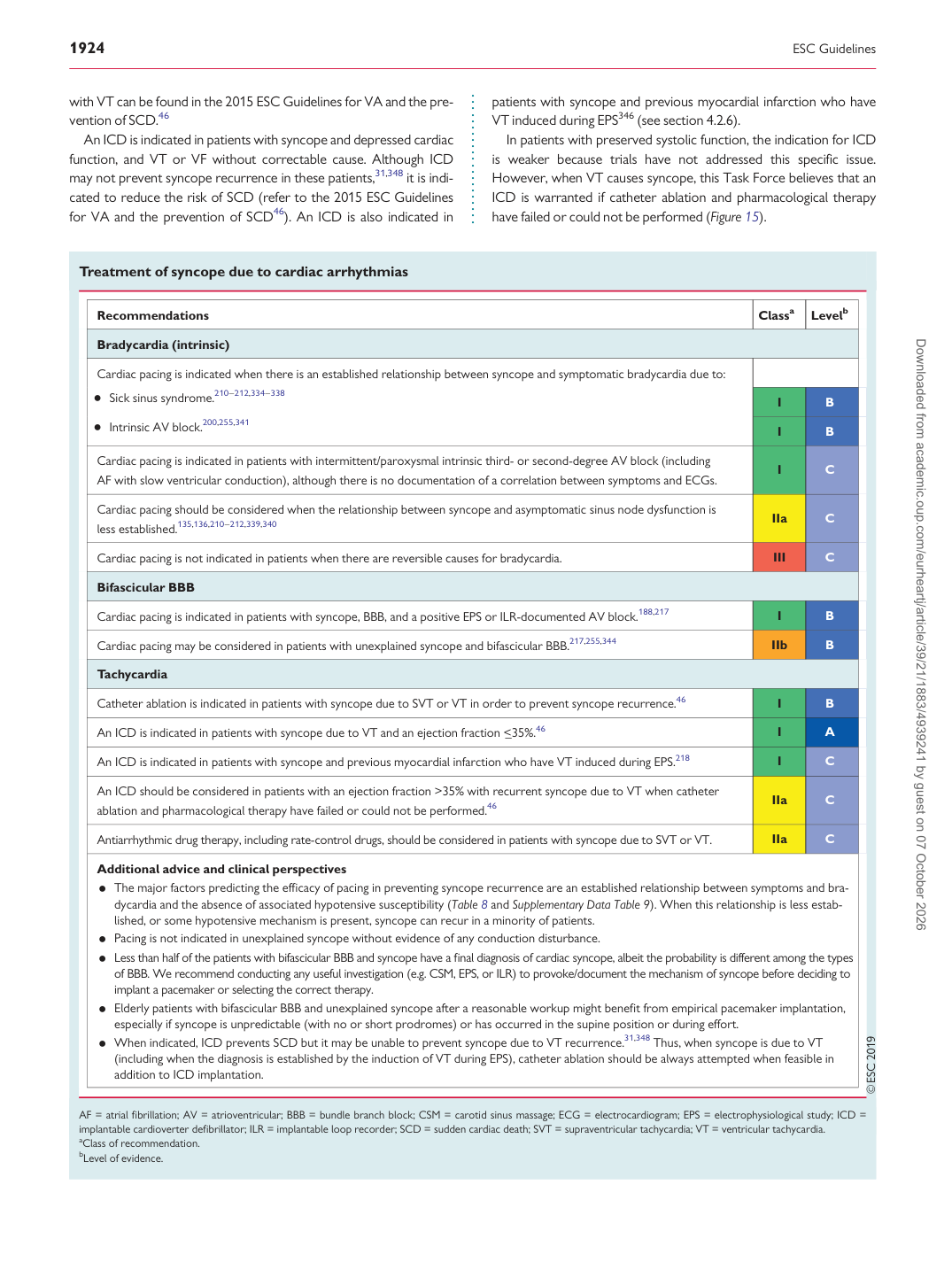
An ICD is indicated in patients with syncope and depressed cardiac function, and VT or VF without correctable cause. Although ICD may not prevent syncope recurrence in these patients,31,348 it is indicated to reduce the risk of SCD (refer to the 2015 ESC Guidelines for VA and the prevention of SCD46). An ICD is also indicated in patients with syncope and previous myocardial infarction who have VT induced during EPS346 (see section 4.2.6).

In patients with preserved systolic function, the indication for ICD is weaker because trials have not addressed this specific issue. However, when VT causes syncope, this Task Force believes that an ICD is warranted if catheter ablation and pharmacological therapy have failed or could not be performed (Figure 15).

Treatment of syncope due to cardiac arrhythmias

Recommendations Classa Levelb

Bradycardia (intrinsic)

Cardiac pacing is indicated when there is an established relationship between syncope and symptomatic bradycardia due to:

• Sick sinus syndrome.210–212,334–338 I B

• Intrinsic AV block.200,255,341 I B

Cardiac pacing is indicated in patients with intermittent/paroxysmal intrinsic third- or second-degree AV block (including AF with slow ventricular conduction), although there is no documentation of a correlation between symptoms and ECGs. I C

Cardiac pacing should be considered when the relationship between syncope and asymptomatic sinus node dysfunction is less established.135,136,210–212,339,340 IIa C

Cardiac pacing is not indicated in patients when there are reversible causes for bradycardia. III C

Bifascicular BBB Cardiac pacing is indicated in patients with syncope, BBB, and a positive EPS or ILR-documented AV block.188,217 I B Cardiac pacing may be considered in patients with unexplained syncope and bifascicular BBB.217,255,344 IIb B

Tachycardia Catheter ablation is indicated in patients with syncope due to SVT or VT in order to prevent syncope recurrence.46 I B An ICD is indicated in patients with syncope due to VT and an ejection fraction <_35%.46 I A An ICD is indicated in patients with syncope and previous myocardial infarction who have VT induced during EPS.218 I C

An ICD should be considered in patients with an ejection fraction >35% with recurrent syncope due to VT when catheter ablation and pharmacological therapy have failed or could not be performed.46 IIa C

Antiarrhythmic drug therapy, including rate-control drugs, should be considered in patients with syncope due to SVT or VT. IIa C

Additional advice and clinical perspectives • The major factors predicting the efficacy of pacing in preventing syncope recurrence are an established relationship between symptoms and bradycardia and the absence of associated hypotensive susceptibility (Table 8 and Supplementary Data Table 9). When this relationship is less established, or some hypotensive mechanism is present, syncope can recur in a minority of patients. • Pacing is not indicated in unexplained syncope without evidence of any conduction disturbance. • Less than half of the patients with bifascicular BBB and syncope have a final diagnosis of cardiac syncope, albeit the probability is different among the types of BBB. We recommend conducting any useful investigation (e.g. CSM, EPS, or ILR) to provoke/document the mechanism of syncope before deciding to implant a pacemaker or selecting the correct therapy. • Elderly patients with bifascicular BBB and unexplained syncope after a reasonable workup might benefit from empirical pacemaker implantation, especially if syncope is unpredictable (with no or short prodromes) or has occurred in the supine position or during effort. • When indicated, ICD prevents SCD but it may be unable to prevent syncope due to VT recurrence.31,348 Thus, when syncope is due to VT (including when the diagnosis is established by the induction of VT during EPS), catheter ablation should be always attempted when feasible in addition to ICD implantation.

AF = atrial fibrillation; AV = atrioventricular; BBB = bundle branch block; CSM = carotid sinus massage; ECG = electrocardiogram; EPS = electrophysiological study; ICD = implantable cardioverter defibrillator; ILR = implantable loop recorder; SCD = sudden cardiac death; SVT = supraventricular tachycardia; VT = ventricular tachycardia. aClass of recommendation. bLevel of evidence. Downloaded from academic.oup.com/eurheartj/article/39/21/1883/4939241 by guest on 07 October 2026