p.40 抽出テキスト
........................................................................................ persistent or intermittent documented AV block (see Supplementary Data Table 9).

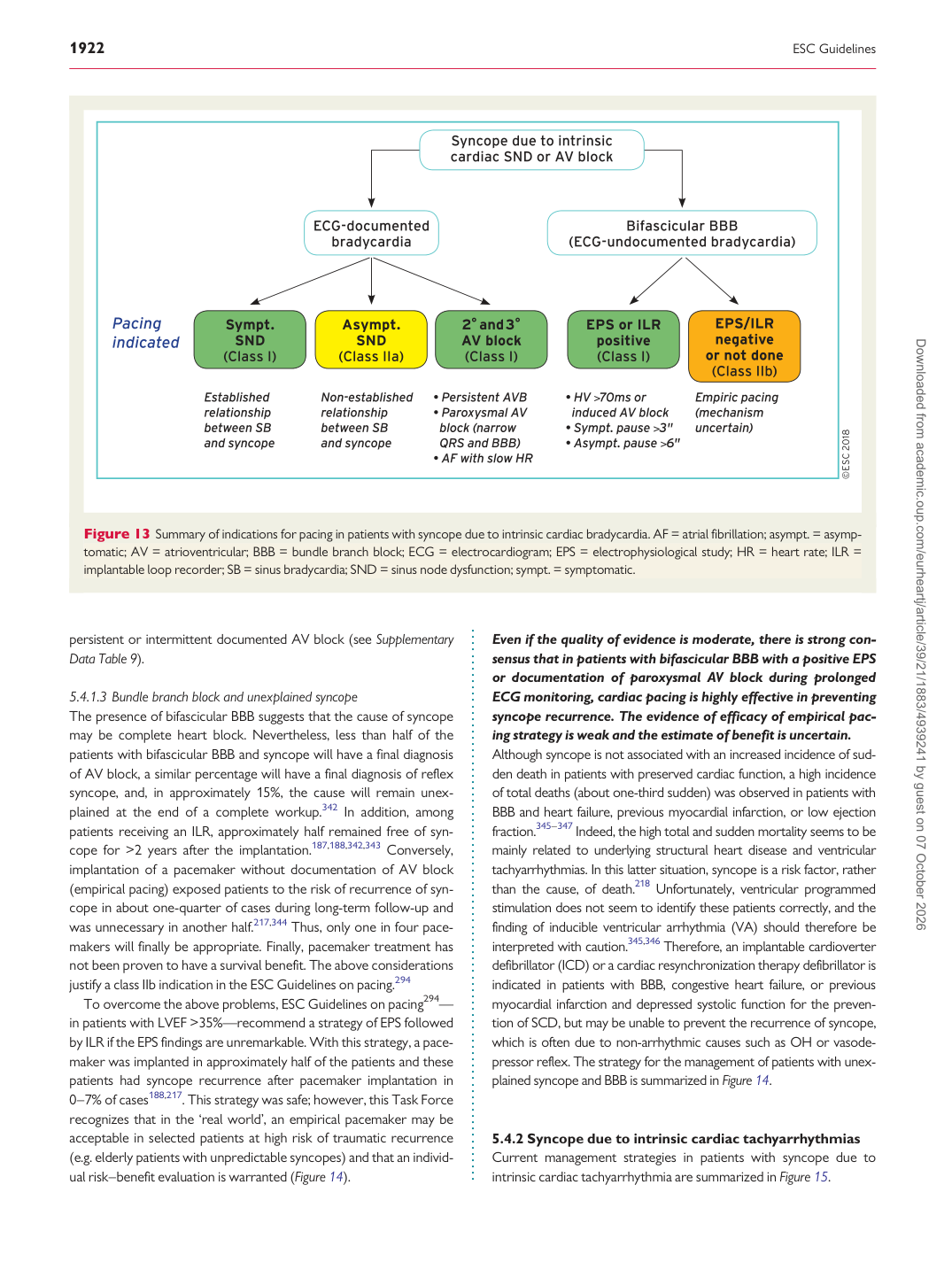
5.4.1.3 Bundle branch block and unexplained syncope The presence of bifascicular BBB suggests that the cause of syncope may be complete heart block. Nevertheless, less than half of the patients with bifascicular BBB and syncope will have a final diagnosis of AV block, a similar percentage will have a final diagnosis of reflex syncope, and, in approximately 15%, the cause will remain unexplained at the end of a complete workup.342 In addition, among patients receiving an ILR, approximately half remained free of syncope for >2 years after the implantation.187,188,342,343 Conversely, implantation of a pacemaker without documentation of AV block (empirical pacing) exposed patients to the risk of recurrence of syncope in about one-quarter of cases during long-term follow-up and was unnecessary in another half.217,344 Thus, only one in four pacemakers will finally be appropriate. Finally, pacemaker treatment has not been proven to have a survival benefit. The above considerations justify a class IIb indication in the ESC Guidelines on pacing.294 To overcome the above problems, ESC Guidelines on pacing294— in patients with LVEF >35%—recommend a strategy of EPS followed by ILR if the EPS findings are unremarkable. With this strategy, a pacemaker was implanted in approximately half of the patients and these patients had syncope recurrence after pacemaker implantation in 0–7% of cases188,217. This strategy was safe; however, this Task Force recognizes that in the ‘real world’, an empirical pacemaker may be acceptable in selected patients at high risk of traumatic recurrence (e.g. elderly patients with unpredictable syncopes) and that an individual risk–benefit evaluation is warranted (Figure 14). Even if the quality of evidence is moderate, there is strong consensus that in patients with bifascicular BBB with a positive EPS or documentation of paroxysmal AV block during prolonged ECG monitoring, cardiac pacing is highly effective in preventing syncope recurrence. The evidence of efficacy of empirical pacing strategy is weak and the estimate of benefit is uncertain. Although syncope is not associated with an increased incidence of sudden death in patients with preserved cardiac function, a high incidence of total deaths (about one-third sudden) was observed in patients with BBB and heart failure, previous myocardial infarction, or low ejection fraction.345–347 Indeed, the high total and sudden mortality seems to be mainly related to underlying structural heart disease and ventricular tachyarrhythmias. In this latter situation, syncope is a risk factor, rather than the cause, of death.218 Unfortunately, ventricular programmed stimulation does not seem to identify these patients correctly, and the finding of inducible ventricular arrhythmia (VA) should therefore be interpreted with caution.345,346 Therefore, an implantable cardioverter defibrillator (ICD) or a cardiac resynchronization therapy defibrillator is indicated in patients with BBB, congestive heart failure, or previous myocardial infarction and depressed systolic function for the prevention of SCD, but may be unable to prevent the recurrence of syncope, which is often due to non-arrhythmic causes such as OH or vasodepressor reflex. The strategy for the management of patients with unexplained syncope and BBB is summarized in Figure 14.

5.4.2 Syncope due to intrinsic cardiac tachyarrhythmias Current management strategies in patients with syncope due to intrinsic cardiac tachyarrhythmia are summarized in Figure 15.

° °

Figure 13 Summary of indications for pacing in patients with syncope due to intrinsic cardiac bradycardia. AF = atrial fibrillation; asympt. = asymptomatic; AV = atrioventricular; BBB = bundle branch block; ECG = electrocardiogram; EPS = electrophysiological study; HR = heart rate; ILR = implantable loop recorder; SB = sinus bradycardia; SND = sinus node dysfunction; sympt. = symptomatic. Downloaded from academic.oup.com/eurheartj/article/39/21/1883/4939241 by guest on 07 October 2026